
Vandaag of morgen in huis

Kwaliteit gegarandeerd

Welkomstaanbiedingen ontgrendelen: GRATIS bezorging | Tot 80% korting | Gratis 30 dagen JoyPlus-proefperiode
Download de app
A wooden coffee table does more than set the tone for your living room. It also needs to suit the available walking space, your sofa and the way you use the room. A table may look spacious in a photo, but in your home it could turn out to be too low, wobbly or difficult to keep clean.
Watch out for these three common pitfalls:
Focusing only on appearance
A rustic or industrial finish tells you little about how stable a table is. Check the base, the thickness of the top and whether it has adjustable feet.
Mistaking storage space for usable storage
An extra shelf is handy, but only if you can reach it easily and there’s enough space between the tiers for books, remote controls or baskets.
Underestimating the dimensions
An 80 cm-wide round coffee table takes up more space than you might expect from a product photo. Measure the space between your sofa, armchair and TV stand before you order.
Start by measuring the space available. Leave enough room around the table to walk comfortably past the sofa. A low table usually works well in front of a sofa, while a narrow model can also work as a side table next to the sofa.
Check these measurements:
A round shape has no sharp corners and creates a different visual effect from a rectangular table. This makes a round coffee table a good choice for a seating area with several walkways.
Not every wooden table is made from solid wood. Many models combine a wooden surface, veneer or engineered wood with a metal frame. That’s not necessarily a problem, but the materials have different properties.
With a mango wood coffee table or acacia wood table, you can expect variations in colour and grain. Check the care instructions too. A damp cloth is generally a better choice than harsh cleaning products, especially for untreated or varnished wood.
A table with a heavy top isn’t automatically stable. Check the width of the base, the number of support points and whether you can adjust the feet to compensate for uneven floors.
Before buying, check:
For a table with a metal base, it’s worth checking how the frame is attached to the top. If you’ll be using the table every day, a sturdy connection and a clearly stated weight capacity matter more than an industrial look alone.
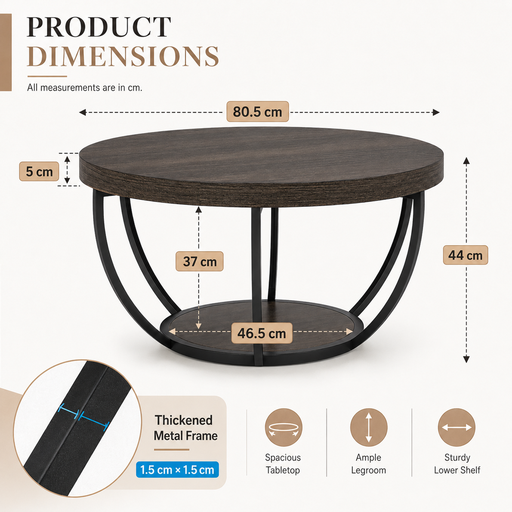
Why it suits this profile: The round shape and two tiers offer a practical layout for a living room where you’re looking for an affordable table with extra storage. The tabletop measures 80 × 80 cm.
The product description specifies a 5 cm-thick tabletop, a metal base and included assembly materials. This gives you more information to assess stability and assembly before buying than you’d get with a model that leaves out these details.
Round tabletop, two storage tiers, a 46 × 46 cm lower shelf and a metal frame with six curved supports.
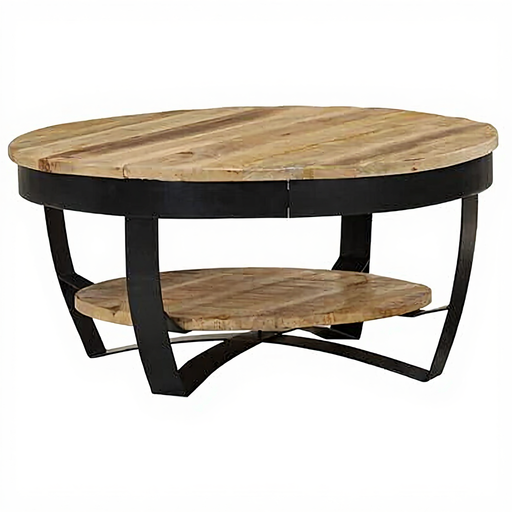
Why it suits this profile: This model is a good fit if you’re looking for solid wood, a low rectangular design and an industrial look. The table measures 65 × 65 × 32 cm and has a shelf for extra storage.
The description gives details of the material, dimensions, shelf and powder-coated steel base. It also notes that the grain and colour may vary from one piece to another.
Solid, raw mango wood according to the product description, a storage shelf and a powder-coated steel frame.
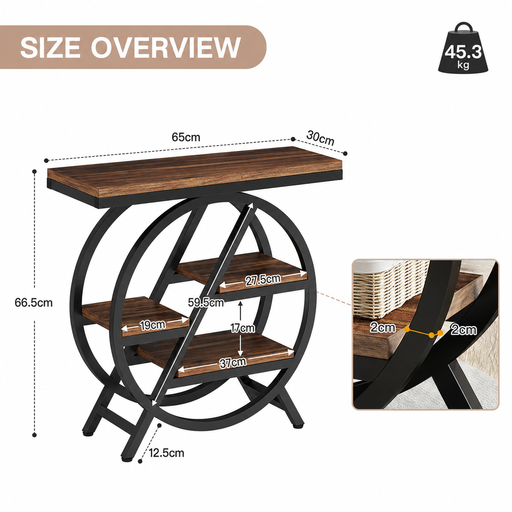
Why it suits this profile: This model is designed for flexible use as a wooden side table, bedside table or table next to the sofa. Three shelves make it ideal for keeping essentials close at hand.
The product description specifies a weight capacity of up to 13.6 kg, shelves that are 1.5 cm thick and four adjustable feet. This gives you clear information about how to use the table and how stable it is.
Three storage tiers, a geometric metal frame, adjustable feet and a water- and scratch-resistant veneer finish according to the product description.
We’ve put together a complete, up-to-date selection of products that meet these strict criteria and comply with current European safety regulations.
A coffee table doesn’t have to sit in front of the sofa. A narrow model can work as a living room console table, for example behind the sofa or against a long wall. A console table with several tiers can also be used in a hallway for keys, baskets and decorative items.
In a bedroom, a small wooden side table can double as a bedside table. In a home office, a compact model is handy for a lamp, documents or accessories. Whichever way you use it, check the height, weight capacity and available floor space.
Compare its height with the seat of your sofa. A table that’s roughly level with the seat is practical for drinks and small items. A lower model can make the room feel more spacious, but may be less comfortable if you often reach for things from the sofa.
Use a soft, slightly damp cloth, then dry the surface. Avoid harsh cleaning products unless the manufacturer’s care instructions say they’re suitable. The colour and grain of solid wood can vary, so it’s best to use coasters for hot cups and damp items.
That depends on the construction, the number of support points and the floor. Check the stated weight capacity, how the frame is attached and whether the table has adjustable feet. An industrial-style coffee table with a metal base can be sturdy, but always check the product specifications rather than relying on looks alone.
