
Vandaag of morgen in huis

Kwaliteit gegarandeerd

Welkomstaanbiedingen ontgrendelen: GRATIS bezorging | Tot 80% korting | Gratis 30 dagen JoyPlus-proefperiode
Download de app
A women's outdoor jacket needs to cope with more than a short shower in the Netherlands. The weather can change quickly during a walk, while cycling or camping calls for reliable protection from wind and moisture. The right jacket therefore depends on your activity, layering system and fit.
Pay particular attention to these three common buying pitfalls:
Waterproofing is often expressed as a hydrostatic head, for example in millimetres H₂O. This is a laboratory measurement of the pressure a material can withstand before water passes through it. A higher figure may indicate greater resistance to rain, but the jacket's construction remains important too.
So check whether the product information mentions:
According to the product description, The North Face Quest jacket comes with fully sealed seams and DryVent fabric. The manufacturer describes this layer as waterproof, windproof and breathable. This is a brand claim; you should also assess whether the details suit the way you intend to use it.
A women's breathable jacket is particularly useful when you are active. When walking, cycling or heading into the hills, your body produces heat and moisture. A jacket that keeps rain out but allows little water vapour to escape can feel clammy inside.
Some product descriptions use an MVTR value, meaning the amount of water vapour that can pass through one square metre of fabric in 24 hours. According to the product information, the PELLIOT fleece-lined jacket has an MVTR value of 16.000 g/m²/24 hours, measured according to JIS. Treat this as a technical indication, not a guarantee of the same comfort in every situation. Your pace, humidity, clothing underneath and ventilation options also make a difference.
A jacket for walking or camping does not always need to be one thick layer. With three layers, you can adapt more effectively to the weather:
A women's 3-in-1 jacket usually combines an outer jacket with a removable inner jacket. According to the product description, the PELLIOT models can be worn separately or together. However, check that there is enough room in the shoulders and chest when wearing both layers.
A good women's walking jacket should allow plenty of movement without feeling unnecessarily loose. Look out for these points:
For everyday commuting, a longer cut can be comfortable. For a women's camping jacket, an adjustable hood, sturdy zips and a hard-wearing outer fabric are often more important than a fashionable fit alone.

Why it suits this profile: The combination of an outer layer and fleece lining offers a practical starting point for walking, travelling and everyday cycling. Wearing the layers separately makes the jacket flexible in changing temperatures.
The product information states a hydrostatic head of 35.900 mm H₂O, an MVTR of 16.000 g/m²/24 hours and more than 40.000 abrasion cycles. Even so, check the seams, zips and fit when the jacket arrives.
3-in-1 wearing options, adjustable hood, hem and cuffs; available in purple and several sizes.

Why it suits this profile: This shell is designed for walking and changeable weather. It works as an outer layer over a fleece or lightweight insulation layer, without being a heavy winter coat itself.
According to the product description, the seams are sealed and the jacket features DryVent fabric, a mesh lining and a DWR finish. The water-repellent treatment may require care or reproofing after use.
Adjustable hood, cuffs and hem; two zipped pockets; 100% polyester outer layer with mesh lining.
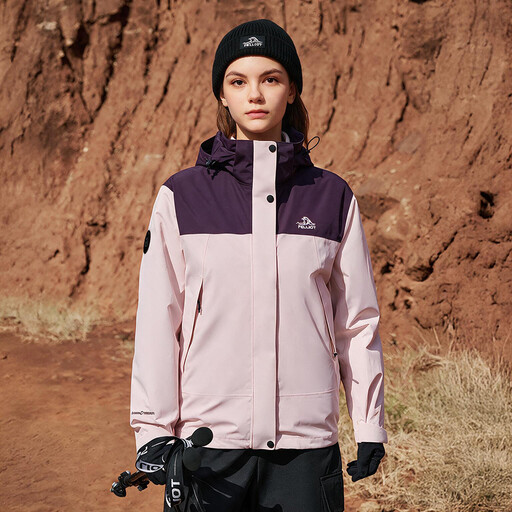
Why it suits this profile: For camping, mountain trips and more intensive use, a hard-wearing shell with a separate thermal inner layer is practical. According to the product description, the jacket can be worn as a shell, liner or combination.
The manufacturer states that it features a microporous STORMS BREATH membrane, taped seams and a scratch-resistant outer layer. These are product specifications; check that the size you choose leaves room for layers and rucksack straps.
3-in-1 system, windproof construction, thermal lining with anti-static treatment and a pink colour option.
We have put together a complete, up-to-date list of products that fully meet these strict selection criteria and the applicable European safety regulations.
The lifespan of an outdoor jacket depends largely on how it is used and cared for. Close the zips before washing and always follow the care label. Do not use bleach. Some waterproof jackets should not be tumble-dried, while insulated jackets need to be dried at a low temperature. Do not automatically use fabric softener on a shell: it can affect the performance of certain technical fabrics.
Store the jacket somewhere dry and clean. Let mud dry first, then brush it off gently. At the end of the walking season, check the seams, cuffs, zips and water-repellent outer layer.
No. A women's fleece jacket is primarily intended as a warm mid-layer. Fleece generally does not keep out prolonged rain. Pair it with a waterproof shell when you are active outdoors in wet weather.
That depends on your activity and the temperature. For quiet everyday use, a women's winter coat may provide sufficient insulation. For walking or camping, a 3-in-1 women's jacket is more practical if you want to regulate warmth and protection from wind and rain separately.
Use the size chart for the specific model and measure your chest, waist and hips. Allow for the clothing you will wear underneath. With a women's walking jacket, a little extra room is often more functional than a very close-fitting model, provided the hood and cuffs fit securely.
