
Vandaag of morgen in huis

Kwaliteit gegarandeerd

Welkomstaanbiedingen ontgrendelen: GRATIS bezorging | Tot 80% korting | Gratis 30 dagen JoyPlus-proefperiode
Download de app
At first glance, a wok seems simple: a round pan, high sides and a long handle. Yet woks vary considerably in terms of materials, base, care requirements and heat distribution. You often only notice you have chosen the wrong one while cooking: the pan wobbles on an induction hob, vegetables turn soft instead of staying crisp, or the non-stick coating becomes damaged quickly.
As a Joybuy Product Recommendation Officer, I therefore focus mainly on verifiable features. Not big marketing promises, but size, material, hob compatibility and the level of maintenance you are genuinely prepared to carry out.
A traditional round Chinese wok with a curved base works well on a conventional gas burner with a wok ring. On a flat induction hob, however, such a base makes very little contact with the cooking zone. As a result, the pan may sit unstably or heat unevenly.
So check whether the product description explicitly mentions induction. Also look at the base diameter. A 30 cm wok does not always have a 30 cm magnetic base.
A non-stick wok is practical for beginners and dishes that require little oil. Its lifespan depends on the type of coating, the utensils you use and how you clean it. Sharp metal objects, overheating and abrasive scourers can damage the inner coating.
A wok without a synthetic coating, such as a carbon-steel wok, requires a different approach. You need to season the pan or maintain its existing seasoning, but the surface can develop a natural patina through use. This is not a maintenance-free option.
A 30 cm wok is a good fit for everyday portions in many households. For two to three people, it is often easier to manage than a 35 or 36 cm wok. A larger wok provides more space for families, but it also becomes heavier when full and requires a larger cooking zone.
As well as the diameter, consider the weight, handles and available storage space. For example, a 30 cm cast-iron wok can be considerably heavier than an aluminium model with the same diameter.
In multi-layer models, such as tri-ply, the pan is made up of several layers of metal. According to the product descriptions from the relevant brands, an aluminium core is designed to distribute heat more evenly. Always check which layer is actually on the inside and whether a coating is present.
For an induction wok, the base must be magnetic and make sufficient flat contact with the hob. A model described as suitable for gas, induction, ceramic and electric hobs offers greater flexibility if you move home or change your hob.
A wok suitable for all hobs is not automatically oven- or dishwasher-safe. These features must be checked separately. Wooden or bamboo handles, for example, may have restrictions when used in the oven.
A wok with a lid is useful for stewing, simmering and steaming. A glass lid lets you see the cooking process without losing heat and moisture immediately. You will usually leave the lid off when stir-frying, as you want to toss the ingredients quickly and allow excess moisture to evaporate.
Also consider the handle. A second handle on the opposite side makes it easier to move a full wok. “Stay-cool handle” does not mean that the handle remains cool in all circumstances; if in doubt, use oven gloves and read the safety information.
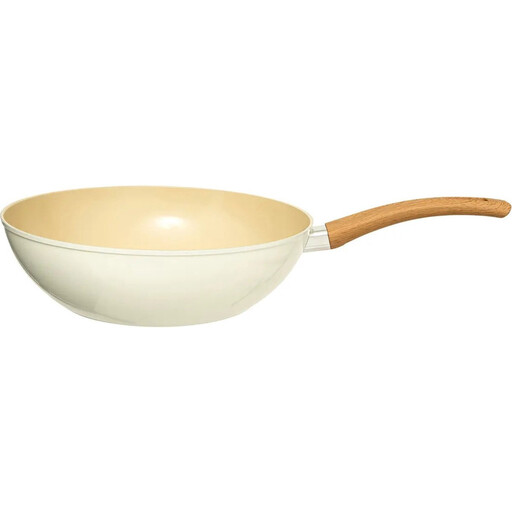
Why it suits this profile: The 29 cm diameter is practical for everyday meals, while the weight of 630 grams makes the wok easy to handle.
The product information states that it is suitable for gas, induction, ceramic and electric cooking. This means you do not have to guess from the shape whether the wok will work on your hob.
Made from recycled aluminium, with two non-stick layers and a soft-grip handle. Hand washing is recommended to preserve the coating.
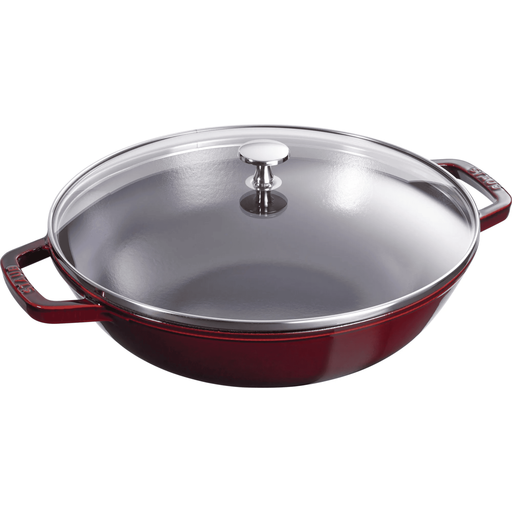
Why it suits this profile: If you are looking for a heavy pan for stir-frying, stewing, deep-frying and finishing dishes in the oven, this cast-iron wok comes with a lid and two side handles.
The product description states that it can be used on gas, induction, electric and ceramic hobs. The glass lid also means you do not need a second pan for stewing.
Cast iron retains heat for a long time, while the matt interior is enamelled. The diameter is 30 cm and, according to the product details, the capacity is 4.4 litres.
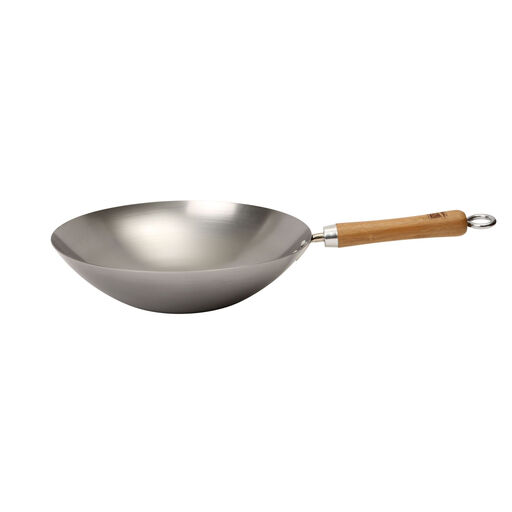
Why it suits this profile: This Chinese wok is designed for high-temperature cooking, stir-frying and dishes for approximately two to three people.
The model has no synthetic non-stick coating, but it does require seasoning and careful drying. This makes the maintenance requirements clear before you buy.
According to the product description, carbon steel heats up quickly. The flat base is suitable for all hobs, including induction; however, the bamboo handle must be kept out of the oven.
We have put together a complete, up-to-date list of products that fully meet these strict selection criteria and the applicable European safety regulations.
A 28 to 30 cm wok is usually practical for two people. For three to four people, 30 to 33 cm can provide more working space. Make sure the base fits your cooking zone.
Yes, but only if the product description states that it is compatible with induction and the base is magnetic and sufficiently flat. Without a suitable wok ring, a traditional round wok may be unstable on a flat induction hob.
That depends on the material and how well it is maintained. Carbon steel and cast iron can last a long time if you prevent rust, thermal shocks and incorrect cleaning. With a non-stick coating, the lifespan depends more heavily on temperature, utensils and cleaning method.
