
Vandaag of morgen in huis

Kwaliteit gegarandeerd

Welkomstaanbiedingen ontgrendelen: GRATIS bezorging | Tot 80% korting | Gratis 30 dagen JoyPlus-proefperiode
Download de app
A wok is ideal for stir-frying, braising, deep-frying and quickly searing ingredients. Yet in practice, a purchase can sometimes disappoint. For example, a pan may be advertised as “suitable for induction”, but a magnetic base that is too small can make heat distribution less efficient. A non-stick coating can also wear more quickly when used at high temperatures or with metal utensils.
So don’t focus solely on appearance or a low price. Pay particular attention to the material, base, diameter, coating and care instructions.
A 32 cm wok sounds spacious, but the flat base may be considerably smaller. This is important with an induction wok: the magnetic cooking zone needs to align well with the base. A wide pan can also become heavy once it is filled with vegetables, sauce and meat.
For a household of one to three people, a 28 cm wok is often practical. A 30 cm wok offers more space for a family. A 32 cm wok is better suited to larger portions, provided your hob and storage space can accommodate it.
A non-stick wok may have a PTFE coating, ceramic coating or another type of finish. So check the exact product specification. If it only says “non-stick”, it is not clear what type of coating has been used or what care it requires.
A PFAS-free wok or ceramic wok may appeal to anyone for whom this feature is important. However, always check that the PFAS-free claim appears directly in the product information. According to the product description, the Brabantia Onyx uses a PFAS-free ceramic double non-stick coating. This is a product specification, not a general guarantee of a longer lifespan.
A wok with a lid is useful for stewing, simmering and keeping dishes warm. For classic wok stir-frying, you will generally use an uncovered pan so that moisture can evaporate quickly. Also check whether the pan is dishwasher-safe. According to many product care recommendations, ceramic coatings remain usable for longer when washed by hand, even if the manufacturer permits dishwasher use.
Look for a clear statement that a pan is a wok suitable for all heat sources if you switch between gas, electric, ceramic and induction. For induction, also check the diameter of the flat base. A pan may technically be suitable for induction but heat less evenly when the base is much smaller than the cooking zone.
On a gas hob, a stable flat base is important. A traditional round-bottomed wok only works well with a suitable wok ring and is not practical on every hob. For most Dutch kitchens, a flat base is the simpler option.
For a coated wok, preferably use wooden, plastic or silicone spatulas. Avoid scouring pads and wire wool if the product information advises against them. Do not heat an empty non-stick pan at a high temperature for an extended period. The Cooker King Lingbai specifically states that you should add oil or ingredients before heating the pan.
An uncoated carbon steel wok requires a different routine: season it before first use, clean it by hand, dry it completely and lightly oil it before storing.
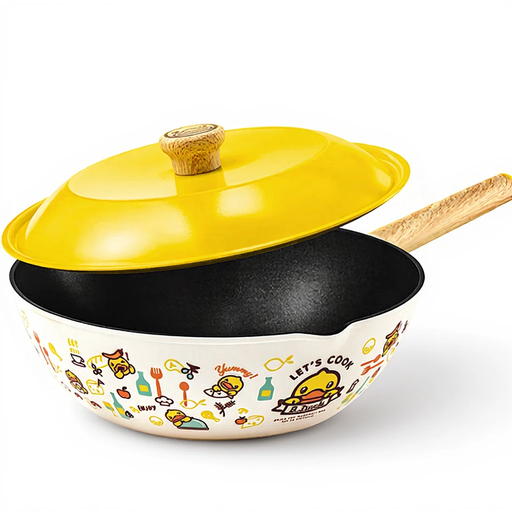
Why it suits this profile: According to the product information, the flat base is suitable for all hobs, including induction. The 30 cm diameter provides plenty of room for everyday meals, while the non-stick coating is designed to make releasing ingredients easier.
The product information explicitly mentions induction compatibility and a flat base. Hand washing is recommended to protect the surface.
30 cm, flat base, suitable for all hobs and suitable for frying, sautéing and simmering.
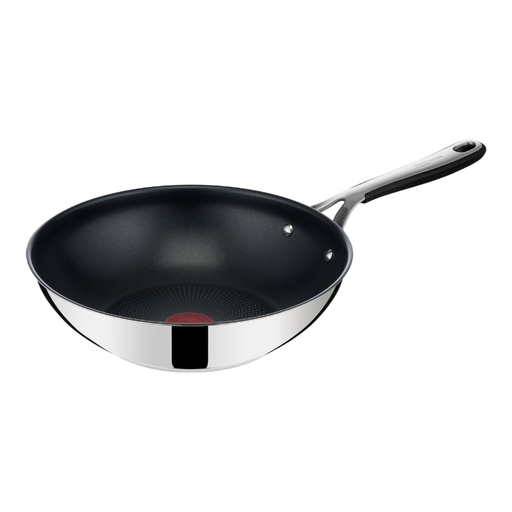
Why it suits this profile: This model combines stainless steel with a titanium-reinforced non-stick coating and, according to the description, is suitable for induction, gas, electric and ceramic hobs.
The compatible heat sources are clearly specified. According to the manufacturer, the Thermo-Signal indicator shows when the pan has reached the ideal starting temperature.
28 cm, suitable for several heat sources, dishwasher-safe according to the product information and fitted with a temperature indicator.
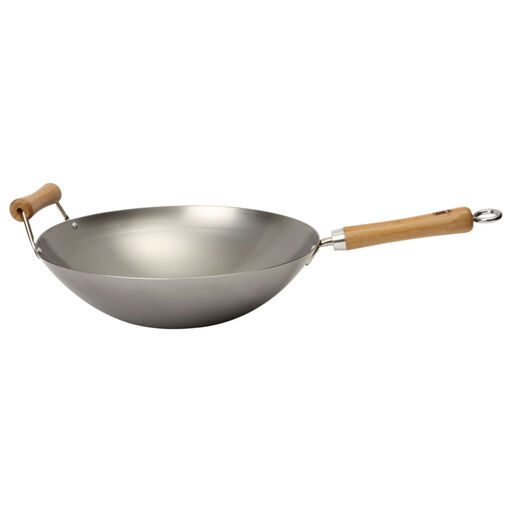
Why it suits this profile: This uncoated carbon steel wok is designed for high temperatures, stir-frying and deep-frying. At 36 cm, the product information states that it is suitable for approximately four to six portions.
There is no coating that can be damaged by unsuitable utensils. However, you must season the pan, clean it by hand and dry it thoroughly immediately afterwards to help prevent rust.
Uncoated carbon steel, 36 cm diameter, suitable for all the listed hobs and fitted with two handles.

Why it suits this profile: This wok has a three-layer stainless steel construction, ceramic non-stick coating, honeycomb texture and glass lid. It is well suited to stir-frying, braising, cooking and deep-frying.
The product information explicitly lists the main heat sources, including induction. Hand washing is recommended, helping to avoid incorrect expectations about dishwasher use.
30 cm, glass lid, 304 stainless steel, ceramic coating and compatibility with induction, gas, electric and ceramic hobs.
We’ve put together a complete, up-to-date list of products that fully meet these strict selection criteria and the applicable European safety regulations.
For one to three people, 28 cm is usually easy to handle. A 30 cm wok is well suited to everyday family cooking. Choose 32 cm when you prepare larger portions and have enough space on your hob. As well as the diameter, consider the flat base and the weight.
Choose a model that explicitly lists induction as a suitable heat source. A magnetic, flat base is essential. Centre the pan on the cooking zone and check that the base diameter is suitable. In the product selection above, the Tefal, Brabantia and MAXCOOK models are described as suitable for induction.
Its lifespan depends on the temperature, utensils and care. Do not use metal utensils if the manufacturer advises against them, do not heat the pan while empty and allow it to cool before washing. An uncoated carbon steel wok does not have a traditional non-stick coating, but it still requires regular care and re-seasoning when the patina starts to wear.
