
Vandaag of morgen in huis

Kwaliteit gegarandeerd

Welkomstaanbiedingen ontgrendelen: GRATIS bezorging | Tot 80% korting | Gratis 30 dagen JoyPlus-proefperiode
Download de app
Turning on a lamp behind a cabinet, controlling mood lighting from the sofa, or adding a light point in the hallway without drilling holes. A wireless switch seems like the perfect, simple solution. And it often is. You plug a receiver into the socket or mount a small module, and you have instant control wherever you want.
But the market is flooded with options that look good at first glance but disappoint in practice. Before making a purchase, it's wise to know where the hidden pitfalls lie. This way, you avoid wasting money on a solution that ends up in a drawer after just a few months.
Much of the frustration with wireless switches stems from exaggerated marketing claims and unclear specifications. These are the three most common pitfalls.
Manufacturers often advertise a range of "30 metres." What they don't always mention is that this applies to an open field with no obstructions. In an average home with concrete walls and ceilings, that range can decrease dramatically. A switch that seems perfect on paper may struggle in practice with the distance from the living room to the hallway.
You start with one switch for a single lamp. A few months later, you want to add a second lamp to the same button or place an extra switch by the other door. If you've bought a closed system, this isn't possible. You're then stuck with the original set and must purchase a completely new system to expand, which is unnecessarily expensive.
A budget-friendly wireless light switch might work perfectly for an 8-watt LED bulb. But if you connect a 500-watt halogen floor lamp or a small electric heater to it, the switch can overheat, burn out, or even cause a fire hazard. The maximum switching power is a critical safety specification that is often overlooked.
To make the right choice, you don't need to read a technical manual. Pay attention to the following three points, and you can be sure you're choosing a product that fits your situation.
Most wireless switches operate on an RF (Radio Frequency) signal. This is generally more reliable for this purpose than Wi-Fi, as it doesn't depend on your (sometimes unstable) home network. The signal is specifically designed for remote control for lighting and is less prone to interference. Look beyond the "open space" claim and search for information about the range through walls.
Always check the maximum power, expressed in Watts (W). This number indicates how much current the switch can safely handle.
Consider how you plan to use the switch. There are roughly three types:
Also, check if the system has a "learning function." This means you can pair additional transmitters (switches) or receivers (sockets).
Based on these criteria, we have selected a number of products suitable for various common situations.
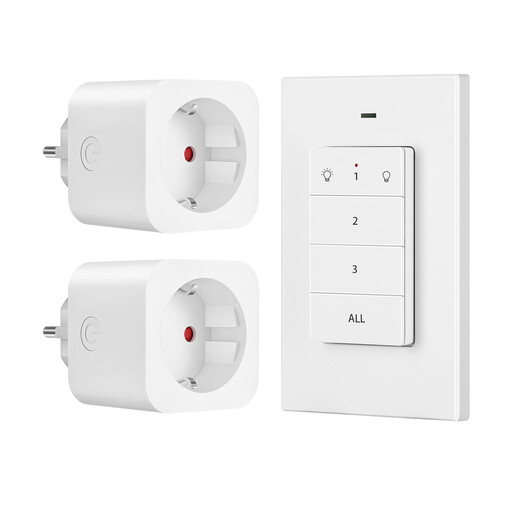
Why This Fits Their Persona: Perfect for those who can't or don't want to drill. You plug the receiver into the socket and stick the switch wherever you want. Ideal for rental properties or if you frequently change your layout. The switch is detachable and also works as a separate remote control.
According to the manufacturer, this set is expandable with other Dewenwils components of the same model. This way, you're not locked into a closed system (pitfall 2) if you need more switch points later.
Ready to use out of the box (pre-programmed). The detachable switch functions as both a fixed wall switch and a portable remote control.
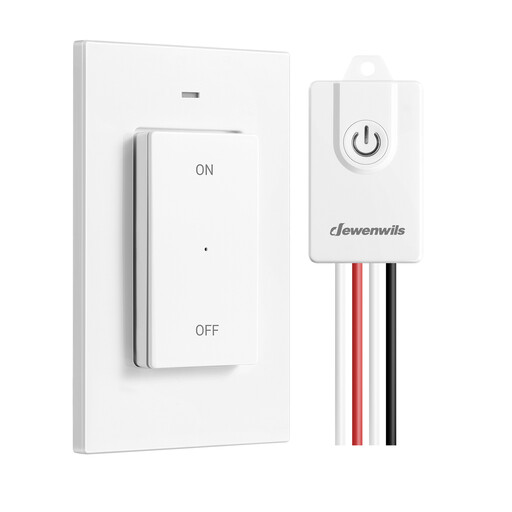
Why This Fits Their Persona: Provides the feel of a permanent wall switch without any chasing or demolition work. The magnetic holder is clever: you click the switch onto the wall, but you can also easily take it with you to the sofa for extra convenience.
The stable RF signal is stated by the manufacturer to work reliably through walls and doors, making the 'open space' range (pitfall 1) less misleading for use in a typical home.
Magnetic, detachable button for flexible use. The high maximum power of 3000W makes it suitable for most lamps and appliances.
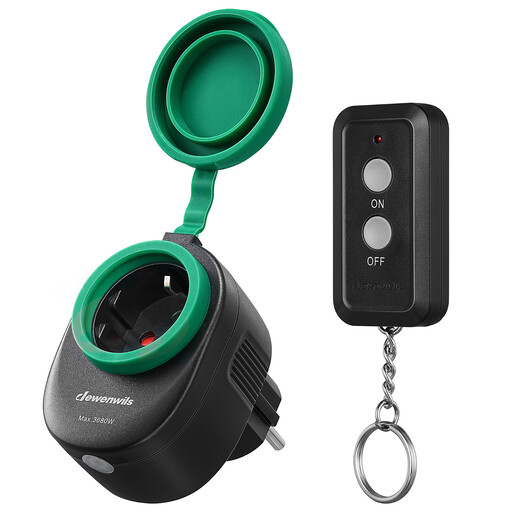
Why This Fits Their Persona: Specifically designed for outdoor use, such as garden lighting, fountain pumps, or Christmas decorations. The IP44 rating means the housing is resistant to water splashes from all directions, which is essential for safe outdoor use.
With a maximum power of 3680W (16A), this set is suitable for heavy-duty applications. This minimises the risk of overload (pitfall 3), even when connecting multiple devices.
IP44 water-resistant for safe outdoor use. Very high switching power and pre-programmed for immediate use.
We have compiled a complete, up-to-date list of products that meet these selection criteria and relevant safety regulations.
The battery life in the transmitter (the switch itself) depends on usage. With normal use, a standard CR2032 coin cell battery, found in most models, typically lasts one to three years. These batteries are widely available and easy to replace yourself.
Yes, this is possible. You can pair multiple receivers (sockets) to a single switch, so all paired lights turn on or off simultaneously. Another method is to plug a power strip into the wireless receiver. When doing so, ensure that the total power of all connected devices does not exceed the maximum switching power of the wireless switch.
No, most models are designed for maximum convenience. A plug-in socket with remote control is a matter of plugging it in. A wireless wall switch can be stuck or screwed onto any wall, with no wiring required. Only in-wall modules, which are concealed in a junction box, require basic electrical knowledge and shutting off the power.
