
Vandaag of morgen in huis

Kwaliteit gegarandeerd

Welkomstaanbiedingen ontgrendelen: GRATIS bezorging | Tot 80% korting | Gratis 30 dagen JoyPlus-proefperiode
Download de app
A speaker may look appealing on a product page, but that tells you little about how well it will suit your home, devices and listening habits. When choosing wireless speakers, people often make the same three mistakes:
Terms such as ‘immersive sound’, ‘powerful bass’ and ‘premium audio’ are also difficult to compare without measurements. So start by checking the objective specifications, connections and intended use. A compact speaker for a desk has different requirements from speakers for music and films in a living room.
An active speaker has a built-in amplifier and can usually be connected directly to a source. A passive bookshelf speaker needs a separate amplifier or receiver. The HiVi-Swans D3.1MKII Passive Bookshelf Speakers are one example. If you overlook this, you could end up with a set of speakers that cannot be connected directly to a phone or television.
Compatibility is even more important with surround sound speakers. Some models only work with a specific soundbar or a compatible receiver. So check:
A large speaker is not automatically the right choice for a small living room. Measure the available space on a cabinet, desk or bookshelf, and check that there is enough clearance from the wall. Also consider your listening distance: a model that sounds good up close may be less convincing in a larger room.
For a wireless speaker for home use, the power supply and cable routing are also relevant. ‘Wireless’ often means the audio signal is transmitted via Bluetooth or a proprietary connection; the speaker itself may still need a power cable.
Bluetooth is handy for phones, tablets and laptops. The range depends on walls, furniture and other wireless devices. For the Bose model in this guide, the product information states a Bluetooth range of up to 30 ft, or about 9 metres in ideal conditions. Treat this as a product specification, not a guarantee for every home.
A Bluetooth speaker with a phone holder adds a useful feature for a desk, bedside table or kitchen. Check that your phone fits securely and that you can use the holder with a phone case on. RGB lighting can add atmosphere, but it has no direct bearing on sound quality. With an RGB Bluetooth speaker, brightness, whether the lights can be switched off and power consumption are therefore more important considerations than the number of lighting modes.
If you mainly use speakers for background music while you work, easy controls, a suitable size and a stable connection are often the deciding factors. For films and television, multiple speakers or a surround sound system can create a more immersive experience. If you mainly listen to music, you may value stereo separation, a separate amplifier and the option to expand your set later.
The three options below each suit a different type of user. These recommendations are based on the stated product descriptions and verifiable features. Before buying, always check the latest compatibility information, what’s included in the box and connection requirements on the product page.
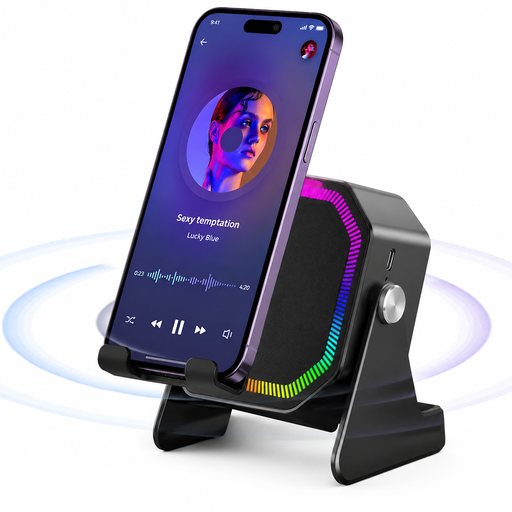
Why it suits this profile: This compact model combines music playback with a phone holder, making it handy for a desk, bedroom, office or use on the go. Its built-in battery gives you more flexibility.
The product name specifies Bluetooth 5.4 and a 1500 mAh battery. However, check the actual playback time and whether you can charge it while using it.
Bluetooth 5.4 according to the product name; built-in phone holder, RGB lighting and 1500mAh battery.

Why it suits this profile: This set is designed for listeners who want to build a traditional stereo setup with a separate amplifier. The pair is suited to left and right channels on a desk, cabinet or speaker stands.
The word ‘passive’ makes it clear that a separate amplifier is required. This helps you avoid buying a passive set expecting it to work wirelessly on its own.
6.5-inch size according to the product name; supplied as a pair for stereo playback. Check the amplifier requirements before buying.
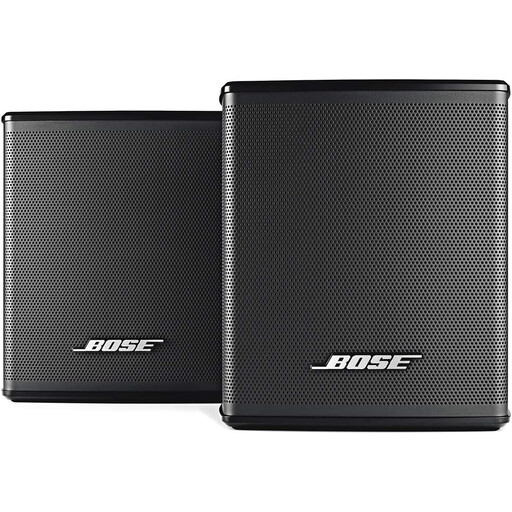
Why it suits this profile: This model is designed for people looking to expand their home cinema setup with rear channels. According to the product description, it is compatible with the Bose Soundbar 500, Soundbar 700 and SoundTouch 300.
The soundbars listed as compatible reduce the risk of choosing the wrong combination. Even so, check your exact model and whether you need an adapter or receiver.
Compact 10 cm size according to the product information; wireless connection via a receiver and designed for home entertainment.
We’ve put together a complete, up-to-date list of products that meet these strict selection criteria and the applicable European safety regulations.
Not always. The audio connection may be wireless, while the speaker still needs power from a socket. Models with a built-in battery are more flexible, but playback time varies depending on volume, lighting and connection method. So check the battery capacity, stated playback time and charging time.
It depends on the available connections and what the television supports. Bluetooth does not work equally well with every TV model and may cause a delay. A surround sound system may also need a specific soundbar or receiver. Check the compatibility lists for both the TV and the speaker.
Their lifespan depends on how they’re used, build quality, exposure to moisture and heat, and, for battery-powered models, battery wear. A passive speaker has no built-in battery, but it does need a suitable amplifier. With active or portable models, the charging connector, battery and software are components worth checking carefully beforehand.
