
Vandaag of morgen in huis

Kwaliteit gegarandeerd

Welkomstaanbiedingen ontgrendelen: GRATIS bezorging | Tot 80% korting | Gratis 30 dagen JoyPlus-proefperiode
Download de app
A wireless keyboard and mouse set keeps your desk tidy and avoids extra cables. However, not every combination is suited to everyday typing, working from home or a shared workspace. A set might look appealing on paper but disappoint in practice because of the wrong keyboard layout, a missing USB port or a mouse that doesn’t feel comfortable in your hand.
This buying guide will help you compare your options. Find out which specifications matter, which marketing claims to scrutinise and which sets suit different ways of working.
In the Netherlands, QWERTY and AZERTY models are both widely available. A QWERTY keyboard and mouse set has a different arrangement of letters and punctuation marks from a Belgian AZERTY model. So don’t just check the product photo: look at the keyboard layout specification too.
For many Dutch users, a US/QWERTY layout is suitable, but the key labels may differ from the Dutch software settings. If you often enter numbers, it’s also worth checking whether the keyboard has a numeric keypad.
A wireless set with a USB receiver usually connects via a 2.4 GHz nano receiver. That’s handy for a desktop PC or laptop with a USB-A port. If your laptop only has USB-C, you may need an adapter.
Bluetooth works without a separate receiver, but pairing can take a little more effort. A multi-device keyboard and mouse set may combine both options and connect to several computers, tablets or phones. Check that both the keyboard and mouse support this feature.
Terms such as “silent”, “quiet” and “silent click” aren’t always based on the same testing method. A membrane or scissor-switch keyboard will generally sound different from a mechanical model. With a quiet keyboard and mouse set, the aim is mainly to provide a softer keystroke and less clicking noise, not complete silence.
A wrist rest or adjustable feet won’t automatically solve every comfort issue either. The right desk height, posture and regular breaks are still important.
Keep these points in mind:
A full-size keyboard includes a numeric keypad, making it useful for spreadsheets, admin and bookkeeping. A compact TKL model saves space but usually doesn’t have a separate numeric keypad.
For everyday office work, low-profile keys, membrane keys and scissor switches are generally designed for a softer keystroke. If you’re looking for a mechanical response, RGB lighting or hot-swappable switches, you’ll need to look specifically at gaming or mechanical keyboards. An office-focused keyboard and mouse set for the office usually won’t have these features.
Check whether the product uses AA or AAA batteries, and whether they’re included. Manufacturer estimates such as “up to 48 months” depend on how the product is used. According to Trust’s product information, for example, the Trezo Comfort can last up to 48 months for the keyboard and up to 12 months for the mouse.
Rechargeable sets reduce the need for disposable batteries, but they do need regular charging. Also check whether you can keep using the set while it’s charging. Low battery consumption is useful, but it doesn’t tell you anything about comfort or connection quality.
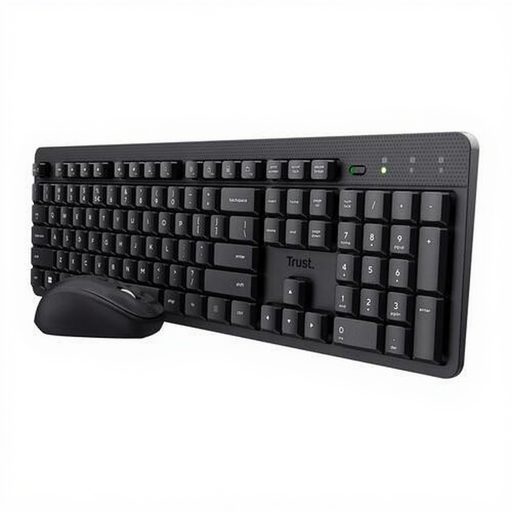
Why it suits this profile: This set is designed for working from home, studying and general office work. It has a US/QWERTY layout, a single USB receiver and an adjustable typing angle.
The product information clearly specifies the US/QWERTY layout, a single receiver and an adjustable mouse speed of 800 to 1600 DPI. This means you can check the key connection and layout details in advance.
Quiet keys and mouse buttons, adjustable typing angle, and compatibility with Windows, macOS, Linux and ChromeOS.
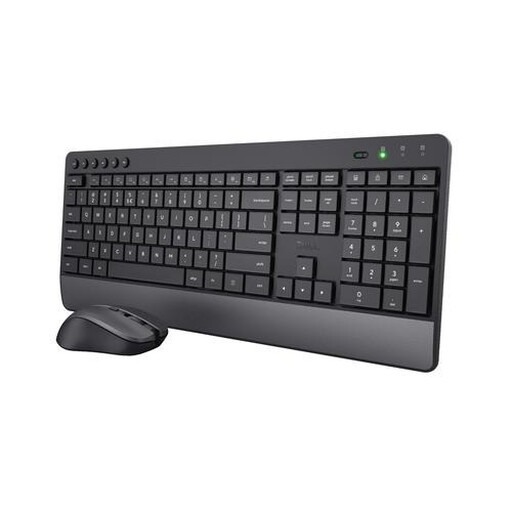
Why it suits this profile: The full-size design, with a numeric keypad, integrated wrist rest and US/QWERTY layout, is well suited to long working days at a dedicated desk.
It connects via a 2.4 GHz nano receiver, with a stated range of up to 10 metres. The product description also lists the keyboard and mouse battery life separately.
Integrated wrist rest, media keys, adjustable mouse sensitivity and, according to the product information, a casing made with 85% recycled material.
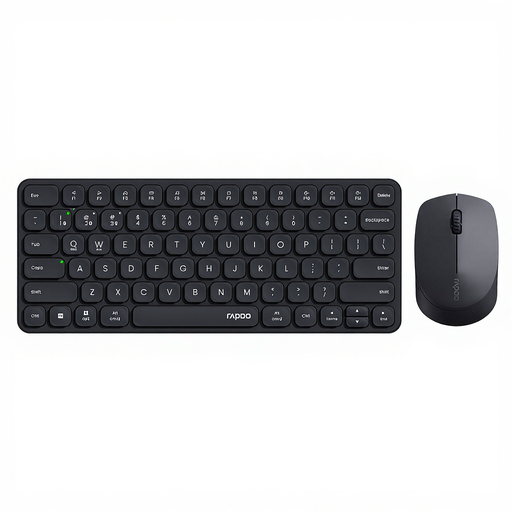
Why it suits this profile: This combo is designed for users who switch between up to four paired devices, such as a laptop, desktop PC, tablet and phone.
The specifications list 2.4 GHz and Bluetooth 4.0/5.0, as well as switching between up to four devices. Check in advance that your devices support Bluetooth.
Low-profile scissor keys, quiet mouse clicks and adjustable mouse resolution from 800 to 2400 DPI.
We’ve put together a complete, up-to-date list of products that meet these strict selection criteria and current European safety regulations.
Many 2.4 GHz sets are plug-and-play: insert the batteries, plug in the USB receiver, then switch on the keyboard and mouse. Bluetooth models usually need to be paired first in your Bluetooth settings. Always check the instructions for your operating system.
It varies by model, battery type and usage. Manufacturers often state a maximum battery life. Treat these figures as a guide, not a fixed guarantee. A set with an automatic sleep mode or on/off switch can help reduce battery use.
It can be, particularly if the set has soft keys and dampened mouse buttons. According to the product descriptions, models such as the Trust Ody II and Trezo Comfort are designed for quieter use. The sound can still vary depending on the user and the surface, so complete silence isn’t guaranteed.
