
Vandaag of morgen in huis

Kwaliteit gegarandeerd

Welkomstaanbiedingen ontgrendelen: GRATIS bezorging | Tot 80% korting | Gratis 30 dagen JoyPlus-proefperiode
Download de app
A wireless keyboard and mouse set keeps your desk tidy and is ideal for a laptop, desktop or workspace at the kitchen table. However, sets vary considerably in connection type, layout, battery life and comfort. A low price means little if the USB receiver doesn't fit your laptop or if the American QWERTY layout doesn't match your habits.
In this guide, you'll discover what to look out for, which marketing claims to take with a pinch of salt, and which wireless keyboard and mouse combination suits different users.
A QWERTY keyboard and mouse with an American layout may look similar to a Dutch or Belgian layout, but the position of characters can differ. Think of the keys for @, " and special punctuation marks. So always check before buying whether US QWERTY, ANSI, AZERTY or another layout is specified.
The Trust Ody II, Trust Trezo Comfort and Trust Lyra in this selection have a US QWERTY layout. The Dell KM5221W, on the other hand, has an AZERTY layout. That doesn't automatically make the Dell unsuitable, but it is less logical if you're used to QWERTY.
Some sets work via a 2.4GHz USB receiver, others via Bluetooth, and some combine both technologies. A USB receiver is often straightforward: plug in and use. However, a tablet or smartphone may lack a suitable USB port. A Bluetooth keyboard and mouse is then more practical, provided your device supports Bluetooth.
Also check whether the set uses a single receiver for both keyboard and mouse. The Trust Ody II uses one USB receiver, which can be stored magnetically inside the keyboard. That limits the number of occupied USB ports.
With a quiet keyboard and mouse, it's usually about dampened keys and mouse buttons. Pressing the keys remains audible, especially when typing firmly. Mechanical keyboards generally have a more distinct key feel and can produce more noise, depending on the switches and dampening used.
According to Trust's product description, the keys and mouse buttons of the Ody II and Trezo Comfort are designed for quieter operation. See this as a product specification, not a guarantee of a completely silent workspace.
Pay attention to the combination of connections:
The Rapoo 9010M supports 2.4GHz and Bluetooth 4.0/5.0 according to the manufacturer, and can be paired with up to four devices. The Trust Lyra works with one USB receiver and two Bluetooth connections, for up to three devices. This is interesting if you alternate between a computer, tablet and phone.
Also check the operating system. Many models support Windows, macOS and Chrome OS, but features such as shortcut keys can differ per system. The Trust Lyra also mentions support for iOS, iPadOS and Android.
A full-size keyboard offers a numeric section and is practical for administration, spreadsheets and accounting. A compact wireless keyboard takes up less space but often lacks a numpad.
The Trust Trezo Comfort is a full-size model with an integrated wrist rest. The Trust Lyra is more compact and has a tenkeyless format with 78 keys. An ergonomic wireless keyboard isn't just about a wrist rest: also look at the height, adjustable feet, key profile and your own sitting posture.
Sets on AA and AAA batteries are ready to use straight away, but will need new batteries eventually. With a rechargeable keyboard and mouse, you need to replace batteries less often, but you do have to charge them in good time.
According to Trust's product information, the Lyra keyboard and mouse can last up to six months per charge under normal use. The Rapoo 9010M is supplied as a battery-powered set according to the product description; the stated battery life may depend on usage and settings. Always check exactly what is included and whether a charging cable is supplied.
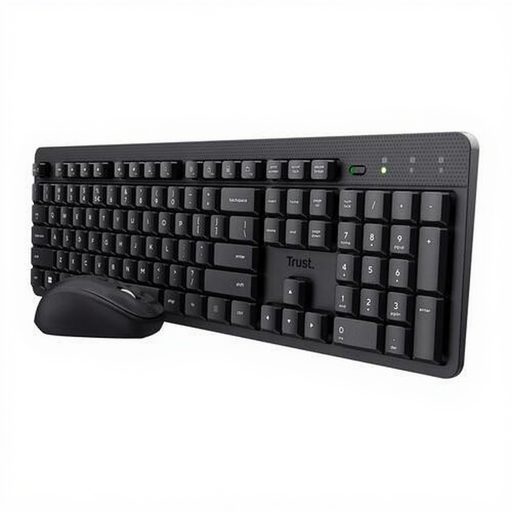
Why this fits the profile: A straightforward wireless keyboard and mouse combination for home workers, students and office starters who want to work with a single USB receiver.
The US QWERTY layout, USB-RF connection and compatibility with Windows, macOS, Linux and Chrome OS are clearly stated. The receiver can be stored inside the keyboard.
Silent keys, adjustable typing angle, media keys and a mouse speed of 800–1600 dpi.
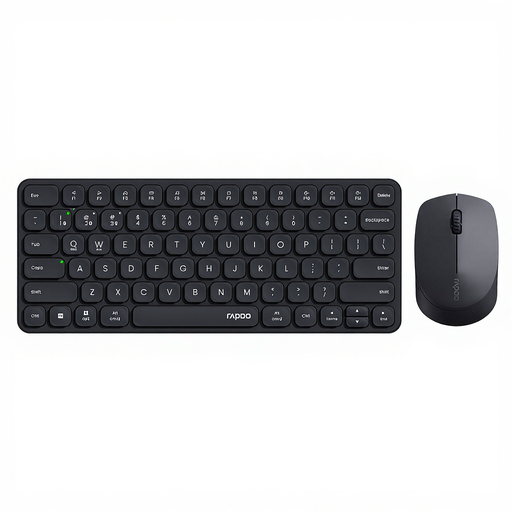
Why this fits the profile: Suitable for professionals who switch between a desktop, laptop, tablet and smartphone.
The set uses both Bluetooth and a 2.4GHz receiver and states support for up to four devices. This makes the connection less restrictive than a set with only USB.
Low-profile scissor keys, quiet mouse clicks, adjustable 800–2400 dpi and Windows/Mac shortcut keys.
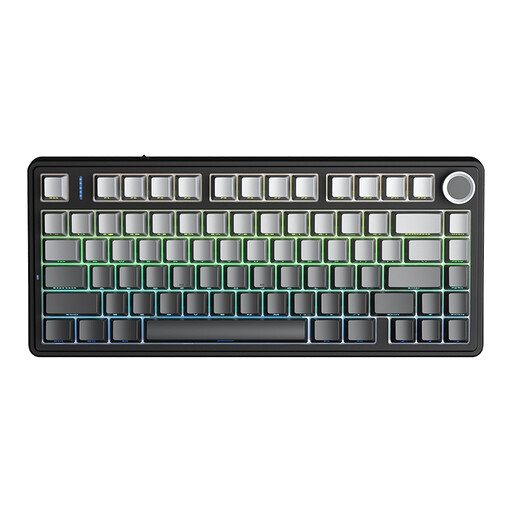
Why this fits the profile: For gamers and users looking for a mechanical gaming keyboard with compact dimensions and multiple connection options.
The product information states tri-mode connection, a 75% layout and a rechargeable battery. So you know in advance that this is not a quiet office combination with a mouse and numpad.
Mechanical switches, hot-swap support, RGB lighting, USB/Bluetooth/2.4GHz and a compact 81-key layout.
We've put together a full, up-to-date list of products that fully meet these strict selection criteria and comply with current European safety regulations.
Not always. Check whether your laptop has a free USB-A port for the receiver or supports Bluetooth. With USB-C laptops, an adapter may be needed. Also check the operating system and keyboard layout.
That depends on the model, usage and battery type. Manufacturers sometimes state a battery life of several months or longer, but these are conditions from their own product information. A rechargeable set avoids loose batteries, but does need to be charged regularly.
For simple games, an office combination may be sufficient. For competitive gaming, users typically look at mechanical switches, polling rate, wireless latency, N-key rollover and programmable functions. A model like the AULA F75 Pro is better suited to gaming in terms of features, but is supplied without a mouse.
