
Two devices, one socket
You want to charge your wireless headphones and, for example, your phone at the same time, so you’re looking for a mains charger with two usable outputs.


Choose a mains charger with multiple ports if you want to charge your wireless headphones and another device from a single socket at the same time. Match the port to your headphones’ cable and charging requirements. If you’re also plugging in a phone, compare the power available from each port when they’re in use together, rather than looking only at the maximum total output.
You want to charge your wireless headphones and, for example, your phone at the same time, so you’re looking for a mains charger with two usable outputs.
Your headphones and another device don’t use the same type of cable connection. For you, having the right combination of USB-A and USB-C ports matters more than a high total output.
You want to charge other devices on your desk from a single mains socket, so you’re comparing the number and layout of the ports.
Choose this option if: both your headphones and your second device use a compatible USB-A cable.
Bear in mind: a USB-C-to-USB-C cable won’t plug directly into a charger with USB-A ports only.
Choose this option if: you want to be able to connect two different cable ends to one charger.
Bear in mind: a charger with two ports doesn’t give you extra connections for more devices.
Choose this option if: you need a dedicated charging spot for several devices as well as your headphones.
Bear in mind: check which ports and how much power are available when they’re used together.
Choose this option if: you don’t need to charge your headphones and a second device at the same time, and your existing charger is suitable according to the product specifications.
Bear in mind: this won’t give you an extra port for charging devices at the same time.
| What to consider | What to look for | Who is this important for? |
|---|---|---|
| Charging at the same time from one socket | Count how many devices you want to connect at once and check how many outputs the mains charger has. | If I want to charge my headphones and, for example, my phone at the same time, I need enough suitable ports on one charger. For around 36% of consumers, this is their main reason for buying. |
| Matching the port to the cable | Check your headphones’ connection, the ends of the cable and the charging requirements for the exact model. | I want to use my existing headphone cable, so I look for the right type of port. Around 29% of consumers prioritise the connection and cable. |
| Power when ports are used together | Check the stated power per port when two devices are connected and compare it with their charging requirements. | If my phone and headphones are connected to the charger at the same time, I want to know how much power each port in use can deliver. This is the main reason for around 21% of consumers. |
| Number of ports and charging spot | Compare the number of USB-A and USB-C ports and decide whether a wall charger or desktop charger is right for the location. | For a dedicated spot with more than two devices, I mainly look for extra connections. Around 14% of consumers give this as their main reason. |
The power available when you use two ports may differ from the maximum output for a single port. So the figure alone doesn’t tell you how much power will be available for your particular combination of devices.
Compare the specifications for the ports you want to use at the same time.
The Belkin charger with two USB-A ports included in our research doesn’t have a USB-C output. Charging requirements can also vary between headphone models.
Check both ends of your cable and your headphones’ manual before choosing a charger.
If your cable doesn’t fit, you may need another suitable cable.
The Anker 543 Charger included in our research has four ports, but it only works when plugged into the mains. The number of outputs doesn’t make it a power source you can use without a socket.
Choose a model like this for a dedicated charging spot with a mains connection.
The models included in our research offer either two USB-A ports or a combination of USB-C and USB-A.
The models included in our research offer a compact combination of USB-C and USB-A, or multiple ports for a dedicated charging spot.
The Nexode 65 W included in our research is a three-port option for anyone wanting to connect more devices as well as headphones.
This selection includes USB chargers with USB-A and USB-C connections, including multi-port options for charging several devices at once. For the specific product, check that its connections and charging specifications are suitable for your devices, and that it carries the required CE marking.
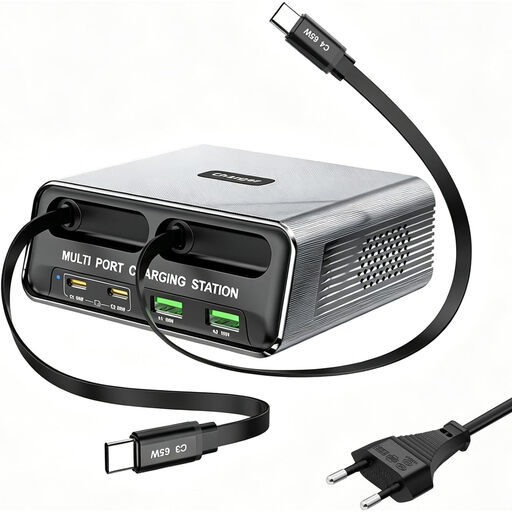 No image available
An option to compare if you want to charge several devices from one mains connection; check that the connections suit your headphones and other devices.
The product name specifies 320 W and two retractable USB-C cables.
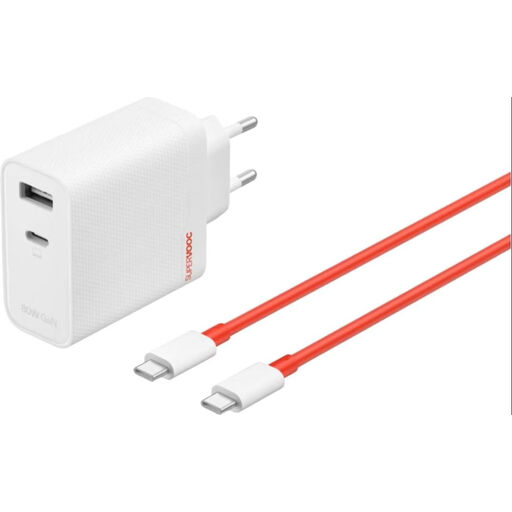 No image available
A two-port option to compare if you want to connect your headphones and a second device at the same time; check that the cables fit the ports.
The product name specifies 80 W and USB-A plus USB-C.
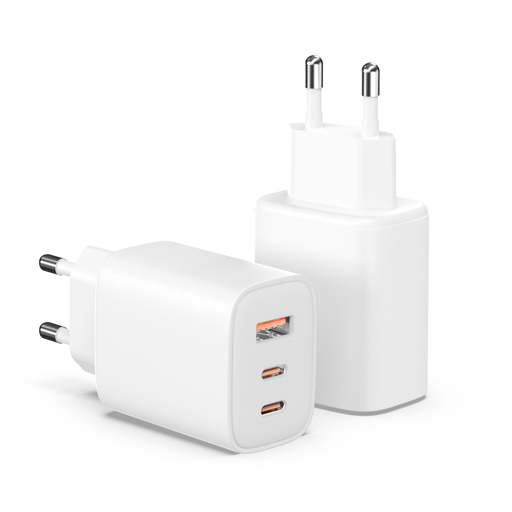 No image available
An option to compare if you need more than two suitable connections from one mains charger.
The product name specifies 65 W, two USB-C ports and USB-A.
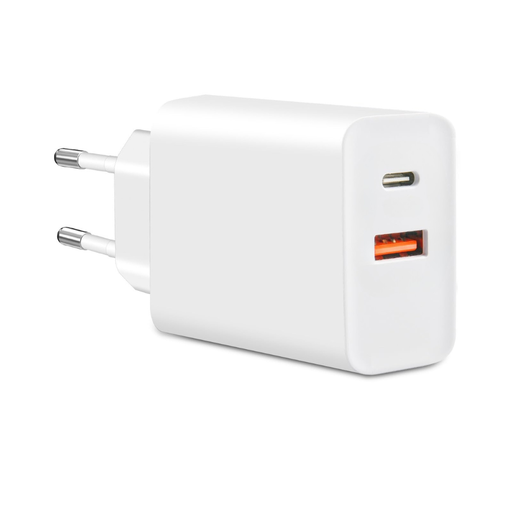 No image available
A two-port option to compare if you want to connect your headphones and a second device at the same time, and both cables fit.
The product name specifies 30 W and USB-A plus USB-C.
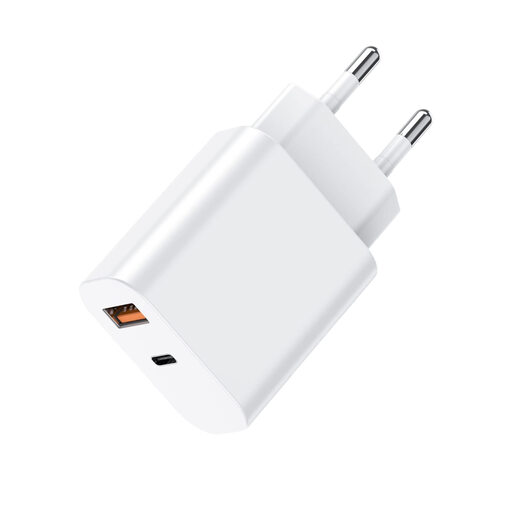 No image available
A two-port option to compare if you want to connect two devices and their cables fit the available ports.
The product name specifies 20 W and USB-A plus USB-C.
Not without checking the connection and charging requirements for the exact model. Sony lists specific adapter and cable requirements for certain headphones; these don’t automatically apply to other models.
You can’t tell from the total output alone. Check how much power the port in use delivers when the second device is also connected, and refer to your headphones’ charging requirements.
Check that the cable is firmly connected and follow your model’s manual. Sony specifically warns that the WF-1000XM4 may not charge with a cable other than the supplied USB-C cable; this advice applies to that model.
A mains-powered USB charger placed on the market in the Netherlands must carry the applicable mandatory CE marking. The Netherlands Food and Consumer Product Safety Authority also sets out requirements for electrical equipment with a nominal AC voltage between 50 and 1000 V. Check the marking on the specific product.
No. The European Commission includes headphones and earbuds among the product categories covered by the common charging connector rules, but that doesn’t mean an older device will be retrofitted with a USB-C connection. Check the connection on your own headphones.