
Vandaag of morgen in huis

Kwaliteit gegarandeerd

Welkomstaanbiedingen ontgrendelen: GRATIS bezorging | Tot 80% korting | Gratis 30 dagen JoyPlus-proefperiode
Download de app
A wireless Bluetooth speaker may seem easy to choose: connect your smartphone, turn on some music and you are ready to go. Yet many purchases disappoint. A small speaker may not deliver enough volume for a living room, an outdoor model may not offer sufficient water protection, and the stated battery life often applies only at moderate volume.
As a Joybuy Product Recommendation Officer, I filter the most important product specifications and practical considerations. This makes it easier to see which portable speaker, wireless battery-powered speaker or soundbar suits your situation.
High wattage sounds appealing, but it does not tell you everything about the listening experience. The size of the drivers, the enclosure, the frequency range and the way the power is specified all matter too. So check whether the figure refers to RMS power or peak power. RMS is more useful when comparing products for normal use.
A compact speaker with 6 W RMS is suitable for a desk or bedroom, while a larger powerful Bluetooth speaker with several dozen watts is better suited to a living room or gathering. More power does not automatically mean better sound in every room.
Manufacturers usually state a maximum playback time. This can vary depending on the volume, Bluetooth connection, lighting effects and type of audio. For example, the Tronsmart Bang 2 has a stated playback time of up to 26 hours at 50% volume with the lighting switched off. With the lighting on, the stated playback time is considerably lower.
So pay attention to:
A waterproof Bluetooth speaker is not automatically suitable for every type of water. The IP rating distinguishes between dust and water protection. According to the product information, the Sony SRS-XB100 with IP67 is dust-tight and protected against immersion in fresh water up to the stated limits. The manufacturer warns against salt water, chlorinated water and high-pressure jets.
An IPX6 model, such as the Tronsmart Bang 2, is stated in the product specifications to withstand powerful water jets, but it has no specified dust-protection rating. So check the complete IP code and follow the instructions for use.
For a small room, home office or desk, a compact 1.0 speaker is often sufficient. For a broader soundstage, look for:
A model with TWS or stereo pairing can be connected to a second identical speaker. However, check that both models support this feature and that the pairing is wireless.
Bluetooth 5.3 or 5.4 provides a modern wireless connection, but the actual experience also depends on your smartphone, laptop and codec. For home use, Wi-Fi can offer additional options, such as AirPlay 2 or multi-room functionality.
A multi-room speaker is particularly useful if you want to play music in several rooms. According to the product information, the Edifier ES300 supports Bluetooth 5.3, 2.4 and 5 GHz Wi-Fi, USB and AUX. The model can also be used in a multi-room set-up via AirPlay 2.
For a television, Bluetooth is not always the most convenient connection. A soundbar for TV with HDMI ARC or eARC can synchronise volume and audio with the television more easily. Check that the soundbar’s connections match those on your TV.
Consider where the speaker will usually be placed. For a balcony, campsite or beach, IP protection, a carrying strap and a sturdy design are practical features. For a permanent spot in the living room, Wi-Fi, AUX, app control and a more refined enclosure may be more important.
Also consider the controls. Physical buttons are useful outdoors or when your phone is out of reach. An app, on the other hand, may offer additional equaliser settings, lighting effects or firmware updates.
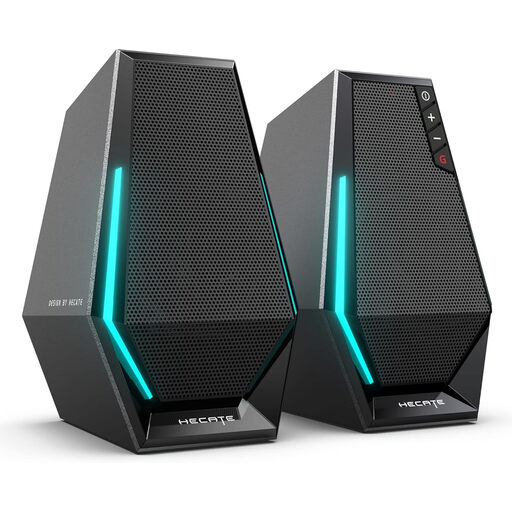
Why it suits this profile: A compact set for PC use, gaming and listening to music at your desk. Bluetooth, USB and 3.5mm AUX offer several connection options.
The product information specifies 10 W peak power and two 2.5-inch drivers. This makes it clearer what the set is designed for: close-range use, rather than serving as a large speaker for a garden party.
Bluetooth 5.3, USB and AUX inputs, five RGB lighting effects, and switching between game, music and film modes.
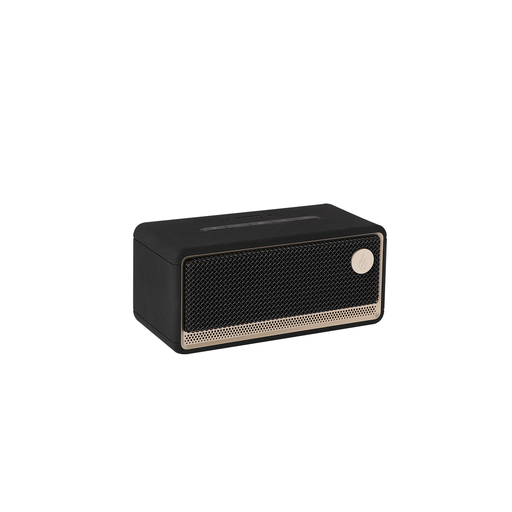
Why it suits this profile: For anyone looking for one speaker for music, films, gaming and use in several rooms. The wooden enclosure suits a permanent position in the home.
Alongside Bluetooth, the product information lists Wi-Fi, USB and AUX. This reduces reliance on a single connection and makes the speaker suitable for a range of sources.
60 W total according to the product listing, Bluetooth 5.3, AirPlay 2, LDAC, USB/AUX and a built-in battery with a stated playback time of up to 12 hours.
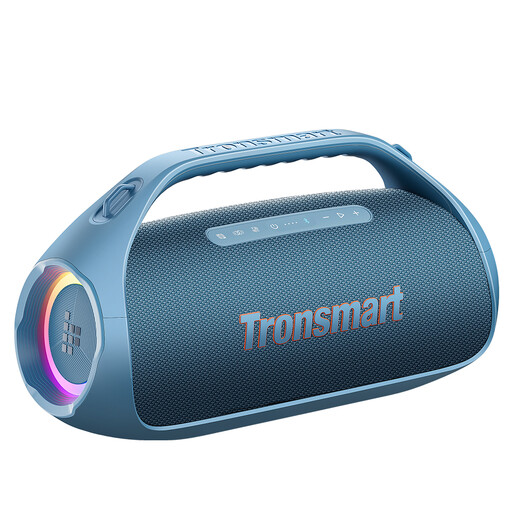
Why it suits this profile: Designed for outdoor use, parties and situations where volume, portability and battery life are important.
The IPX6 rating and separately stated playback time make it clear that this model is designed for mobile use. According to the product information, battery life depends on the volume and lighting.
90 W stated power, up to 26 hours under specific conditions, USB-C, TWS pairing, app equaliser and a carrying strap.
We have put together a complete, up-to-date list of products that fully meet these strict selection criteria and the applicable European safety regulations.
A portable speaker is handy for listening to music from your phone, but a soundbar may be the more logical choice for television use. In that case, look for HDMI ARC or eARC, an optical connection, a supplied remote control and a subwoofer.
According to the product information, the TCL S45H is a 2.0 soundbar with Bluetooth 5.2, HDMI connections, an optical input and support for Dolby Atmos and DTS Virtual:X. The Ultimea Poseidon M4T adds a wireless subwoofer and surround speakers. Check in advance how much space you have and whether you can conceal the cables running to the rear speakers.
Turn on Bluetooth on your smartphone, tablet or laptop. Put the speaker into pairing mode and select the product name from the Bluetooth list. If the device has been paired before, the connection will often be made automatically. Keep obstacles and the distance between the two devices in mind.
This varies by model and usage. Manufacturers generally state a maximum playback time at a particular volume. High volumes, lighting effects and phone calls reduce the operating time. A speaker with long battery life is therefore most useful when the stated conditions match the way you intend to use it.
Power consumption mainly comes from charging the battery or using the speaker via mains power. A smaller battery generally requires less energy per charge than a large party speaker. Also check the charging time and USB-C compatibility. This lets you charge the speaker easily with a suitable adapter you already use.
