A window vacuum cleaner can collect dirty water from a glass kitchen splashback, but it won’t loosen baked-on grease and food residue by itself. First, wash off the splashes using a method suitable for the glass and its edges. Then choose a model based on the width of clear glass, the suction nozzle actually included in the set and how you empty the dirty-water tank.
Who is a window vacuum cleaner suitable for?
Tidying up cooking splashes
You want to loosen food and grease splashes from your glass splashback after having people round, then collect the wash water. Kärcher Netherlands identifies grease and food residue as cooking grime; Vileda Netherlands recommends washing before vacuuming the water away.
For a narrow splashback
You have little clear glass next to cupboards, plug sockets or a tap. In that case, the nozzle included in the set you choose matters more than the appliance’s compact size alone. Bosch DIY and Leifheit Netherlands describe narrow or optional nozzles for specific models.
For regular use
You want to use the window vacuum cleaner on other smooth surfaces too, so you’re considering battery life, how to empty the tank and whether suitable replacement parts are available. Kärcher Netherlands and Leifheit Netherlands mention using their products in different positions; always check that parts are compatible with the exact model.
What should you look for when buying?
First loosen the splashes, then check which nozzle suits the clear strip of glass. Finally, consider whether emptying and maintenance work for how often you’ll use the appliance.
| What to consider |
What should you check? |
Who is this important for? |
| Loosening splashes |
Check whether the set includes a washer or spray bottle, and use a cleaning method suitable for the glass and its edges. |
I want to loosen grease and food residue before vacuuming up the wash water; around 36% of consumers prioritise pre-washing cooking splashes. |
| Narrow strips of glass |
Measure the clear width and compare it with the nozzle included in the exact package. |
I need to work around a tap, plug socket or cupboard, and want to know whether the nozzle will fit on the clear glass; around 29% of consumers give access to narrow strips top priority. |
| Collecting wash water |
Check which operating positions the manufacturer recommends and how to empty the model’s tank. |
I want to collect the wash water after washing and limit drips on the worktop; around 21% of consumers prioritise removing wash water. |
| Emptying and maintenance |
Check how to empty the tank and whether any replacement parts are compatible with the exact model. |
I want to use the window vacuum cleaner regularly, so I’m looking at how to empty it and whether suitable parts are available; around 14% of consumers make maintenance and reuse their main buying concern. |
Avoiding common buying mistakes
-
Expecting the window vacuum cleaner to replace pre-washing
The vacuum collects wash water, but baked-on cooking splashes need to be loosened first. Vileda Netherlands recommends washing with a cloth or sponge before vacuuming the water away.
First loosen the splashes using a method suitable for the glass and surrounding materials.
-
Assuming every version includes a narrow nozzle
According to Leifheit Netherlands, the complete Leifheit Dry & Clean 51016 set includes a 17 cm nozzle; for version 51000, this nozzle is sold separately. Bosch DIY lists a small suction head for the GlassVAC as an option.
Measure the clear glass width and check the exact model number and what’s included in the set you choose.
-
Making the longest stated battery life the deciding factor
For a single small splashback, nozzle width and the washing steps required may matter more than battery life. Manufacturer figures for different models don’t automatically provide a comparison of cleaning results.
First work out how much glass you want to clean in one go, then compare the stated battery life of the models that suit you.
Relevant brands
Bosch
Bosch describes the GlassVAC as a compact window vacuum cleaner for surfaces including glass and tiles.
- Bosch DIY states that the GlassVAC has a battery life of 30 minutes and lists a small suction head as an option for tight spaces.
- Compact size doesn’t mean every set includes the small head; check what’s included in the version you choose.
Kärcher
According to Kärcher Netherlands, the WV 1 Go Care is designed for compact cleaning of smooth surfaces.
- Kärcher Netherlands states that it has a battery life of 25 minutes, can be used in different positions and has an easy-to-empty dirty-water tank.
- Check which nozzle and accessories are included with each version; a general mention of interchangeable nozzles doesn’t tell you what’s in every set.
Leifheit
The Dry & Clean is available as a standalone appliance or in a set; the set number and included nozzle matter for a narrow splashback.
- Leifheit Netherlands states that model 51000 has a 28 cm nozzle. According to Leifheit, the complete 51016 set also includes a 17 cm nozzle.
- The 17 cm nozzle is sold separately for model 51000. The stated maximum battery life of 38 minutes is a manufacturer figure.
Window vacuum cleaners at Joybuy
This Joybuy product selection is aimed at washing glass first, then collecting the water.
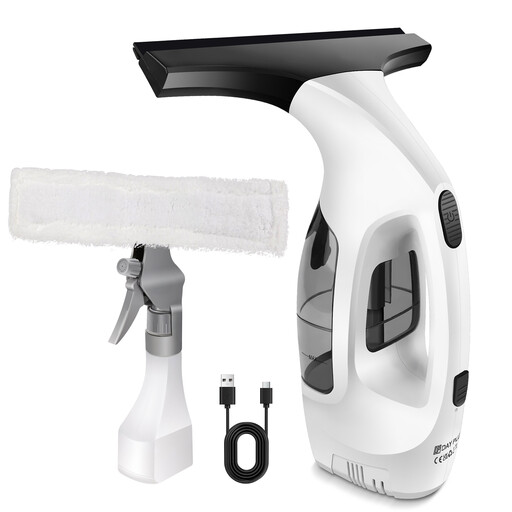 Image unavailable
Rechargeable window vacuum cleaner with spray bottle and microfibre cloth
The spray bottle and microfibre cloth are handy if you want to wash off splashes first; the window vacuum cleaner is designed to collect water from glass.
View at Joybuy
Frequently asked questions
Can I remove baked-on grease splashes straight away with a window vacuum cleaner?
First loosen the splashes using a method suited to the surface; the window vacuum cleaner can then collect the wash water. Vileda Netherlands recommends washing before vacuuming the water away. Also take care around other materials along the edge of the glass.
What can I do if my window vacuum cleaner doesn’t work properly after I buy it?
If a product you bought as a consumer in the Netherlands is faulty, contact the seller. The Dutch government states that there is no single statutory guarantee period for all products; this doesn’t affect your right to a product that is fit for purpose. An additional guarantee is most relevant if it gives you rights beyond those you already have.


