
Families with rooms separated by thick walls
You want to watch videos in another room and mainly need to improve the connection between those rooms. TP-Link points out that walls, the layout and the position of your equipment all affect coverage.


Don’t automatically replace your router: if the connection between rooms is the problem, adding Wi-Fi points is one option to explore. With Ethernet, you can connect these points by cable. Without a cable, you could try wireless mesh in a spot where the signal is still usable, or test powerline, which depends on your home’s electrical wiring. Also check whether you want to keep your existing router and how saved videos will reach your playback device.
You want to watch videos in another room and mainly need to improve the connection between those rooms. TP-Link points out that walls, the layout and the position of your equipment all affect coverage.
You share videos from a device such as a NAS and want your storage and playback devices to communicate over your home network. Synology describes streaming from a NAS over the local network; the capabilities of both the storage device and the receiving device also matter.
You want to add a Wi-Fi point without installing network cables. Wireless mesh and powerline are different options: the former still needs a usable wireless connection, while powerline performance depends on your electrical wiring.
Choose this option if: the connection where you watch is already good and you first want to rule out an issue with the video source or network settings.
Bear in mind: a single central Wi-Fi point won’t automatically provide extra coverage beyond a thick wall.
Choose this option if: there’s a network cable to the other room or floor, or you can install one.
Bear in mind: check the connection mode. TP-Link notes that some Deco features aren’t available in access point mode.
Choose this option if: there are no cables and you can place an extra point somewhere it still has a usable connection to the main network.
Bear in mind: the connection between the points also needs to work throughout your home. TP-Link lists walls, layout and positioning as factors.
Choose this option if: Wi-Fi between rooms is unreliable and installing Ethernet isn’t practical.
Bear in mind: TP-Link says your electrical wiring affects the actual powerline speed, so test the sockets you plan to use.
| What to consider | What should you look for? | Who is this most relevant to? |
|---|---|---|
| Coverage beyond thick walls | Test the connection where you plan to watch and decide where an extra point could go. TP-Link lists walls, layout and positioning among the factors that can affect coverage. | If family videos need to play in a room behind a thick wall, I want to make sure there’s a usable signal there first. Coverage is the top priority for around 36% of consumers. |
| Sharing and playing local videos | Check where the videos are stored, how that source shares them and whether the receiving device can play them. Synology describes streaming from a NAS over the local network. | If my videos are stored on a NAS, I want to know whether the source and my TV or phone can connect over my home network. Sharing and playing local videos is the top priority for around 29% of consumers. |
| Installation and positioning | Check whether Ethernet is available. If you’re trying powerline, test the sockets you plan to use. TP-Link notes that electrical wiring affects the actual speed. | I’d rather not run a cable through the rooms, but a wireless point still needs to maintain a good connection with the router. Easy installation and positioning are the top priority for around 21% of consumers. |
| Cost and network management | Check how many Wi-Fi points are included and which features remain available if you keep your existing router. The available features can vary between router and access point modes. | If I want to keep my broadband provider’s router, I want to know in advance which kit I need and which features will still work. Cost and management are the top priority for around 14% of consumers. |
According to TP-Link, coverage at home depends on factors including the layout, materials and positioning. The stated coverage area alone can’t tell you what signal you’ll get where you plan to watch.
Test reception in the room in question and see where an extra Wi-Fi point can still connect to the main network.
A repeater needs a usable connection of its own to pass the signal on. It won’t solve the problem by itself if you place it somewhere with no reception.
Choose a spot where the connection is still usable, or find out whether LAN backhaul is an option.
TP-Link notes that the quality of your electrical wiring affects actual data throughput.
Test the adapters in the sockets you plan to use, with the application you’ll use to share or play videos.
In access point mode, your main router continues to manage network features. Some features of the additional system may not be available.
Choose between router and access point mode carefully, and check in advance which features you need.
TP-Link offers a range of Deco mesh Wi-Fi systems, with features varying by model.
ASUS describes the ZenWiFi XD5 as a mesh system that can connect wirelessly or, where Ethernet ports are available, by cable.
The FRITZ!Repeater 3000 AX can extend an existing network over Wi-Fi or LAN.
The Magic 2 WiFi 6 next is a powerline Wi-Fi option that carries your network to another room through your electrical wiring.
This selection includes mesh Wi-Fi with wired backhaul and a powerline Wi-Fi kit. Check that the connections, modes and included Wi-Fi points suit your home and existing router.
 No image available
An option to consider if you want to connect mesh points by cable.
Wi-Fi 7; dual-band on 2.4 and 5 GHz; two 2.5 Gbit/s Ethernet ports; wired backhaul.
 No image available
An option for extending your Wi-Fi with two mesh points, which can also be connected by cable if you wish.
Wi-Fi 6; two units; Ethernet backhaul listed as an option; two Ethernet ports per unit.
 No image available
A mesh kit for spreading Wi-Fi across several rooms. Wired connections between the points are another option to consider.
Wi-Fi 6; three units; dual-band on 2.4 and 5 GHz; three gigabit Ethernet ports per unit. TP-Link lists optional Ethernet backhaul for the Deco X50.
 No image available
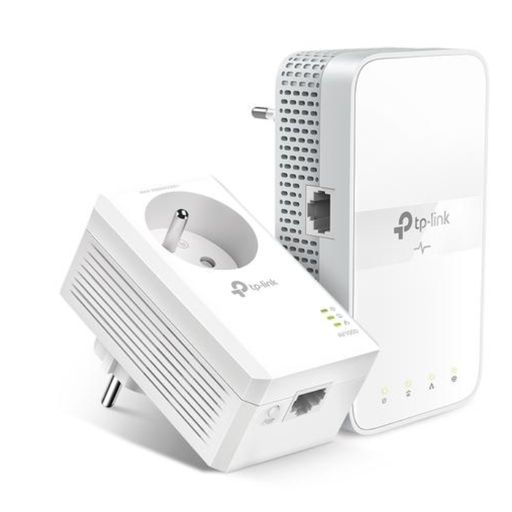
A powerline Wi-Fi option to test when the wireless connection between rooms is unreliable and there’s no Ethernet.
Powerline with Wi-Fi; stated maximum data transfer rate of 1200 Mbit/s; two units. Actual throughput depends on your electrical wiring and isn’t guaranteed by the stated speed.
 No image available
A mesh kit for setting up several Wi-Fi points. Check whether PoE power suits your planned installation.
Wi-Fi 6; three units; PoE support; two Ethernet ports per unit.
No, you can also look into adding a suitable system behind your existing router. In access point mode, your main router continues to manage network features. Check which features of the additional system will still be available.
Don’t simply place it in the room with no reception: it needs a usable connection to the main network itself. TP-Link lists walls, floors, sources of interference and positioning as factors. With Ethernet backhaul, the connection between the points is wired.
No, a router doesn’t automatically control how files are shared or played. Synology describes accessing videos stored on a NAS over the local network. Also check that your storage and playback devices support your chosen sharing and playback method.
Not necessarily: actual powerline throughput depends, among other things, on your electrical wiring. TP-Link advises taking the quality of your powerline connection into account when weighing up your options. Test the adapters in the sockets you plan to use.
The Dutch Authority for Digital Infrastructure states that equipment must carry the CE marking. Check the marking on the specific device; don’t assume it’s there based only on the model name or product description.