
People sharing large project files
You regularly move files between workstations on different floors and want to know how well the connection works between them, not just how many Wi-Fi bars you can see.


If you have Ethernet between floors, a wired access point or mesh point is a sensible first option. If there’s no cable, you can position a wireless point where the router signal is still usable, or test a powerline adapter with Wi-Fi in the sockets you plan to use; floors and your electrical installation can affect the results. Assess file transfers at your workstations: the advertised Wi-Fi speed won’t predict how well they perform.
You regularly move files between workstations on different floors and want to know how well the connection works between them, not just how many Wi-Fi bars you can see.
You don’t have enough coverage upstairs or downstairs and want to work out where one or more Wi-Fi points could provide a usable connection.
You want to share files with authorised devices without automatically giving others access to shared files or devices.
Start with the connection between floors: use a wired connection if Ethernet is available, or a wireless connection or powerline if running a cable isn’t practical. Then test the connection and file sharing where you work.
If you’re sharing project files between workstations on different floors, these are some of the key things to consider when buying:
| What to consider | What to look for | Who is this most relevant to? |
|---|---|---|
| Connection between floors | Check whether the device supports a wired connection to the router or access point mode. Test file transfers between your workstations. | I want to transfer large project files between floors and need to know whether the connection between the points can handle it. Around 36% of consumers prioritise file transfers. |
| Coverage at every workstation | Map out where the signal drops and check whether there’s still a usable connection where you plan to place a wireless point. | I want a connection at every workstation and need to know where an extra point is required. Around 29% of consumers prioritise coverage on each floor. |
| Access to shared files | Check that sharing works with authorised devices, who has access to the network, and whether the router and point software is up to date. | I only want to share files with the intended devices and prevent unwanted access. Around 21% of consumers prioritise the security of shared files. |
| Compatibility and running costs | Check the exact router model, the mesh or access point mode you want, how many points you need and the stated power consumption. | I want to extend my existing network in a suitable way, without unnecessary equipment or running costs. Around 14% of consumers prioritise compatibility and ongoing costs. |
Distance, floors and the connection back to the router all affect what’s achievable at a workstation. A stated speed doesn’t guarantee successful project file transfers.
Compare the connection methods and test file transfers on the floors where you work.
A device may connect to a router without supporting features such as OneMesh or AiMesh; you may need a compatible router model to use them.
Check your exact router model and the mesh features you want before choosing a Wi-Fi point.
If you want to use a specific mesh feature, you may need extra equipment or a replacement router.
Data transfer over electrical wiring can vary from socket to socket and may be affected by electrical appliances.
Test the kit in the sockets you plan to use and check file transfers before relying on it across all floors.
Network access can also allow access to shared files and devices.
Check which devices are allowed to share files, configure your router correctly and keep its software up to date.
The RE705X is a Wi-Fi 6 extender with a gigabit port and access point mode.
According to the manufacturer, the FRITZ!Repeater 3000 AX offers tri-band Wi-Fi 6, two gigabit LAN ports and a LAN bridge function.
According to ASUS, the RP-AX58 has an access point mode and can work with compatible routers.
The Magic 2 WiFi 6 next Starter Kit combines powerline technology using your electrical wiring with Wi-Fi, and has two gigabit ports on the Wi-Fi point.
According to NETGEAR, the EAX15 is a Wi-Fi 6 extender with a gigabit Ethernet port.
This selection includes mesh Wi-Fi systems with wired or wireless connections between points, as well as a powerline Wi-Fi kit that uses your existing electrical wiring. For the specific radio equipment, check for the CE marking: the Dutch Authority for Digital Infrastructure states that it must appear on the equipment.
 No image available
A mesh kit to consider if you want to connect points across multiple floors.
The product description mentions wired and wireless backhaul. Each unit is listed with 10, 2.5 and 1 Gbit/s WAN/LAN ports; port specifications don’t measure file transfer performance.
 No image available
A mesh option to consider if you can connect the points via Ethernet.
The product description mentions a wired backhaul option, a guest network and setup through the ASUS Router app. The stated Wi-Fi speed doesn’t measure file transfer performance at your location.
 No image available
A mesh kit with three points to consider if you want to extend Wi-Fi to workstations in different locations.
The product description mentions optional Ethernet backhaul. This requires a suitable Ethernet connection between the Deco points.
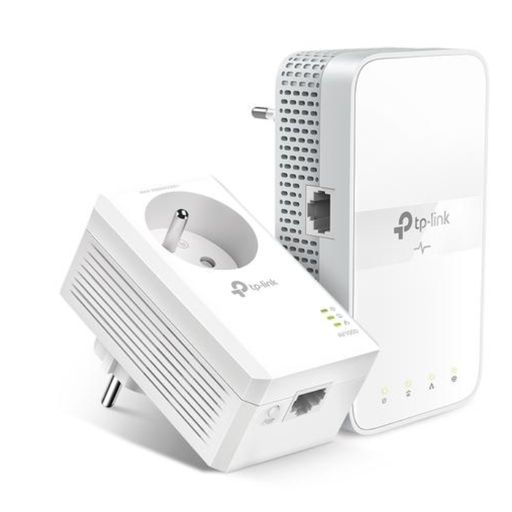 No image available
A powerline Wi-Fi kit to consider if running a new data cable between floors isn’t practical.
According to the product description, the kit uses your existing electrical wiring. Test the transfer in the sockets you plan to use, as results can vary between installations.
 No image available
A mesh kit to consider if you want to extend Wi-Fi to several areas and connect wired devices to a point.
The product description mentions tri-band Wi-Fi 6E and three gigabit ports per Deco unit. These port specifications don’t indicate transfer speeds between your workstations.
Radio equipment placed on the market in the Netherlands must meet the applicable European requirements. The Dutch Authority for Digital Infrastructure states that the CE marking must appear on the equipment. Check the marking on the specific device; a model name or product listing doesn’t confirm this.
Choose a spot in between where the connection to the router is still usable, rather than placing it only where there’s no coverage. Then check the connection at your workstation; walls and ceilings can affect the results.
On the floors where you’ll be working, try transferring a file using the authorised devices and check their network access. The National Cyber Security Centre recommends, among other things, changing the default password and updating the software; access to an unsecured network can also expose shared files.
When you buy as a consumer, the seller remains responsible if the product doesn’t perform as you could reasonably expect with normal use. According to ACM ConsuWijzer, the seller must then resolve the issue, for example through repair, replacement or a refund. This answer applies to consumer purchases; if you’re buying for business, don’t assume the same consumer rights apply.