
Family with weak Wi-Fi on several floors
You want to watch or share family videos in different rooms. So, consider coverage where you use the connection, as well as the link between floors.


First, decide how the connection between floors will work. A repeater suits one weak spot where it can still get a good signal, while multiple Wi-Fi points can help if you need coverage in more places. With a network cable, you can compare wired access points or Ethernet backhaul; without one, powerline may be an alternative, although the connection depends on your electrical installation. Also check compatibility with your router, how many points you need and the details of the exact model.
You want to watch or share family videos in different rooms. So, consider coverage where you use the connection, as well as the link between floors.
You can use a network cable to reach another floor and want to compare wired connections between Wi-Fi points with wireless extension.
Running a network cable isn’t a practical option. Your choice then comes down to where to place wireless points or using a Wi-Fi connection over your mains wiring.
Best for: one weak spot where the repeater itself can still get a good connection to the router.
Bear in mind: placement and the wireless connection to the router remain key; mesh features may require a compatible router.
Best for: coverage across more than one floor or in several rooms, if you can position multiple points.
Bear in mind: more points mean extra placement and power requirements; wireless connections between points can be affected by distance and obstacles.
Best for: a home where you can run a network cable to another floor.
Bear in mind: you’ll need a cable route and equipment that supports access point mode or Ethernet backhaul.
Best for: situations where running a network cable isn’t practical and a wireless connection between floors is difficult.
Bear in mind: performance depends partly on your electrical installation and the conditions at the sockets.
| What to consider | What to look for when buying | Who should pay particular attention? |
|---|---|---|
| Coverage on each floor | Map out the rooms with weak Wi-Fi and work out how many points and intermediate locations you may need. | If I want to watch family videos on more than one floor, I’ll focus on coverage in the right places; around 27% of consumers prioritise coverage across multiple floors. |
| Connection for videos | Compare a wireless connection with Ethernet backhaul, access point mode or powerline; assess the connection where you share videos. | If I want to share videos between floors, I’ll need to know which type of connection will work there; around 27% of consumers prioritise a stable connection for videos. |
| Router compatibility | Check the exact router model and whether the feature you want is standard repeater operation or a compatible mesh feature. | If I want to keep my existing router, I’ll check that the chosen extension is compatible with that model; around 20% of consumers prioritise compatibility with their own router. |
| Cable route and placement | Check where Wi-Fi points can go and whether a network cable or suitable sockets are available. | If running a cable isn’t practical for me, I’ll look for a workable way to connect the points; around 13% of consumers prioritise easy installation. |
| Security and running costs | Check the information on security, updates, energy use and warranty for the model you’re considering. | If I’m adding network equipment at home, I’ll also want to know how to keep it updated and what it costs to run; around 13% of consumers prioritise security and running costs. |
A wireless point needs a usable connection to another point. So, it can’t simply improve the connection if you place it somewhere with barely any reception.
First, find an intermediate spot with a good enough signal. If there isn’t one, compare a cable route or powerline instead.
You may still need an extra Wi-Fi point or a different type of connection.
An advertised wireless or powerline speed doesn’t tell you what throughput you’ll get on another floor. With powerline, your electrical environment also plays a part.
Compare the connection options and assess how well they work where you share videos, rather than relying only on the figure on the box.
Standard repeater operation isn’t automatically the same as shared mesh features. The TP-Link OneMesh and FRITZ! Mesh features mentioned here have specific compatibility requirements.
Before buying, check the exact router model and look separately at repeater operation and the mesh features you want to use.
You may need suitable additional equipment for the mesh features you want.
Your electrical installation and interference can affect the connection. Kits can also vary in the number of adapters included.
Check how many adapters you need and assess the connection in your own home. Where possible, use suitable wall sockets.
You may need extra adapters for a setup with multiple points.
TP-Link offers both standalone Wi-Fi extenders and mesh systems. The right choice depends on the setup you need and the router you already have.
The FRITZ!Repeater 1200 AX is worth considering if you already use a FRITZ!Box.
The devolo Magic 2 WiFi 6 next combines Wi-Fi with a connection over your mains wiring, offering another option for floors that are difficult to reach wirelessly.
The RP-AX58 is a standalone Wi-Fi 6 repeater to compare if you want to extend an existing router’s coverage.
These products include mesh systems with multiple Wi-Fi points and a powerline Wi-Fi kit. Before buying, check that the connections and exact model suit your setup. For wireless equipment, the relevant requirements and safety information for that model may also be important.
 No image available
A mesh system with two points to consider if you want to extend Wi-Fi to several areas.
Check that the points included and the connection options suit the layout of your home.
 No image available
A mesh system with three points to compare if you need coverage across multiple floors or in several rooms.
The product name specifies dual-band at 2.4 GHz and 5 GHz, and Wi-Fi 6 (802.11ax). Check that the wired connection option suits your network setup.
 No image available
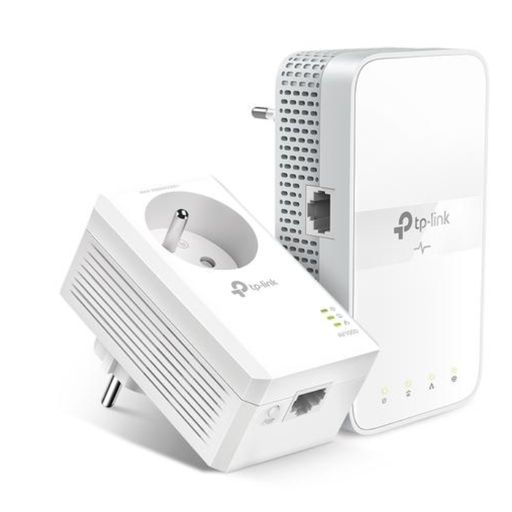
A powerline Wi-Fi kit with two units to consider if you want to avoid running a new network cable.
The stated 1200 Mbit/s doesn’t guarantee the actual throughput; your electrical installation affects the powerline connection.
 No image available
A mesh system with two points to consider if you want to connect several areas and are looking at a wired installation option.
The product name specifies PoE and Wi-Fi 6 (802.11ax). Check that your equipment and cabling are suitable for the setup you have in mind.
 No image available
A mesh system with three points to compare if you want to connect several rooms or floors.
The product name specifies PoE and Wi-Fi 6 (802.11ax). Check that your equipment and cabling are suitable for the setup you have in mind.
The Consumentenbond suggests starting with two points for two floors and three for three floors. Then consider the layout and reception in your own home; this number doesn’t guarantee coverage in every room.
Don’t wait until you reach a room where the router is barely detectable before placing your repeater. The Consumentenbond recommends keeping obstacles between Wi-Fi points to a minimum. If possible, use the signal indicator or installation app to find a suitable spot too.
According to the Rijksinspectie Digitale Infrastructuur, a router also handles wireless communication between devices on your home network. So, first check the connection between the devices and Wi-Fi points you use; a higher advertised Wi-Fi speed doesn’t prove that the connection will be faster at home.
Use a strong Wi-Fi password, keep your router and Wi-Fi devices updated, and check which encryption options are available. These are security measures, not a guarantee that a particular device is secure.
Radio equipment placed on the market in the Netherlands must meet the relevant European requirements and carry the correct CE marking, according to the Rijksinspectie Digitale Infrastructuur. Since 1 August 2025, stricter digital security requirements have also applied to wireless devices covered by those rules. Check the information for the exact model; a product listing alone doesn’t show that the model meets the requirements.