
Student behind a thick wall
Attends lessons from a fixed spot where the router signal is weak. Getting a connection to your study area matters more than a high advertised Wi-Fi speed.


A wireless repeater is an option if there’s still a usable router signal somewhere between the router and the room where you study. Placing it behind the thick wall itself won’t help if it can’t receive a strong enough signal there. If you can run an Ethernet cable to your study area, an access point avoids the wireless connection through the wall. If you can’t run a cable, powerline is an alternative to try in your home. First, check that your internet connection is working properly at the router.
Attends lessons from a fixed spot where the router signal is weak. Getting a connection to your study area matters more than a high advertised Wi-Fi speed.
Can’t run an Ethernet cable to the study room and wants to know whether a repeater will get enough signal in a midway spot, or whether powerline will work at home. Devolo describes powerline as transferring data over the mains electricity network.
Also wants to get Wi-Fi to other rooms, so needs to think about where to place multiple access points, how they connect to each other and whether they’re compatible with the router.
| Buying concern | What to look for when buying | For which consumers |
|---|---|---|
| Connection in your study area | First, check the internet connection at the router. If you’re extending the network wirelessly, choose a midway spot where the repeater can still receive a usable signal from the router. | If I take lessons from a fixed spot behind a thick wall, my main priority is a usable connection there. Around 36% of consumers with this buying concern prioritise a reliable connection for lessons. |
| No new Ethernet cable | Test the signal in a possible midway spot. If it’s not strong enough, compare it with a powerline kit that provides Wi-Fi, and test the kit in your own home. | If I can’t run a cable to the study room, I want to know whether a repeater or powerline can solve the problem. Around 29% of consumers with this buying concern prioritise extending their network without a new Ethernet cable. |
| Several rooms and devices | Decide which rooms need coverage, and check that the router and your chosen access points support the mesh features you need and any wired connections you plan to use. | If I want to use other rooms as well as my study area, the setup needs to cover more than one spot. Around 21% of consumers with this buying concern prioritise coverage across several rooms. |
| Overall cost and effort | First, work out the connection route and how many access points you’ll need. Also factor in installation work and energy use. | If I’m looking for a suitable solution without unnecessary extra equipment or installation work, I want to consider the whole setup. Around 14% of consumers with this buying concern prioritise manageable purchase and running costs. |
A wireless repeater needs to receive the signal from the router itself. A stronger signal from the repeater won’t help if its connection back to the router is weak.
Check the signal in the intended midway spot before choosing a wireless extender.
Mesh features may depend on compatible equipment. Standard access point mode isn’t the same as mesh.
Check the exact router model, the mesh features it supports and how it connects.
Data transfer over the mains electricity network also depends on your home’s wiring and sources of interference.
Test powerline using the sockets you plan to use, and assess the connection during a video call.
The information below relates to the product ranges mentioned and doesn’t guarantee coverage in your home.
TP-Link describes the RE605X as a Wi-Fi repeater with a signal indicator, gigabit Ethernet port and access point mode.
ASUS describes the RP-AX58 as suitable for wireless extension, use as an access point via Ethernet, and AiMesh with a compatible router.
According to its own product information, devolo offers both a WiFi 6 Repeater 3000 and powerline solutions.
The FRITZ!Repeater 1200 AX is an option for extending an existing FRITZ!Box via LAN.
This selection includes wired mesh and access point setups, powerline Wi-Fi and wireless extension. Choose based on the connection route you can set up at home, and check the product specifications for your needs.
 No image available
A mesh system with two devices to consider if you can connect them via Ethernet. Check whether you can run cables to the locations you want.
2-pack.
 No image available
An access point to consider if you can bring a wired connection to the location where you want Wi-Fi. Check in advance which connection and installation this setup requires.
 No image available
An option for extending a mesh network with a wired connection between access points. Check that the setup is compatible with your existing ASUS mesh equipment.
Dual-band, 2.4 GHz / 5 GHz; Wi-Fi 7 (802.11be); white; 2 internal.
 No image available
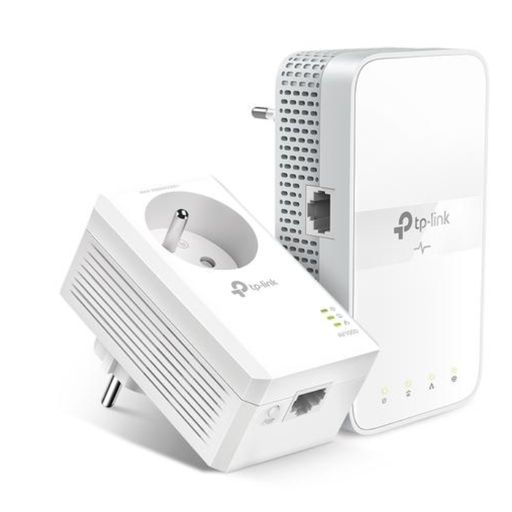
A powerline Wi-Fi kit to try if running a long Ethernet cable isn’t practical. Performance over your electrical wiring can vary from one home to another.
1200 Mbit/s; Ethernet LAN; Wi-Fi; 2-piece set.
 No image available
Consider this option when comparing wireless extension or access point use. Choose repeater mode only if there’s a router signal in the midway spot.
N up to 300 Mbps; 2 antennas; WPS; Passive PoE.
First, check the internet connection at the router using a laptop connected with an Ethernet cable. If the Wi-Fi is weak mainly in your study area, find a midway spot where the repeater can still receive a signal from the router. If that isn’t possible, a wired access point is likely to be a better option.
Only if the repeater can get a strong enough signal from the router there. Otherwise, try a spot closer to the router or, if possible, use a cable and access point mode.
No. Check that the mesh feature is compatible with both devices. TP-Link’s OneMesh requires a compatible OneMesh router, while ASUS AiMesh requires a compatible AiMesh router. Standard access point use is different from mesh.
Radio equipment sold in the Netherlands must meet the applicable European requirements and carry the required CE marking, according to the Dutch Authority for Digital Infrastructure. Check the marking on the device you receive; a claim on a product page doesn’t prove that the specific version meets the requirements.