
Taking a lesson behind a thick wall
You mainly take your lesson in one room and want to know whether a wireless repeater can get a usable connection to the router from a suitable spot.


First, decide how the connection will reach the room where you take your lesson. A wireless repeater is only a sensible option if it can be placed somewhere with a good Wi-Fi signal. An Ethernet cable to an access point or mesh point avoids a weak wireless connection between rooms. If running a cable isn’t practical and there’s nowhere suitable for a repeater, you could try powerline with Wi-Fi, but performance depends on your home’s sockets and sources of electrical interference.
You mainly take your lesson in one room and want to know whether a wireless repeater can get a usable connection to the router from a suitable spot.
You can run Ethernet to the room where you take your lesson, or somewhere nearby, and want to avoid a wireless connection between rooms.
You can’t run a cable and can’t find a spot between the router and the room where you take your lesson with a good Wi-Fi signal, so you’re considering a connection over your home’s electrical wiring.
First, work out how you can get a usable connection: through your existing Wi-Fi, an Ethernet cable or your home’s electrical wiring. When checking a specific product, also make sure it has the required CE marking; the Rijksinspectie Digitale Infrastructuur says this must be displayed on the equipment.
| What matters | What to look for when buying | Who is this important to? |
|---|---|---|
| Usable Wi-Fi signal beyond the thick wall | Check the Wi-Fi signal in a potential spot for the repeater, then test the connection in the room where you take your lesson. | If I take my lesson in one room, I want to know whether a repeater can still maintain a good connection to the router from there. Around 40% of consumers in this situation are most concerned about coverage. |
| A lesson that keeps playing | Try the lesson on your usual device and in your usual spot; a quoted Wi-Fi speed isn’t a measurement of performance in your home. | If my lesson video keeps buffering, I want to assess the connection where I usually take my lesson. Around 30% of consumers in this situation prioritise uninterrupted playback. |
| A solution you can install at home | Map out the cable route and suitable sockets; for mesh, check that your router and Wi-Fi points are compatible. | If I can’t run a cable or find a suitable spot for a repeater, the layout of my home will determine which option is practical. Around 20% of consumers in this situation prioritise ease of installation. |
| Total cost and support | Compare what you need for the complete installation and check the support available for the specific model. | If I’m choosing between a standalone unit and a complete kit, I want to consider the equipment I need and the support available together. Around 10% of consumers in this situation are most concerned about total cost and support. |
The repeater also needs to receive a usable signal from the router. If you place it somewhere with poor reception, it can’t simply fix that connection.
First, choose a spot where the existing Wi-Fi signal is still good, then test the lesson stream in the room where you need it. If there’s no suitable spot, consider Ethernet or try powerline using the sockets you plan to use.
A quoted wireless speed doesn’t tell you how the connection will perform in your home, behind your walls, while streaming. The Consumentenbond describes tests carried out in different locations and at different distances.
Assess the connection where you take your lesson, and consider the connection between the router and the additional Wi-Fi point too.
OneMesh, AiMesh and FRITZ! Mesh have model-specific requirements. So a repeater’s mesh feature won’t automatically work with any router.
Before you buy, check that your router and the Wi-Fi point you’ve chosen support the mesh features you want to use together.
A powerline solution uses adapters by the router and where you want Wi-Fi. Performance can vary between sockets, and electrical devices may affect the connection.
Compare the complete kit and test the adapters in the sockets you actually plan to use.
Offers both standalone repeaters and Deco mesh points, for situations where you’re choosing between one wireless Wi-Fi point and several.
Offers Magic powerline products with Wi-Fi, using adapters to carry the connection through your home’s electrical wiring to another room.
According to ASUS, the RP-AX58 can be used as a repeater, access point or AiMesh point with a compatible ASUS router.
The FRITZ!Repeater 1200 AX is worth comparing if you’re looking for a compact repeater or already use FRITZ! equipment.
These product options include wired access points and mesh systems, as well as powerline kits with Wi-Fi that use your home’s electrical wiring. Before buying, check that the connections, power supply and installation suit your home and router.
 No image available
A wired option if you can install an access point on a wall or ceiling.
The description lists a 2.5-GbE uplink, PoE+ (802.3at) and management via the UniFi Network platform. A compatible PoE+ power supply is required.
 No image available
A mesh option to consider if you want to extend your Wi-Fi coverage with multiple points and can use wired backhaul.
The product description lists Wi-Fi 7, MLO and Ethernet ports, with the option of wired backhaul. Check that this version and its connections suit your existing network.
 No image available
An option if you want to carry the connection between rooms over your existing electrical wiring.
The product description lists both wired and wireless network connections. Test the connection using the sockets you plan to use in the room where you take your lesson.
 No image available
A multi-point mesh kit to consider if you want Wi-Fi coverage in more than one room.
The product information lists dual-band Wi-Fi 6 (802.11ax) and three gigabit Ethernet ports per unit. Check that the ports and wired connection options suit your installation.
 No image available
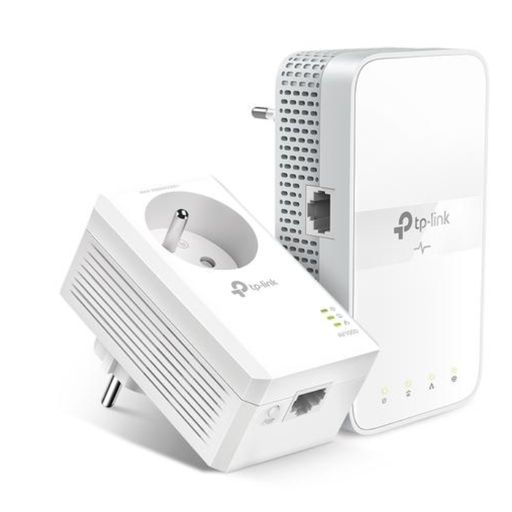
A powerline Wi-Fi kit to compare if running a network cable isn’t practical.
The product name lists a two-piece set and a maximum data transfer rate of 1200 Mbit/s. This quoted figure isn’t a measurement of the connection in your home; the kit uses your existing electrical wiring.
Place the repeater somewhere the existing Wi-Fi signal is still good, rather than automatically putting it in the room where you take your lesson. Then test whether the lesson plays smoothly in the spot you want to use. A wired Wi-Fi point, on the other hand, can be connected where the Wi-Fi signal is weak.
No, the connection can vary from socket to socket. devolo says some sockets can deliver low data rates and electrical devices may cause interference. Test the connection at the points you plan to use; devolo recommends plugging the adapter directly into a wall socket.
If a product is faulty or doesn’t meet the terms of the agreement, the seller is the point of contact for a solution, according to the Rijksoverheid. For online purchases from a business, you generally have a 14-day cooling-off period, subject to applicable exceptions. Disappointing Wi-Fi caused by your home’s layout or installation doesn’t in itself prove that the product is faulty; check the terms of your specific purchase too.
According to the Rijksinspectie Digitale Infrastructuur, you don’t need a licence for home Wi-Fi if you use the frequencies allocated for it and comply with the conditions of use. Check that the specific device has the required CE marking and follow the installation instructions.