
Uploading photos on another floor
Your upload works better near the router than upstairs or downstairs, and you need coverage in one particular spot. TP-Link’s placement advice and KPN’s guidance on testing are relevant to this kind of check.


First, test your upload speed using a cable at the router, then compare it with a test on the floor where you upload photos. KPN recommends a wired test for a reliable picture of your internet connection. If the Wi-Fi is particularly weak on that floor, a well-positioned repeater may be enough. If there are several weak spots or the wireless connection between Wi-Fi points is unreliable, a wired access point or mesh system with Ethernet backhaul is a better fit. Before buying, check compatibility with your router and make sure the specific model carries the required CE marking.
Your upload works better near the router than upstairs or downstairs, and you need coverage in one particular spot. TP-Link’s placement advice and KPN’s guidance on testing are relevant to this kind of check.
You need coverage across several floors and may be able to connect Wi-Fi points using an Ethernet cable. The Consumers’ Association describes placing one or more Wi-Fi points where you want to boost the signal.
You want to extend your network without assuming that a new repeater supports all your router’s mesh features. TP-Link, FRITZ! and ASUS describe features that depend on the combination of devices you use.
A good fit when: coverage is missing in just one area and the repeater can still receive a usable signal from the router there.
Trade-off: the wireless connection back to the router still depends on signal strength and placement. A repeater won’t fix a slow wired internet connection.
A good fit when: you can run an Ethernet cable to the floor and want to address one or more weak spots there.
Trade-off: you’ll need to run a cable and have a suitable port or operating mode. For EasyMesh Ethernet backhaul, both devices must support the feature, as TP-Link explains.
A good fit when: floors interfere with the wireless connection and running a new Ethernet cable isn’t practical.
Trade-off: the connection runs through your existing electrical wiring, so performance can vary between homes and sockets.
A good fit when: an upload speed test using an Ethernet cable at the router is also disappointing.
Trade-off: an extra Wi-Fi point may extend coverage, but it won’t fix a limitation in the wired internet connection itself.
| What to consider | What to look for | Who is this important to? |
|---|---|---|
| Coverage on the floor where you upload | Test where you upload and at a potential repeater location; check that it can still receive a usable signal from the router. | If I mainly upload photos upstairs, I want a usable connection there without placing the repeater in a Wi-Fi dead zone. Around 34% of consumers prioritise coverage on the floor where they upload. |
| Upload speed and connection between floors | Compare a wired upload speed test at the router with one where you upload; check whether the Wi-Fi points can be connected by cable. | If my upload is slow, I want to know whether the limitation is with my internet connection or the Wi-Fi link. Around 33% of consumers prioritise fixing the upload bottleneck. |
| Router compatibility | Make a note of the brand, model and hardware version; check that both devices support the mesh features and wired backhaul you want. | If I want to keep my existing router network, I want to know in advance which features will actually work together. Around 20% of consumers prioritise compatibility with their current router. |
| Use and ongoing support | Consider how many points you need, any cabling, power consumption, updates and warranty terms. | If I’m considering extra equipment for several areas, I also want to factor in installation and ongoing use. Around 13% of consumers prioritise their overall needs for use and aftercare. |
Upload speed also depends on your internet connection and the links between your router, Wi-Fi points and the device you’re uploading from.
First, compare your wired upload speed at the router with a test where you upload. KPN explains how to test upload and Wi-Fi speeds separately.
The repeater needs a usable connection to the router to extend its signal.
Look for an intermediate spot where the router’s signal is still usable. TP-Link recommends placing the repeater between the router and the weak spot. If that isn’t possible, consider a wired connection.
An Ethernet port or access point mode doesn’t, by itself, prove that a device supports the mesh feature or Ethernet backhaul you want to use with your router.
Check the specific router, repeater and firmware combination. TP-Link says both devices need to support EasyMesh Ethernet backhaul.
For the Deco X50-PoE, TP-Link lists support for IEEE 802.3at and IEEE 802.3bt, but not IEEE 802.3af.
Before installation, check that the power source meets the required standard. TP-Link says you can also use the supplied DC adapter with the Deco X50-PoE.
Plan for a suitable PoE power source or use the specified adapter as an alternative.
The RE705X is a standalone repeater with access point mode. Deco X50-PoE is a separate mesh range with multiple points and wired options.
The FRITZ!Repeater 1200 AX is a compact Wi-Fi 6 extension that’s most relevant if you already use a compatible FRITZ! home network.
The RP-AX58 is a standalone repeater with access point mode. AiMesh is most relevant when used with a compatible ASUS router.
The WiFi 6 Repeater 5400 is designed for wireless placement. devolo also discusses solutions for coverage across multiple floors.
These product picks focus on wired mesh connections and Wi-Fi points that use your mains wiring. Before buying, check that the specific model carries the required CE marking. The Dutch Authority for Digital Infrastructure explains this requirement for radio equipment placed on the market in the Netherlands.
 No image available
A mesh option to consider if you can run an Ethernet cable between floors.
The product information lists dual-band (2,4 GHz / 5 GHz), Wi-Fi 7 (802.11be) and wired backhaul.
Check that the specific model carries the required CE marking.
 No image available
A two-unit mesh set to consider if you need coverage in several areas.
The product information lists Ethernet backhaul. Check that the devices you choose support this feature in your setup.
Check that the specific model carries the required CE marking.
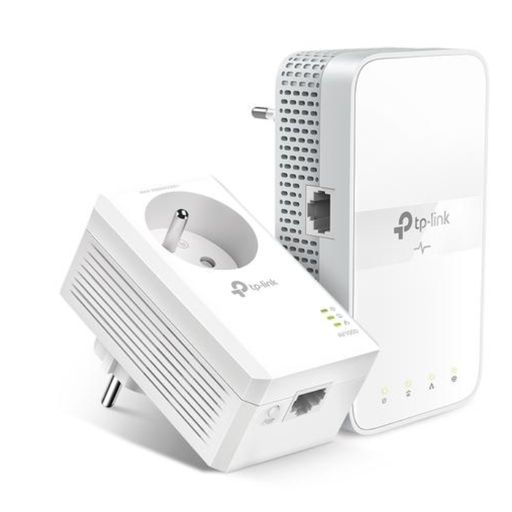 No image available
Worth considering if floors interfere with the wireless connection and you want to use your existing electrical wiring.
A connection through your mains wiring doesn’t guarantee a particular upload speed in every electrical installation.
Check that the specific model carries the required CE marking.
 No image available
A three-unit mesh set to consider if you want to extend coverage to several areas and wired placement is possible.
The product information lists dual-band (2,4 GHz / 5 GHz), Wi-Fi 6 (802.11ax), PoE and two Ethernet ports per unit.
TP-Link says this model supports IEEE 802.3at and 802.3bt, but not IEEE 802.3af; the manufacturer also lists a DC adapter as an alternative. Check that the specific model carries the required CE marking.
 No image available
A two-unit mesh set to consider if you need coverage in different areas.
The product information lists Ethernet backhaul. Check that the devices support it in your planned setup.
Check that the specific model carries the required CE marking.
Not if the wired upload speed at the router is already poor. Compare it with a test where you use your device; KPN explains how to measure upload speed over your internet connection and Wi-Fi. If the wired test is slow, check your internet connection first.
Place it between the router and the weak spot, somewhere it can still receive a usable signal from the router. TP-Link recommends this placement for its extenders. If there’s no usable connection there, consider an access point connected by Ethernet cable.
No. Standard Wi-Fi compatibility doesn’t guarantee that all mesh features will work together. Check the specific mesh feature supported by your router and repeater. TP-Link says both devices need to support EasyMesh Ethernet backhaul.
It can be an option if you don’t want to or can’t run an Ethernet cable and the wireless connection between floors is being affected. Performance depends on your electrical installation, so test the connection using the sockets you plan to use and don’t assume you’ll get a particular upload speed.
The Dutch Authority for Digital Infrastructure says radio equipment placed on the market in the Netherlands must carry the correct CE marking. Check that the specific model you want to buy has it.