
Video caller on a floor with poor coverage
You have meetings in a fixed spot where the router downstairs doesn’t provide enough coverage. Whether a repeater will help depends partly on the connection between floors.


A repeater may be enough for a single fixed workspace if it can still get a usable connection to the router from a midway point. If you need coverage in several workspaces, a mesh system is a more suitable option. With thick floors or a weak wireless connection between floors, it’s worth considering a wired access point. Also check compatibility with your router and the connection options available on the exact model.
You have meetings in a fixed spot where the router downstairs doesn’t provide enough coverage. Whether a repeater will help depends partly on the connection between floors.
You work in different places and need coverage on more than one floor. Look at systems with multiple Wi-Fi points and how they connect to one another.
If a wireless point struggles to reach the other floor, or you already have Ethernet cabling, a wired access point may be worth exploring. Compare other ways of connecting the points, too.
| What to consider | What to look for | Most relevant for |
|---|---|---|
| Coverage in your meeting spot | Check whether there’s a midway spot where the repeater can still get a good signal from the previous Wi-Fi point. Check how many points you need. | If you have meetings in one fixed spot on another floor, you’ll need usable coverage there; around 36% of consumers prioritise coverage in their meeting spot. |
| Connection between floors | Compare wireless backhaul with Ethernet backhaul if you have a network cable. Powerline may offer an alternative, but check how well it works in your home. | If your main concern is preventing the connection between the router and Wi-Fi point from disrupting your meeting, prioritise that link; around 29% of consumers do so. |
| Coverage in multiple workspaces | Compare an expandable mesh kit with individual repeaters. Check that your existing router and the new points will actually form a mesh network together. | If you have meetings on different floors, you’ll need coverage in several places; around 21% of consumers put this at the top of their wish list. |
| The right way to expand your network | Check compatibility with your router, installation options and how many devices you need. A higher claimed Wi-Fi speed doesn’t measure the performance of your video call. | If you want to extend your existing network without adding unnecessary devices, focus on finding a suitable solution; around 14% of consumers prioritise a straightforward way to expand. |
A wireless repeater also needs a usable connection to the previous Wi-Fi point. Placing it next to your laptop won’t automatically fix a weak connection between floors.
First, find a midway spot with a signal and minimise obstacles. If you have thick floors, compare wired connections, too.
You may need an additional point or a different way to connect.
Mesh features may depend on your router. FRITZ! describes Mesh integration as available under certain conditions with a compatible FRITZ!Box; ASUS requires a compatible ASUS router for AiMesh.
Check which mesh combinations are supported by your router. Otherwise, deliberately choose the standard repeater or access point function.
Some mesh features may require you to add compatible equipment.
According to the Dutch government, there is no fixed two-year statutory warranty period in the Netherlands. Your statutory rights to a product that meets reasonable expectations are separate from any manufacturer’s warranty.
Check the terms of any additional warranty. If the product is faulty, contact the retailer.
Deco mesh points may be worth considering if you need coverage across multiple floors. According to TP-Link, the Deco X50-PoE offers PoE and Ethernet ports for a wired setup.
The FRITZ!Repeater 1200 AX is a standalone Wi-Fi 6 repeater with a gigabit LAN port, designed as a possible way to extend an existing FRITZ!Box network.
The RP-AX58 is a standalone repeater for addressing a local coverage problem. ASUS describes AiMesh use with a compatible ASUS router.
devolo offers the WiFi 6 Repeater 5400 and Magic powerline products. These give you options to compare a wireless repeater with a connection over your home’s electrical wiring.
This selection focuses on mesh expansion for multiple workspaces, wired connections between Wi-Fi points and powerline as an alternative way to connect them.
 No image available
This mesh kit is designed to extend coverage to workspaces on multiple floors.
Configuration: 2-pack.
 No image available
This kit is designed to provide mesh coverage across multiple workspaces; the product name mentions optional Ethernet backhaul.
3-pack; dual-band (2.4 GHz/5 GHz); Wi-Fi 6 (802.11ax).
 No image available
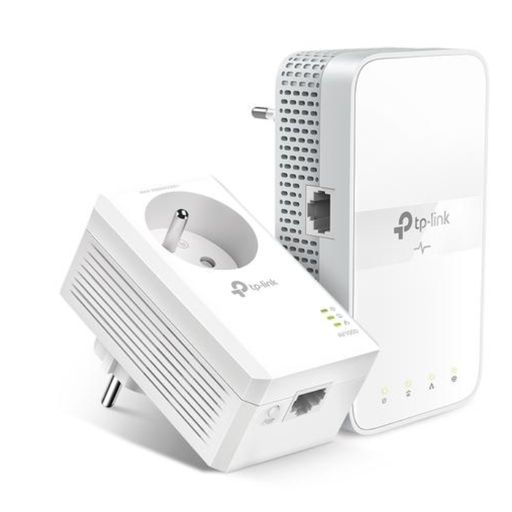
This powerline Wi-Fi extender kit is an option to consider if the wireless connection between floors isn’t strong enough.
The product name mentions 1200 Mbit/s, Ethernet LAN and a set of two; this isn’t a measured speed on your floor.
 No image available
This mesh kit may suit an expanded setup with multiple points and a wired installation.
2-pack; dual-band (2.4 GHz/5 GHz); Wi-Fi 6 (802.11ax).
 No image available
This mesh kit is designed to extend coverage to multiple workspaces; check how many points your home needs.
3-pack; tri-band (2.4 GHz/5 GHz/6 GHz); Wi-Fi 6E (802.11ax).
Don’t automatically place it next to your laptop: the repeater also needs to get a good signal from the previous Wi-Fi point. The Consumers’ Association recommends keeping obstacles between the points to a minimum and suggests using an indicator or app to help with placement. Test the connection in the actual spot where you’ll have your meeting.
No. A higher claimed AX speed doesn’t prove that your video call will be more stable. The Consumers’ Association points out that the Wi-Fi version alone says nothing about a device’s performance. Zoom’s bandwidth recommendations depend on the meeting setup and video resolution, so test the connection on the floor where you’ll be having your meeting.
If you buy from a business online, you generally have a 14-day cooling-off period, according to the Dutch government. You also have statutory rights to a product that meets reasonable expectations in the Netherlands; there is no fixed two-year statutory period. If the product is faulty, contact the retailer.
According to the Dutch Authority for Digital Infrastructure, Wi-Fi can be used without a licence as long as the applicable conditions are met. Product requirements still apply: equipment placed on the market in the Netherlands must carry the correct CE marking.