
If you want to compare wholemeal options and fibre
You’re looking for a base for party snacks that is clearly labelled ‘wholemeal’. Then compare the fibre per 100 g: this can vary between products, even if they’re both called wholemeal.


For small cold bites, choose a thin piece of wholemeal toast that you can top or dip. If you want to make a larger, crunchy snack, consider wholemeal crackers; for hot toasted sandwiches or sandwiches, soft wholemeal sandwich bread is a better choice. Then compare the nutritional information per 100 g and check the ingredients and allergens on the packaging you choose.
You’re looking for a base for party snacks that is clearly labelled ‘wholemeal’. Then compare the fibre per 100 g: this can vary between products, even if they’re both called wholemeal.
For small bites and dips, you might want a thin piece of toast; for a larger, crunchy snack, a cracker. A hot sandwich calls for soft sandwich bread. These shapes aren’t necessarily interchangeable.
If you have an allergy or are watching your salt intake, ‘wholemeal’ alone doesn’t tell you enough. For Van der Meulen Melba Wholemeal Toast, Jumbo lists wheat, sesame and soya, among other ingredients, and 1.9 g of salt per 100 g. Check the current packaging of the product you choose.
Best for: small cold toppings and dips that call for a thin, crunchy piece of toast.
Consider: a thin piece of toast isn’t necessarily a practical base for lots of topping or wet toppings.
Best for: a larger, crunchy snack if you’d rather serve a sturdy cracker than a thin piece of toast.
Consider: cracker size and ingredients vary, so check the packaging of the option you choose.
Best for: toasted sandwiches and sandwiches. Albert Heijn recommends these uses for AH Extra lang lekker wholemeal sandwich bread.
Consider: soft bread makes for a different bite from a small, crunchy piece of toast.
| What to consider | What to check when buying | Who it matters to |
|---|---|---|
| Wholemeal and fibre | Look for the ‘wholemeal’ label and compare the fibre per 100 g in the nutritional information. | I want to choose a wholemeal base and see how much fibre the different products contain. This combination is the top priority for around 42% of consumers. |
| Shape and toppings | Match the size and texture to small toppings, a larger crunchy snack or a hot sandwich. | When I’m making snacks for an Asian-themed evening, the base needs to suit what I want to serve on it. This is the top priority for around 33% of consumers. |
| Ingredients and salt | Check the allergens and compare the salt per 100 g; also check whether iodised salt is listed as an ingredient if that matters to your choice. | I need to know what ingredients are in the product first, especially if allergens or salt are a concern. This is the most important consideration for around 25% of consumers. |
The colour or the label ‘multigrain’ doesn’t mean the same as ‘wholemeal’. According to the Voedingscentrum, toast or crackers can only be called wholemeal if they’re made entirely from wholemeal flour.
Check the exact product name and read the ingredients before comparing the fibre content of different products.
A thin piece of melba toast for small bites and soft bread for a hot toasted sandwich give you a different shape and texture. A cracker isn’t automatically the same as melba toast, either.
Decide whether you want to serve cold party snacks, larger crunchy bites or hot sandwiches, then choose your base.
The wholemeal label doesn’t tell you which allergens a product contains or how much salt it has. For example, Jumbo lists 1.9 g of salt per 100 g and several allergens for Van der Meulen Melba Wholemeal Toast.
Compare salt values on the same basis and check the allergens on the packaging, even if you’ve bought the product before.
Melba Wholemeal Toast is a thin piece of toast for small toppings or dips; Jumbo lists it in a 120 g pack.
Wholemeal Toast is another small toast option; Jumbo lists it in a 90 g pack.
AH Extra lang lekker wholemeal sandwich bread is designed for toasted sandwiches and sandwiches, not small crunchy pieces of toast.
The sturdy wholemeal crackers from ALDI are a crunchy alternative to small pieces of toast.
Lidl lists Tastino Luxe wholemeal crackers in a 210 g pack as an in-store product.
Bolletje Wholemeal Knäckebröd is a cracker-style base, not melba toast.
These two products are crunchy alternatives to small pieces of toast. Choose the shape that suits your snacks and check the packaging for the exact wholemeal label, nutritional information and allergens.
 Image unavailable
A crunchy option if you’d rather use knäckebröd than small pieces of melba toast for your snacks. Check the packaging for the exact wholemeal label and allergens.
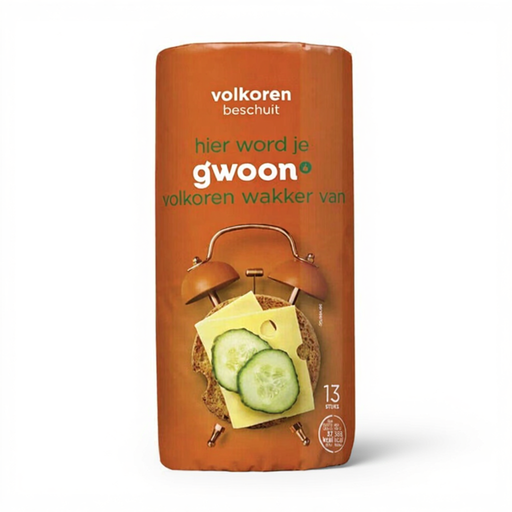 Image unavailable
A crunchy base to consider for topped snacks. Check the wholemeal label and allergens on the packaging; compare fibre and salt only once you know whether the values are given per 100 g or per serving.
Look for the explicit ‘wholemeal’ label on the packaging. According to the Voedingscentrum, toast and crackers can only carry this label if they’re made entirely from wholemeal flour; ‘multigrain’ or ‘made with wholemeal flour’ doesn’t mean the same thing.
No, check the allergens for the specific product. For Van der Meulen Melba Wholemeal Toast, Jumbo lists wheat, sesame and soya, among other ingredients; ingredients and allergens may differ for another product or if the packaging has changed.
Don’t assume it does. Albert Heijn lists iodised salt as an ingredient in AH Extra lang lekker wholemeal sandwich bread; for another toast product, check the ingredients list on the packaging you choose.
Compare the amount of salt per 100 g and consider what else you’re serving. Jumbo lists 1.9 g of salt per 100 g for Van der Meulen Melba Wholemeal Toast and 1.64 g per 100 g for Jos Poell Wholemeal Toast; check the current nutritional information before comparing products.