
Fussy coffee drinkers
Looking for something crisp to enjoy with their coffee, with a choice of plain toast, a product made with white and wholemeal flour, or fully wholemeal toast.


Choose wholemeal toast if having an entirely wholemeal grain ingredient is your priority. If you’re looking for a middle ground for fussy eaters, look for a product whose ingredients include both wheat flour and wholemeal flour, without assuming it’s the same as fully wholemeal toast. Compare the fibre, salt and allergens for each variety; the label ‘plain’ tells you nothing about how much wholemeal flour it contains.
Looking for something crisp to enjoy with their coffee, with a choice of plain toast, a product made with white and wholemeal flour, or fully wholemeal toast.
Want to know whether the grain ingredient is entirely wholemeal, and also compare the fibre content of the variety they choose.
Check the allergens, salt and serving size for the exact flavour and pack they’re buying.
First decide whether you’re looking for an accessible flavour or an entirely wholemeal grain ingredient. Then check the nutritional information and allergens for the exact variety.
| What to consider | What to check | Who it matters to |
|---|---|---|
| Flavour and grain blend | Check whether the ingredients include both wheat flour and wholemeal flour, and compare the stated amounts. | If fully wholemeal seems like too big a step, I’m looking for a crisp middle-ground option to enjoy with my coffee. Around 42% of consumers say this is their top priority. |
| Wholemeal and fibre | Check the wholemeal label and compare the fibre per 100 g and per serving. | I want the grain ingredient in my toast to be entirely wholemeal, even if I prefer the flavour of a plain variety. This preference comes first for around 33% of consumers. |
| Label and serving | Check the allergens, salt per 100 g and amount per piece or serving on the current packaging. | If I’m having several pieces of toast with a topping, I want to know what I’m actually eating and whether the ingredients are suitable for me. This matters most to around 25% of consumers. |
A product made with both white and wholemeal flour is not entirely wholemeal. According to the Netherlands Food and Consumer Product Safety Authority, a grain product can only be called wholemeal if its grain ingredient is made entirely from wholemeal flour.
For fully wholemeal toast, look for that description on the packaging. If you’re looking for a blend, check which grain ingredients and quantities are listed.
If you’re eating several pieces of toast, the total amount of salt matters too. The Netherlands Nutrition Centre gives 0.11 g of salt as a general reference for one 6 g piece of wholemeal toast; the amount in the brand you choose may differ.
Compare the salt per 100 g and take the serving size on the packaging into account if you’re eating several pieces.
Ingredients vary by product and flavour. A name such as ‘plain’ or ‘wholemeal’ doesn’t tell you which allergens are listed for the variety you’ve chosen.
Read the ingredients and allergen information on the current packaging, even if you’ve previously bought a different variety from the same brand.
A 2008 Dutch agreement on the use of iodised baker’s salt doesn’t tell you which type of salt is used in every toast variety currently available.
If the type of salt matters to you, check the packaging or ask the manufacturer.
Van der Meulen offers plain and wholemeal options in its Melba range for anyone looking for thin, crisp toast.
At Albert Heijn, you can compare product information for toast and crackers, including LU Mini Crackers made with wheat flour and wholemeal flour.
Jumbo lists plain and wholemeal Melba toast, Jos Poell Toast Naturel and crisp own-brand toast, among other products.
Bolletje is worth considering if you’re also thinking about crackers or crispbread to enjoy with your coffee, as well as Melba toast.
If you’re also considering a cracker for your coffee break, Liga Cracotte is a different type of product from classic Melba toast. Assess the ingredients and nutritional information for this variety separately.
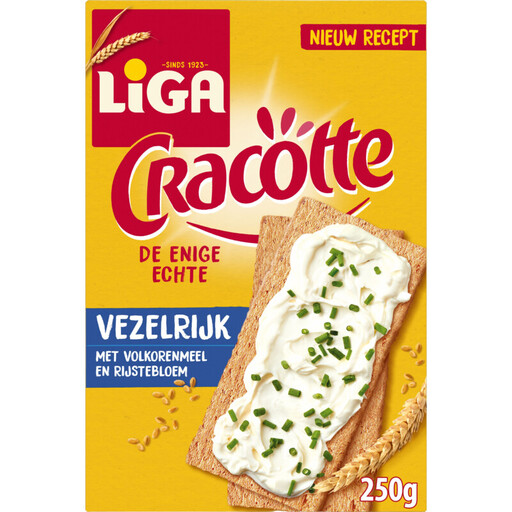 Image unavailable
A cracker for anyone considering something other than Melba toast with their coffee; the pack contains 250 g.
The ingredients list mentions wheat and whey powder from milk, but the allergen information contradicts this. So, if allergens are relevant to you, check the current packaging carefully.
Also check the fibre per 100 g and per serving on the packaging: the stated amount per serving doesn’t have a clearly defined basis.
Yes. According to the Netherlands Food and Consumer Product Safety Authority, ‘wholemeal’ means that the grain ingredient is made entirely from wholemeal flour. So you can’t consider a product made with both wheat flour and wholemeal flour to be fully wholemeal just because it contains the latter.
It could be a good choice if you’re looking for something in between and want to know that it contains wholemeal flour. It isn’t the same as fully wholemeal toast, so compare the ingredients and nutritional information of the varieties you’re considering.
Compare the salt per 100 g, then consider how many pieces you eat. The Netherlands Nutrition Centre gives 0.11 g of salt for one 6 g piece of wholemeal toast as a general reference, but for a specific product, use the figures and piece size shown on the packaging.
Don’t assume it does without checking the variety you’ve chosen. An official Dutch publication from 2008 describes an agreement that encouraged the use of iodised baker’s salt, but this doesn’t establish which type of salt is used in every toast variety currently available. Check the packaging or ask the manufacturer.
Follow the storage advice on your product’s packaging and reseal it after use. Albert Heijn’s product information for LU Mini Crackers says to store them in a dry place away from heat.