
Families keeping an eye on fibre
You’re looking for a rusk base that is clearly labelled wholemeal and want to compare the fibre content of different rusks.


When choosing rusks with chocolate sprinkles, first look for rusks explicitly labelled ‘wholemeal’, then compare the fibre per 100 g and the size of each rusk. Choose the sprinkles separately, based on taste, ingredients and how much you use. For a family occasion, this combination is better suited to a sweet breakfast, lunch or snack than a complete evening meal.
You’re looking for a rusk base that is clearly labelled wholemeal and want to compare the fibre content of different rusks.
You choose sprinkles for their taste, but also want to consider how much you use and the nutritional information on sugars and saturated fat.
You compare pack sizes and availability, while checking the current label on both the rusks and the sprinkles.
For a family occasion with rusks and chocolate sprinkles, choose the rusk base and sweet topping separately. Then decide which consideration matters most to your household.
| What to consider | What to check when buying | Who it matters most to |
|---|---|---|
| Wholemeal and fibre | Look for the label ‘wholemeal’ and compare the fibre per 100 g, as well as the size of each rusk. | When I choose rusks as a base, I want to know that they really are wholemeal and how much fibre the product contains. This is the top priority for around 36% of consumers. |
| Amount of chocolate sprinkles | Compare sugars and saturated fat per 100 g, and bear in mind how much you actually sprinkle on. | For a sweet family occasion, I want to decide how many sprinkles go on each rusk. The amount of topping is the first thing around 29% of consumers consider. |
| Ingredients and allergens | Check the ingredients and statements such as ‘contains’ and ‘may contain’ on both current packs. | If someone in the household needs to avoid an ingredient, I want to check both products before serving. Around 21% of consumers make this their top priority. |
| Family-sized supplies | Compare the number of rusks or the pack weight, and check that the variety you want is available. | When I’m shopping for several people, I want to know how large the pack is and whether I can get the same variety again. This practical consideration matters most to around 14% of consumers. |
The colour or visible seeds alone don’t tell you whether a rusk is wholemeal.
Look for the explicit label ‘wholemeal’ on the pack. According to the Netherlands Nutrition Centre, this label is used for a product made entirely from wholemeal flour.
Choosing wholemeal rusks doesn’t change the sugars or saturated fat in the sprinkles you use.
So choose the rusks and the amount of sprinkles separately, and use a topping portion that suits the occasion.
Ingredients can vary between products and recipes. The combination also consists of two separate products.
Before serving, check the current labels on both the rusks and the sprinkles, including any ‘may contain’ statements.
A variety you looked at before may not be available in the same way next time you shop.
Check the current variety and availability before comparing packs or nutritional values.
You can compare rusks or chocolate sprinkles from these brands. The features listed apply to the specific varieties, not necessarily to the whole brand.
Bolletje makes several wholemeal rusk varieties, including a standard option and a larger farmhouse-style variety.
De Ruijter offers dark chocolate sprinkles as a separate topping to enjoy with rusks.
Venz makes dark chocolate sprinkles for anyone comparing different flavours and varieties.
The own-brand range includes both wholemeal rusks and dark chocolate sprinkles, which you can assess as separate products.
Jumbo’s own-brand range is another option if you want to compare the ingredients and nutritional information for a specific wholemeal rusk.
Lidl lists wholemeal rusks in a 140 g pack.
ALDI lists Goud Gebakken Volkoren Beschuit as an option for households keeping an eye on pack size.
This selection includes wholemeal rusks as a base and dark chocolate sprinkles as a separate topping. First choose the rusks that suit your needs, then compare the sprinkles; none of the packs contains the complete combination on its own.
 Image unavailable
A rusk base for anyone who wants to serve wholemeal rusks at a family occasion and compare fibre content.
Albert Heijn’s product information lists 11 g of fibre per 100 g for Bolletje Volkoren Beschuit, and wheat, gluten and egg as allergens. Check the label on the pack you buy.
 Image unavailable
Another rusk variety to consider if you’re looking for a pack of 10.
Before choosing chocolate sprinkles to go with them, compare the size of each rusk, fibre content and allergens with those of the other variety using the current pack.
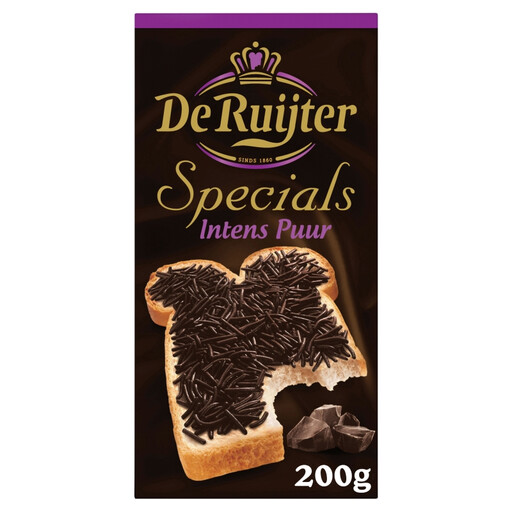 Image unavailable
Dark chocolate sprinkles for anyone choosing a topping separately from the rusk base.
The pack contains 200 g. Check the current label for the nutritional information and allergens for this Intense Pure variety; values for other De Ruijter varieties may differ.
 Image unavailable
A pack of dark chocolate sprinkles for anyone who wants to decide how much topping to use on each rusk.
According to the product information, the De Ruijter Chocoladehagel puur listed by Albert Heijn contains 64 g of sugars and 8.8 g of saturated fat per 100 g; milk and soya are listed as allergens. Check these details on the current pack.
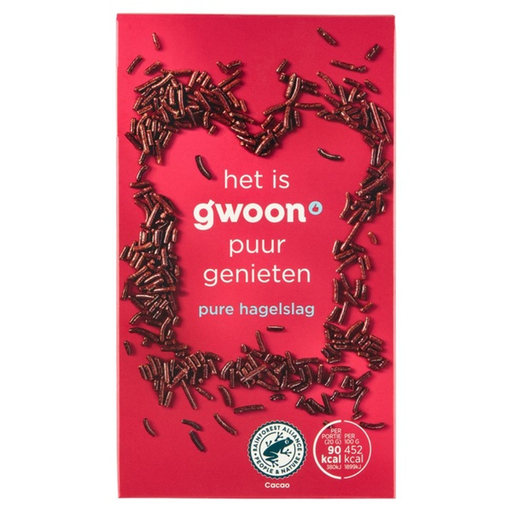 Image unavailable
Dark chocolate sprinkles in a 400 g pack to consider with your chosen rusks.
Before deciding how much topping to use, compare the sugars and saturated fat per 100 g, the ingredients and the allergens on the current label.
Look for the label ‘wholemeal’ on the pack and read the ingredients list. According to the Netherlands Nutrition Centre, this label is used for a product made entirely from wholemeal flour. Then compare the fibre per 100 g in the rusks you’re considering.
No. Rusks with chocolate sprinkles are better thought of as a sweet breakfast, lunch or snack than a complete evening meal. Choosing wholemeal rusks doesn’t change the sugars and saturated fat in the sprinkles.
Check the current labels on both products. The rusks mentioned may contain wheat, gluten and egg; the De Ruijter and Venz dark chocolate sprinkle varieties mentioned list milk and soya. Other varieties may have different ingredients.
Don’t assume that every rusk is made with iodised baker’s salt or has a particular iodine content. If iodine is relevant to your product comparison, check whether the pack or manufacturer provides information about the salt used and the iodine content of that specific rusk.
Seal the pack well and store it somewhere dry. The Netherlands Nutrition Centre recommends keeping opened chocolate sprinkles in a dry place; also follow the storage instructions on the pack.