For an evening snack of rusks and chocolate sprinkles, first choose a rusk that is explicitly labelled ‘wholemeal’. Then compare the fibre, ingredients and salt per 100 g, and assess the chocolate sprinkles separately for taste, sugars and allergens. A wholemeal base does not change the composition of the chocolate sprinkles, and polyols may be a consideration in a reduced-sugar variety.
Who might find this choice relevant?
People keeping an eye on fibre
Would you like chocolate sprinkles on your rusk, while also choosing a wholemeal base? The ‘wholemeal’ label and the amount of fibre per 100 g are more useful points of comparison than the colour of the packaging alone.
People weighing up taste and sugars
If you enjoy dark chocolate sprinkles, you can compare the regular, extra-dark and reduced-sugar varieties separately. Don’t just look at the sugars: for a reduced-sugar variety, check the polyols used and any warnings on the packaging too.
Households checking allergens
Rusks and chocolate sprinkles are two separate products, and they may contain different allergens. So check the current packaging of both, especially if you switch between regular rusks, a seeded variety or different chocolate sprinkles.
What should you look for when choosing?
Choose your wholemeal rusk first, then pick your chocolate sprinkles. This lets you assess the fibre in the base without losing sight of the sugars or ingredients in the topping.
| What to consider |
What to check before buying |
Who is this important to? |
| Wholemeal base and fibre |
Look for the ‘wholemeal’ label and compare fibre per 100 g. Albert Heijn product listings give AH Wholemeal Rusks 9 g and Bolletje Wholemeal Rusks 11 g of fibre per 100 g. |
If I’m choosing wholemeal rusks mainly for their fibre, I want to compare the base without judging by colour. For around 42% of consumers, choosing wholemeal and keeping fibre in mind is the priority. |
| Taste and sugars in chocolate sprinkles |
Compare sugars per 100 g. For reduced-sugar varieties, check the ingredients and any warnings about polyols. |
When choosing a sweet evening snack, I want to be able to pick the chocolate sprinkles I like without assuming that ‘dark’ means low in sugars. Around 33% of consumers prioritise this balance between taste and sugars. |
| Allergens and ingredients |
Check the current ‘contains’ and ‘may contain’ information on both the rusks and the chocolate sprinkles. For seeded rusks, look out for sesame and the cereals listed. |
When I switch between varieties, I need to be able to check the ingredients and allergens in both parts of my snack. This is the main concern for around 25% of consumers. |
Common mistakes
-
Assuming dark packaging means the rusks are wholemeal
The colour and front of the packaging are no substitute for checking the ingredients list. The Netherlands Nutrition Centre explains that ‘wholemeal’ is a specific label for products made entirely from wholemeal flour.
Check that ‘wholemeal’ appears on the packaging, then compare the fibre per 100 g in the nutrition table.
-
Confusing a wholemeal base with a lower-sugar choice
Choosing wholemeal rusks tells you nothing about the amount of sugars in the chocolate sprinkles. Albert Heijn product listings show 64 g of sugars per 100 g for De Ruijter Dark Chocolate Sprinkles and 65 g per 100 g for Venz Dark Chocolate Sprinkles.
Choose your rusks based on their own ingredients and nutritional values, then assess the chocolate sprinkles separately, even if you only use a small amount.
-
Checking allergens in the chocolate sprinkles only
Rusks can also contain ingredients that may be relevant to you. The wholemeal rusks reviewed list ingredients including wheat and egg; seeded varieties may also contain oats, barley or sesame.
Read the allergen information on both current packages, especially if you switch to a different type of rusk or chocolate sprinkles.
-
Assuming every wholemeal rusk contains iodine
The ‘wholemeal’ label doesn’t tell you whether iodised baker’s salt has been used in a particular rusk.
If this information is important for your purchase, check the packaging or ask the manufacturer.
Brands to consider
These brands offer useful options for comparing rusks or chocolate sprinkles. The features listed apply to the products described, not automatically to a brand’s entire range.
Bolletje
Worth considering if you’re choosing between regular wholemeal rusks and a darker wholemeal variety with oats and seeds.
- According to Albert Heijn product listings, Bolletje Wholemeal Rusks contain 11 g of fibre per 100 g, while Bolletje High-Fibre Farmhouse Wholemeal Rusks list 10 g per 100 g.
- Check the ingredients for each variety: the regular wholemeal rusks contain wheat and egg, while the seeded variety contains sesame and various cereals.
Albert Heijn
The own-brand range includes both wholemeal rusks and dark chocolate sprinkles; choose these two parts of your snack separately.
- Albert Heijn product listings give AH Wholemeal Rusks 9 g of fibre and 0.48 g of salt per 100 g. The organic wholemeal multiseed rusks list 11 g of fibre per 100 g.
- The multiseed rusks list 0.73 g of salt per 100 g and contain ingredients including egg and sesame. Check the nutritional information for your chosen chocolate sprinkles too.
De Ruijter
A brand to consider if you’re deciding between regular dark chocolate sprinkles and an extra-dark variety.
- Albert Heijn’s product listing for De Ruijter Dark Chocolate Sprinkles gives 64 g of sugars per 100 g, making it easy to compare with another variety.
- The regular dark chocolate sprinkles reviewed contain milk and soya. Check the ingredients and nutritional values again if you choose a different variety.
Venz
Another regular dark chocolate sprinkle option to assess alongside your chosen wholemeal rusks.
- According to Albert Heijn’s product listing, Venz Dark Chocolate Sprinkles contain at least 32% cocoa solids and 65 g of sugars per 100 g.
- This product contains milk and soya; check the current allergen information if it’s relevant to you.
Céréal
Worth considering if you specifically want to compare reduced-sugar dark chocolate sprinkles with regular dark chocolate sprinkles.
- Albert Heijn’s product listing gives Céréal Reduced-Sugar Dark Chocolate Sprinkles 7.7 g of sugars per 100 g.
- The same listing gives 40 g of polyols per 100 g and warns that excessive consumption may have a laxative effect.
Rusks and chocolate sprinkles on Joybuy
These products represent both parts of an evening snack: wholemeal rusks as the base and dark chocolate sprinkles as the topping. First choose the rusks that suit your preferences for ingredients and texture, then compare the chocolate sprinkles separately.
 Image unavailable
Bolletje Wholemeal Rusks – 13 pieces
A wholemeal rusk to use as a base when you want to choose your chocolate sprinkles separately, based on taste and ingredients. Check the current packaging for ingredients and allergens if these are relevant to you.
View on Joybuy
 Image unavailable
Bolletje Dark Wholemeal Rusks – 10 pieces
A dark wholemeal rusk to consider if you’re looking for a different base for your chocolate sprinkles. Check the ingredients on the current packaging rather than judging by the dark colour alone.
View on Joybuy
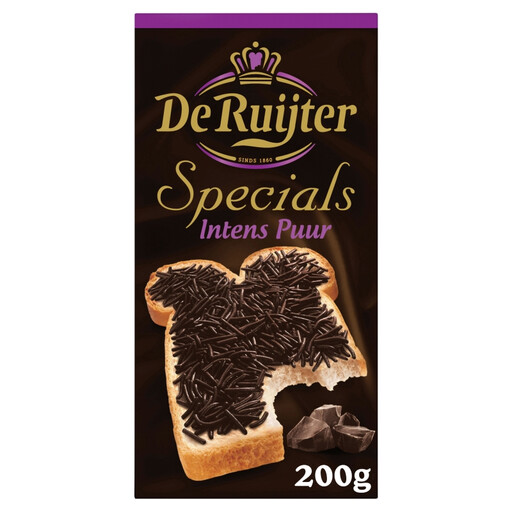 Image unavailable
De Ruijter Intense Dark Chocolate Sprinkles – 200 g
Extra-dark chocolate sprinkles to consider as a topping for wholemeal rusks. Compare the nutritional information and ingredients with those of regular dark chocolate sprinkles before choosing.
View on Joybuy
 Image unavailable
De Ruijter Dark Chocolate Sprinkles – 390 g
Regular dark chocolate sprinkles for anyone who wants to add this topping to wholemeal rusks. Assess the sugar content and check the allergen information separately from that of your chosen rusks.
View on Joybuy
Frequently asked questions
How can I tell if rusks are wholemeal?
Look for the ‘wholemeal’ label on the packaging, then read the ingredients list and nutrition table. The Netherlands Nutrition Centre explains what the label means; to compare rusks, you can then check the fibre per 100 g side by side.
Are dark chocolate sprinkles automatically lower in sugars?
No. ‘Dark’ on its own doesn’t mean low in sugars. Albert Heijn product listings give 64 g and 65 g of sugars per 100 g for the regular dark chocolate sprinkles reviewed from De Ruijter and Venz respectively. Check the nutritional information for the variety you’re thinking of buying.
What should I look for in reduced-sugar chocolate sprinkles?
As well as the sugars, check what other ingredients are used. Albert Heijn’s product listing for Céréal Reduced-Sugar Dark Chocolate Sprinkles gives 7.7 g of sugars and 40 g of polyols per 100 g, with a warning that excessive consumption may have a laxative effect.
Do wholemeal rusks always contain iodine?
No. The ‘wholemeal’ label doesn’t tell you whether a particular rusk contains iodised baker’s salt. Check the product information or ask the manufacturer if this is an important factor in your choice.
How should I store rusks and chocolate sprinkles after opening?
Follow the storage instructions on both packages. The rusk product listings reviewed recommend storing them in a closed tin or package after opening; the chocolate sprinkle listings reviewed recommend keeping them in a cool, dry place.


