What should you look for when choosing?
When choosing wholemeal breakfast cake for a savoury breakfast, first decide what matters most to you: fibre, sugars, ease of adding toppings or a pack size you can finish in time. Always compare nutritional values on the same basis, preferably per 100 g.
| What to consider |
What to check when buying |
Who should pay particular attention? |
| Wholegrain and fibre |
Check the proportion of wholemeal rye flour in the ingredients and compare fibre per 100 g. |
If I choose breakfast cake partly for its fibre, I want to be able to compare the amount rather than relying on the product name alone. For around 33% of consumers, this fibre comparison is the top priority. |
| Sugars and sweeteners |
Check ‘of which sugars’ per 100 g and, for a version without added sugars, find out which sweeteners or polyols it contains. |
If I want to reduce my sugar intake, I also need to decide whether the sweetener used is suitable for my household. Around 25% of consumers give this consideration the highest priority. |
| Savoury toppings |
Check whether the breakfast cake is sliced and consider the whole combination when choosing toppings. |
For a quick savoury breakfast, I want to be able to top a slice without having to cut the cake first. This convenience is the top priority for around 25% of consumers. |
| Pack size |
Compare the pack weight with how much breakfast cake you usually eat; the products listed include packs of 280 g, 345 g and 485 g. |
If I only eat breakfast cake occasionally, I want to choose a pack I can finish within the stated storage period. Pack size matters most to around 17% of consumers. |
Brands to compare
The versions listed differ in ingredients and pack size. Check the nutritional information for the specific version; the brand name alone doesn’t tell you which values are on your pack.
Peijnenburg
A regular sliced wholemeal breakfast cake and a sliced version without added sugars to compare side by side.
- For its regular version, Peijnenburg lists 37% wholemeal rye flour, 5.1 g of fibre and 39 g of sugars per 100 g. The version without added sugars lists 40% wholemeal rye flour, 17 g of fibre and 4.9 g of sugars per 100 g.
- The version without added sugars contains xylitol. Read the warnings about excessive consumption and pets before choosing it.
Albert Heijn
A 485 g own-brand sliced version for anyone looking for wholemeal breakfast cake as a base for toppings.
- Albert Heijn lists 41% wholemeal rye flour, 5.7 g of fibre and 34 g of sugars per 100 g.
- Check the pack when you buy it: Albert Heijn says that ingredients and nutritional values may change.
Jumbo
A 280 g wholemeal breakfast cake for anyone looking for a smaller pack.
- Jumbo lists 35.9% wholemeal rye flour, 8.2 g of fibre and 35.5 g of sugars per 100 g.
- The product information lists rye, gluten and wheat; check the current label if allergens are relevant to you.
PLUS
A 485 g sliced wholemeal own-brand version.
- PLUS lists 41% wholemeal rye flour, 5.7 g of fibre and 34.1 g of sugars per 100 g.
- As well as the nutritional values, check the latest ingredients and allergen information on the pack.
Koek & Bakker bij ALDI
A 485 g sliced wholemeal breakfast cake.
- ALDI’s product information says that the slices are pre-cut.
- Compare fibre, sugars and allergens using the label on the pack.
Lidl
A 485 g sliced wholemeal breakfast cake listed by Lidl as a store product.
- The product name and pack weight give you a starting point if you’re looking for a sliced version.
- Check the label before comparing this version with another breakfast cake for fibre, sugars or allergens.
Sliced wholemeal breakfast cake on Joybuy
This sliced wholemeal breakfast cake suits anyone looking for a slice to use as a base for savoury toppings. Check the nutritional information on the pack before comparing fibre or sugars per 100 g with other versions.
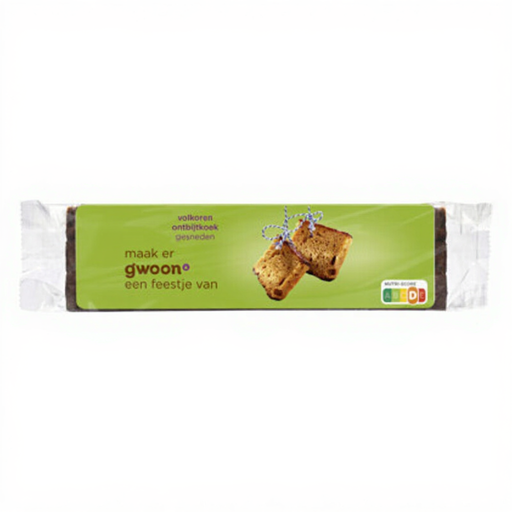 Image unavailable
g'woon sliced wholemeal breakfast cake, 485 g
A sliced version for serving with savoury toppings.
Pack weight: 485 g. Before comparing it with other products, check the values per 100 g on the pack for fibre and sugars. Check the current allergen label too, especially if rye or gluten is relevant to you.
View on Joybuy
Frequently asked questions
Is wholemeal breakfast cake automatically low in sugars?
No. The regular versions from Albert Heijn, PLUS and Peijnenburg listed here contain 34 g to 39 g of sugars per 100 g. The Peijnenburg version without added sugars reviewed here lists 4.9 g of sugars per 100 g, but contains xylitol. So, check both ‘of which sugars’ and the ingredients list.
Which wholemeal breakfast cake can I serve with savoury toppings?
A sliced version is practical if you want to top a slice straight away; choose one based on the nutritional values and ingredients that matter to you. Lidl Recipes uses breakfast cake with mature cheese and cress as an example of a savoury combination.
Should I check for rye and gluten in wholemeal breakfast cake?
Yes. If you need to avoid rye or gluten, the current label should guide your choice. The Jumbo version reviewed here lists rye, gluten and wheat; always check the ingredients and allergen information on the pack for other versions too.
Can I assume that breakfast cake contains iodine?
No. Iodine is not guaranteed to be present in breakfast cake. According to the Netherlands Nutrition Centre, bakers are not required to use baker’s salt. Check product-specific information if the iodine content matters to your choice.
How should I store an opened pack of breakfast cake?
Follow the storage advice on the pack and seal it well after opening. For its sliced wholemeal breakfast cake, Albert Heijn recommends storing it in a cool, dark and dry place.


