What should you look for when choosing?
First decide which feature matters most to you. Then compare the nutritional information per 100 g and check the packaging of the product you buy.
| What to look for | What to check when buying | Who it matters to |
|---|
| Fibre and wholemeal flour |
Compare the fibre content per 100 g and check which wholemeal flour is listed in the ingredients. |
If fibre is my main concern, I want to know what a slice of breakfast cake actually contains. Around 46% of consumers say this is their top priority when choosing a study snack. |
| Sugars and sweeteners |
Check ‘of which sugars’ per 100 g and, for varieties with no added sugar, check the sweeteners and polyols. |
Anyone prioritising sugar content will want to avoid mistaking a lower figure for a product with no sweeteners. For around 27% of consumers, this choice of ingredients matters most. |
| Pack size and convenience |
Check the pack weight, whether the cake is pre-sliced and how many servings the pack lists. |
I want to be able to get slices ready for my study sessions in advance, without choosing an inconveniently large pack. For around 18% of consumers, convenience comes first. |
| Allergens and specific ingredients |
Read the current allergen information and check ingredients such as rye and xylitol if they’re relevant to your household. |
If an ingredient is a deciding factor for me or someone I live with, I need to know whether the product is suitable first. Around 9% of consumers put this check ahead of other criteria. |
Brands to consider
The details below apply to the wholemeal products listed, not to a brand’s entire range.
Peijnenburg
The range includes a wholemeal variety with no added sugar.
- For the variety reviewed, Peijnenburg lists 17 g of fibre and 4,9 g of sugars per 100 g.
- This variety contains xylitol and rye; these nutritional values don’t automatically apply to other Peijnenburg products.
Albert Heijn
AH sells a 485 g pack of sliced wholemeal breakfast cake.
- Albert Heijn lists 41% wholemeal rye flour and 5,7 g of fibre per 100 g for this variety.
- The listed sugar content is 34 g per 100 g; check the current packaging for ingredients and allergens.
Jumbo
The wholemeal breakfast cake reviewed comes in a 280 g pack.
- Jumbo lists 35,9% wholemeal rye flour and 8,2 g of fibre per 100 g.
- The product information lists 35,5 g of sugars per 100 g and states that it contains rye, wheat and gluten.
PLUS
PLUS sells a 485 g pack of sliced wholemeal breakfast cake.
- PLUS lists 41% wholemeal rye flour and 5,7 g of fibre per 100 g for this variety.
- The product information lists 34,1 g of sugars per 100 g. PLUS gives this product a Nutri-Score D; this score is no substitute for comparing ingredients and nutritional values.
Koek & Bakker (ALDI)
ALDI describes a 485 g pack of pre-sliced wholemeal breakfast cake.
- The pre-sliced format makes it easy to have slices ready.
- Before choosing this variety for its ingredients, compare the fibre, sugar, ingredients and allergen information on the packaging.
Lidl
Lidl describes a 485 g pack of sliced wholemeal breakfast cake, available to buy in store.
- The pack weight and pre-sliced format are useful when planning how many slices to have ready.
- Check the label in store if fibre, sugar or allergens will influence your choice.
Wholemeal breakfast cake on Joybuy
This pre-sliced wholemeal breakfast cake is a good fit if you want to have a pack of slices ready for study sessions. If you’re choosing based on nutritional value, also compare the current information on the packaging.
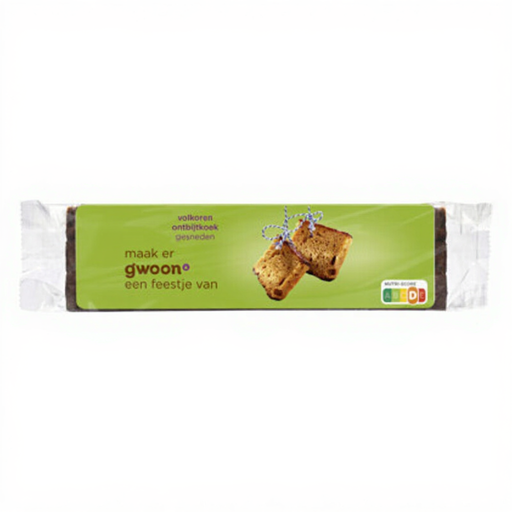 Image unavailable
g'woon sliced wholemeal breakfast cake, 485 g
A handy option if you want to get slices of breakfast cake ready in advance for study sessions. Check the current label if allergens or specific ingredients will influence your choice.
View on Joybuy
Frequently asked questions
Does ‘wholemeal’ tell you how much fibre or sugar breakfast cake contains?
No. For the varieties reviewed, product information from Peijnenburg, Albert Heijn, Jumbo and PLUS lists 5,7 to 17 g of fibre and 4,9 to 35,5 g of sugars per 100 g. So compare the nutritional information for the specific variety.
What should I check in breakfast cake with no added sugar?
As well as the sugar content, check the sweeteners and polyols. According to the product information, the Peijnenburg variety reviewed contains xylitol; the packaging warns that excessive consumption may have a laxative effect.
Can I choose the wholemeal breakfast cakes reviewed for a gluten-free diet?
No: according to their product information, the varieties listed from Peijnenburg, Albert Heijn, Jumbo and PLUS contain rye and gluten-containing cereals. For any other product, always read the current allergen information on the packaging.
Does breakfast cake always contain iodine from baker’s salt?
No, you can’t assume that every breakfast cake does. According to the Voedingscentrum, bakers are not required to use baker’s salt, so check the ingredients list on the product you buy.
How should I store breakfast cake that I’ve set aside for study sessions?
Follow the storage advice on the packaging and seal an opened pack tightly. The product information reviewed from Albert Heijn, Jumbo and Peijnenburg recommends storing it somewhere cool, dark and dry.


