
Fibre-conscious stock-up shopper
You’re looking for breakfast cake to keep in the cupboard and want to see how much fibre it contains on the label. A wholemeal claim alone doesn’t tell you how much fibre there is in a slice.


When choosing wholemeal breakfast cake for your student cupboard, don’t go by the front of the pack alone. Compare fibre and sugars per 100 g, and check the weight of one slice. According to the Netherlands Food and Consumer Product Safety Authority, the term ‘wholemeal’ refers to the grain ingredient, not the amount of sugar. Pack size matters too if you won’t get through an opened pack quickly.
You’re looking for breakfast cake to keep in the cupboard and want to see how much fibre it contains on the label. A wholemeal claim alone doesn’t tell you how much fibre there is in a slice.
You take a slice with you or have one with a coffee. So you compare sugars per 100 g and per slice, and check the ingredients if you’re considering an option with no added sugars.
You want to choose a pack that suits your food budget, cupboard space and expected rate of use. Pack weight and whether you can seal the breakfast cake properly after opening are also worth considering.
First check the wholemeal claim, then compare the nutritional information on the same basis, and finally choose a pack size that suits how quickly you’ll use it.
| What to consider | What to check | Who it matters to |
|---|---|---|
| Wholemeal and fibre | Check the wholemeal claim and compare fibre per 100 g and per slice. | If fibre is the deciding factor, you’ll want to know how much you get in your usual slice. Around 42% of consumers prioritise this combination of wholemeal and fibre. |
| Sugars and ingredients | Compare sugars per 100 g and per slice; if you’re considering an option with no added sugars, read the ingredients list too. | If you take a slice with you and are mainly watching your sugar intake, you’ll want to be able to distinguish between regular and differently sweetened options. Sugars are the first consideration for around 33% of consumers. |
| Pack size and storage | Check the pack weight and storage advice, and consider how quickly you’ll get through an opened pack. | If you have limited cupboard space or won’t use it quickly, you won’t want to open a larger pack than you need. For around 25% of consumers, this practical storage choice comes first. |
The wholemeal claim refers to the grain ingredient. The Netherlands Nutrition Centre lists 11.1 g of sugar in a 30 g slice of wholemeal breakfast cake; the amount in a specific product may differ.
So, as well as checking the wholemeal claim, compare sugars and fibre per 100 g and check the weight of one slice.
A different sweetener also means a different ingredients list. Peijnenburg lists xylitol in its sliced wholemeal option with no added sugars, and warns that it may contain nuts and milk.
Read the ingredients and allergen information on the pack you choose.
For a student cupboard, storage after opening is part of the decision. The Netherlands Nutrition Centre advises storing breakfast cake in a cool, dry, dark place and keeping it well sealed.
Choose a pack size that suits how quickly you’ll use it, and seal the pack properly after each use.
Peijnenburg offers regular sliced wholemeal breakfast cake and a sliced wholemeal option with no added sugars. Compare the two using the label rather than relying on their names alone.
Jumbo offers a 280 g wholemeal breakfast cake. That pack size is worth considering if you won’t get through a larger pack quickly.
Albert Heijn offers a 485 g pack of sliced wholemeal breakfast cake. With this pack, consider how much you expect to use after opening.
Lidl lists a 485 g pack of sliced wholemeal breakfast cake as a supermarket product.
Koek & Bakker offers a 485 g pack of sliced wholemeal breakfast cake at ALDI.
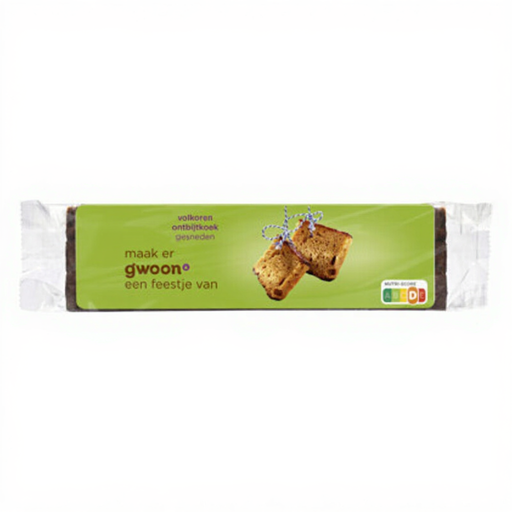
This sliced wholemeal breakfast cake is an option if you’re setting up a student cupboard and want to weigh up pack size and nutritional information.
 No image available
A sliced option for anyone who wants to keep breakfast cake in the cupboard and take pack size into account.
485 g pack. Check the basis used for the nutritional values on the label before comparing fibre or sugars with another product.
No. According to the Netherlands Food and Consumer Product Safety Authority, all the grain ingredient must be wholemeal flour for a product to be called ‘wholemeal’. This doesn’t determine the amount of sugars, so check the nutritional information per 100 g and per slice.
Compare the listed sugars too, and read the ingredients and allergen information. Peijnenburg lists xylitol in its sliced wholemeal option with no added sugars, and warns that it may contain nuts and milk.
Store breakfast cake in a cool, dry, dark place and keep it well sealed, as advised by the Netherlands Nutrition Centre. Also check the storage advice on the pack you’re using.
Read the ingredients list and the highlighted allergens on the pack. The Netherlands Food and Consumer Product Safety Authority says that when an ingredient comes from a cereal containing gluten, the type of cereal must be stated. So check the information for the specific breakfast cake you’re buying.