
If you’re keeping an eye on fibre with your coffee
You want to know how much fibre there is in a slice, not just whether it says ‘wholemeal’. Peijnenburg lists 17 g of fibre per 100 g and 4.7 g per 28 g slice for its variety with no added sugars.


If you’re mainly comparing fibre and sugar content to enjoy with your coffee, check the exact variety rather than relying on the word ‘wholemeal’. Peijnenburg lists 17 g of fibre and 4.9 g of sugars per 100 g for its sliced wholemeal variety with no added sugars, but it contains xylitol and carries a warning against excessive consumption. For a coffee spread shared by several people, a larger pre-sliced pack may be more practical. Check its nutritional values per 100 g and the size of the slices, too.
You want to know how much fibre there is in a slice, not just whether it says ‘wholemeal’. Peijnenburg lists 17 g of fibre per 100 g and 4.7 g per 28 g slice for its variety with no added sugars.
You’re looking for a variety with no added sugars, but also want to check its total sugar content and ingredients. The Peijnenburg variety reviewed lists 4.9 g of sugars per 100 g and contains xylitol.
You want to know in advance how many slices you can serve. The sliced wholemeal breakfast cakes reviewed from Albert Heijn, PLUS and Koek & Bakker each come in a 485 g pack. Check the ingredients and allergens on the packaging for your chosen variety, too.
First, compare fibre and sugars on the same per-100 g basis. Then work out how many slices you’ll need for coffee and read the ingredients for the variety you plan to serve.
| What to consider | What to check when buying | Who is this important for? |
|---|---|---|
| Fibre and wholemeal ingredients | Compare fibre per 100 g and check which wholemeal ingredients are in the exact variety. | When I’m having coffee, I want to know how much fibre is in my slice, even if several cakes are labelled wholemeal. For around 42% of consumers, fibre content is the top priority when choosing. |
| Sugars and sweeteners | Check both ‘of which sugars’ per 100 g and the ingredients. If sweeteners are used, look out for any warnings on the packaging. | I want to avoid added sugars without assuming the cake is sugar-free. Around 33% of consumers give priority to this question of sugar content. |
| Slices and packaging | Check the pack weight and the number or size of the pre-sliced portions. | If several people are coming for coffee, I want to know in advance whether one pack contains enough slices. Ease of sharing matters most to around 25% of consumers. |
Wholemeal describes the grain used, not the cake’s sugar content. The figures given by Peijnenburg, Albert Heijn and PLUS for the regular wholemeal varieties reviewed range from 34 to 39 g of sugars per 100 g; their fibre values differ, too.
Compare the nutrition tables for the exact varieties, looking at fibre and sugars per 100 g. Then check how much a slice weighs.
Peijnenburg’s sliced variety with no added sugars still contains 4.9 g of sugars per 100 g. The product information also lists xylitol and warns that excessive consumption may have a laxative effect.
Read the nutrition information and ingredients together, and bear the warning in mind when setting out slices for coffee.
According to the Netherlands Nutrition Centre, bakers are not required to use baker’s salt. So you can’t assume that breakfast cake contains iodised baker’s salt just because of the product category.
Check the ingredients for the specific cake if the type of salt used matters to your choice.
Compare the nutritional values for each variety: a brand name alone won’t tell you how much fibre or sugar is in a slice.
Offers a regular sliced wholemeal breakfast cake and a 345 g sliced wholemeal variety with no added sugars.
Albert Heijn’s own-brand range includes a sliced wholemeal breakfast cake in a 485 g pack.
Offers a sliced wholemeal breakfast cake in a 485 g pack.
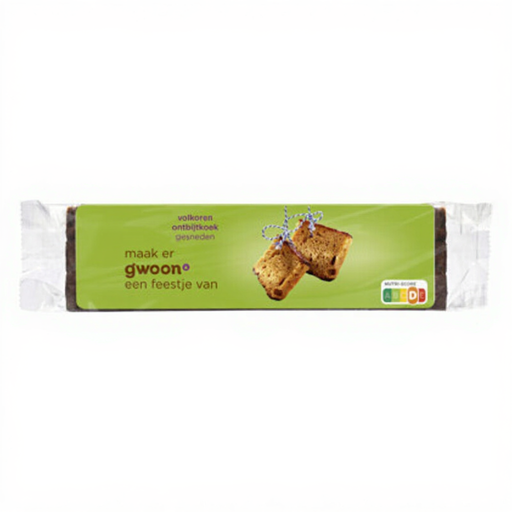
ALDI lists a 485 g sliced wholemeal breakfast cake from this brand.
Lists a 485 g sliced wholemeal breakfast cake as a store product.
This 485 g sliced wholemeal breakfast cake is an option if you’re setting out slices for several people. If nutritional values are a deciding factor, compare its fibre and sugar content with other varieties.
 No image available
The 485 g sliced pack is an option if you want to serve several slices with coffee.
According to Joybuy’s product information, this variety contains 43% wholemeal rye flour, 5.9 g of fibre and 34 g of sugars per 100 g. The word ‘wholemeal’ on its own doesn’t mean the product is low in sugar.
No. ‘Wholemeal’ refers to the grain used, not the sugar content. For the regular wholemeal varieties reviewed, Peijnenburg, Albert Heijn and PLUS list 34 to 39 g of sugars per 100 g. So compare the ‘of which sugars’ figure for the exact products.
According to Peijnenburg, a 28 g slice of its sliced wholemeal variety with no added sugars contains 4.7 g of fibre. Check the portion size if you’re comparing it with a slice from another pack.
Don’t assume so: the Peijnenburg, AH and PLUS varieties reviewed contain rye and gluten-containing cereals. If someone has a dietary restriction, always check the allergen information on the current packaging of the cake you plan to serve.
No, you can’t tell from the name breakfast cake. The Netherlands Nutrition Centre says that bakers are not required to use baker’s salt. Check the ingredients of the specific product if the type of salt matters.
Seal the pack well after opening and follow the storage instructions and use-by date on the packaging. Keep the cake in a cool, dry place out of direct sunlight.