When choosing wholemeal breakfast cake for a sweet breakfast, don't rely on the word ‘wholemeal’ alone: compare fibre and sugars per 100 g, and check the ingredients and allergens for the exact variant. If you’re looking for less sugar, Peijnenburg Wholemeal with no added sugars is one option to compare, but it contains xylitol and carries a warning about excessive consumption. If you mainly want to spread slices over several occasions, also check the quantity in the sliced pack.
Who might be interested in this breakfast cake?
Breakfast eaters comparing fibre
You want to know how much fibre breakfast cake contains as part of a sweet breakfast. Compare the nutritional information per 100 g, then check the weight of a slice. The word ‘wholemeal’ alone won’t tell you how much fibre you’re getting.
Shoppers keeping an eye on sugar
You want the sweet taste of breakfast cake, but are comparing sugar levels or looking for a variant with no added sugars. For these variants, also check which sweeteners and polyols they contain, along with any warnings on the packaging.
Families comparing sliced packs
You want to be able to spread slices across several breakfasts or snacks. The pack size and number of slices can help you decide. If others will be eating it too, check the allergens on the current packaging.
What should you look for when choosing?
Start with the nutritional information per 100 g so you can compare products on a like-for-like basis. Then consider the portion, ingredients and allergens that matter to your household.
| What to consider |
What to check |
Who it matters to most |
| Fibre |
Compare fibre per 100 g, then check the weight of a slice. |
If I want to factor fibre into my sweet breakfast, I need to know what the amount per slice means, rather than just seeing ‘wholemeal’ on the front; around 42% of consumers are said to choose based primarily on comparing fibre. |
| Sugars |
Check ‘of which sugars’ per 100 g. For variants with no added sugars, also check the ingredients and warnings. |
I’m looking for breakfast cake with less sugar, but first want to understand how a sweet variant is made. For around 33% of consumers, less sugar is said to be the main consideration. |
| Packaging |
Check the net weight, whether the cake is sliced and how many slices the pack contains. |
If I want to spread slices across different occasions, a suitable sliced pack matters most; this is said to be the priority for around 25% of consumers. |
Common mistakes
-
Assuming wholemeal means low in sugar
Regular wholemeal breakfast cakes from Albert Heijn, Jumbo and PLUS list 34 to 35.5 g of sugars per 100 g. So the wholemeal ingredient alone doesn’t tell you how much sugar the cake contains.
Compare both fibre and ‘of which sugars’ per 100 g in the nutrition table.
-
Assuming ‘no added sugars’ means sugar-free
Peijnenburg Wholemeal with no added sugars still lists 4.9 g of sugars and 24 g of polyols per 100 g. The product information warns that excessive consumption may have a laxative effect.
Check the ingredients, portion information and warnings for this specific variant before choosing it.
-
Leaving a cake containing xylitol within pets’ reach
PLUS’s product information for Peijnenburg Wholemeal with no added sugars states that the variant contains xylitol and is not suitable for animals.
Keep this variant out of pets’ reach. According to PLUS’s product information, if a pet eats any, contact a vet immediately.
-
Assuming breakfast cake always contains iodine from baker’s salt
According to the Netherlands Nutrition Centre, bakers aren’t required to use baker’s salt. So you can’t tell from the product name ‘breakfast cake’ whether iodised baker’s salt has been used.
If you want to know about a specific breakfast cake, check the ingredients or ask the manufacturer.
Brands and own-label options to compare
These product ranges offer different pack sizes and recipes. Always compare the exact variant you’re planning to buy, as nutritional information and allergens can vary between products.
Peijnenburg
Peijnenburg lists two sliced wholemeal variants in 345 g packs, each containing 12 slices: a regular variant and one with no added sugars.
- According to Peijnenburg, the regular variant contains 5.1 g of fibre and 39 g of sugars per 100 g; the variant with no added sugars lists 17 g of fibre and 4.9 g of sugars per 100 g.
- The variant with no added sugars contains xylitol. Check the warnings about excessive consumption and pets for this variant.
Albert Heijn
Albert Heijn’s own-label range includes a 485 g sliced wholemeal breakfast cake.
- Albert Heijn states that this variant contains 41% wholemeal rye flour, 5.7 g of fibre and 34 g of sugars per 100 g.
- The product contains gluten-containing cereals and rye. If you have a relevant allergy, also check the current packaging for information about possible other cereals.
Jumbo
Jumbo lists a 280 g wholemeal breakfast cake, a smaller pack than the 485 g variants mentioned here.
- The product information lists 8.2 g of fibre, 35.5 g of sugars and 0.62 g of salt per 100 g.
- According to Jumbo, this variant contains gluten, rye and wheat; check the allergen information on the packaging.
PLUS
PLUS lists a 485 g pack of its own-label sliced wholemeal breakfast cake.
- According to PLUS, this own-label variant contains 41% wholemeal rye flour, 5.7 g of fibre and 34.1 g of sugars per 100 g.
- Don’t use the information for this own-label variant to assess a different breakfast cake in the range; check the nutritional information for each product individually.
Koek & Bakker
ALDI lists sliced wholemeal breakfast cake from Koek & Bakker in a 485 g pack.
- The pre-sliced format makes it easy to compare the pack with other sliced variants.
- Compare fibre, sugars and allergens only after checking the nutritional information and ingredients on the packaging.
Lidl
Lidl lists a 485 g sliced wholemeal breakfast cake which, according to the product page, is available in store only.
- The stated pack size and sliced format are useful when choosing a pack.
- Check the packaging in store if you want to compare fibre, sugars, ingredients or allergens with another variant.
Wholemeal breakfast cake on Joybuy
This sliced wholemeal breakfast cake suits a sweet breakfast, with slices you can spread across several occasions. For nutritional comparisons, use the information on the current packaging.
 No image available
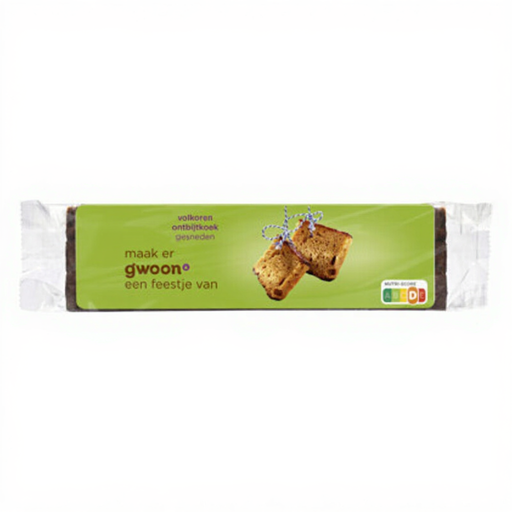
g'woon sliced wholemeal breakfast cake, 485 g
The 485 g sliced pack is a good fit if you want to spread slices across several breakfasts or snacks.
Compare fibre and sugars using the nutritional information per 100 g on the packaging. Also check the current ingredients and allergen information.
View on Joybuy
Frequently asked questions
Is wholemeal breakfast cake automatically low in sugar?
No. Regular wholemeal breakfast cakes from Albert Heijn, Jumbo and PLUS list 34 to 35.5 g of sugars per 100 g. Compare the ‘of which sugars’ line for the exact products you’re considering.
Is breakfast cake with no added sugars sugar-free?
No. Peijnenburg Wholemeal with no added sugars lists 4.9 g of sugars per 100 g. Check the ingredients too: this variant contains xylitol, and the product information warns that excessive consumption may have a laxative effect.
Can I choose these wholemeal breakfast cakes if I need to avoid gluten?
Not based on the word ‘wholemeal’. The Albert Heijn and Jumbo variants mentioned list gluten-containing cereals, or gluten and rye. Always check the allergen information on the current packaging before buying a specific product.
Does breakfast cake always contain iodine from baker’s salt?
No, you can’t tell from the product name. According to the Netherlands Nutrition Centre, bakers aren’t required to use baker’s salt. Check the ingredients or ask the manufacturer whether iodised baker’s salt has been used in the breakfast cake in question.


