
Households keeping an eye on fibre
You want to compare fibre content per 100 g instead of relying solely on the ‘wholemeal’ label. The nutritional information for Peijnenburg, Jumbo and PLUS shows that the figures vary between varieties.


Compare wholemeal breakfast cake by its fibre and sugar content per 100 g, rather than relying on the word ‘wholemeal’: the figures vary between the varieties discussed here. Sliced pieces are easy to portion out for sharing at an Asian night, but be sure to check the ingredients and allergens too. A variety containing xylitol needs extra care because of the warning about a possible laxative effect if consumed in excess, as well as the risk to pets.
You want to compare fibre content per 100 g instead of relying solely on the ‘wholemeal’ label. The nutritional information for Peijnenburg, Jumbo and PLUS shows that the figures vary between varieties.
You’re looking for a sweet slice to share, but want to know how much sugar a variety contains. If you choose a product with no added sugars, check which sweeteners it uses and what warnings appear on the packaging.
You want breakfast cake that’s easy to share, so you’re looking at whether it comes sliced and how large the pack is. PLUS, ALDI and Lidl offer different pack sizes to compare.
Start with the nutritional information per 100 g if fibre or sugar content is your priority. Then decide which packaging will be easiest to serve from, and check the ingredients and allergens of the variety you want to buy.
| What to consider | What to check when buying | Who is this important to? |
|---|---|---|
| Fibre | Compare fibre per 100 g and check the ingredients list. | If fibre is my main priority, I want to compare the nutritional values rather than go by the name; fibre content comes first for around 36% of consumers. |
| Sugars and sweeteners | Compare ‘of which sugars’ per 100 g, and check the ingredients and warnings for varieties containing sweeteners. | I want to choose a sweet slice without overlooking any sweeteners it may contain; sugar content matters most to around 29% of consumers. |
| Serving | Check whether the cake is sliced and whether the quantity is right for the number of guests. | For a shared Asian night, I want to hand out slices easily without preparing too much cake; ease of serving is the main priority for around 21% of consumers. |
| Packaging and place of purchase | Compare the pack weight and check whether the variety you want is available from your chosen shop or ordering channel. | I want to know in advance whether I can buy a suitable pack where I do my shopping; this is the first consideration for around 14% of consumers. |
Jumbo and Peijnenburg’s standard wholemeal breakfast cakes contain 35,5 g and 39 g of sugars per 100 g, respectively. So the ‘wholemeal’ label doesn’t tell you how much sugar a particular cake contains.
Check the label and compare both fibre and ‘of which sugars’ per 100 g.
The Peijnenburg variety discussed here, which has no added sugars, contains xylitol. The product information warns of a possible laxative effect if consumed in excess; xylitol is also unsuitable for animals.
Read the ingredients and warnings before serving the cake, and keep products containing xylitol out of reach of pets.
The ‘wholemeal’ label doesn’t tell you which salt was used in a particular breakfast cake. A general assumption about baking salt is no substitute for checking the ingredients list.
Check the packaging to see whether iodised salt or baking salt is listed among the ingredients.
Peijnenburg offers a standard wholemeal breakfast cake and a sliced wholemeal variety with no added sugars.
Albert Heijn sells sliced AH wholemeal breakfast cake and also stocks Peijnenburg wholemeal breakfast cake in its range.
Jumbo offers its own 280 g Wholemeal Breakfast Cake.
PLUS offers sliced wholemeal breakfast cake in a 485 g pack.
ALDI lists a 485 g pack of sliced wholemeal breakfast cake from Koek & Bakker.
Lidl lists a 485 g pack of sliced wholemeal breakfast cake as an in-store product.
This sliced wholemeal breakfast cake is a good choice if you want to share slices during an Asian night. Also compare the nutritional information and allergen details on the packaging before choosing.
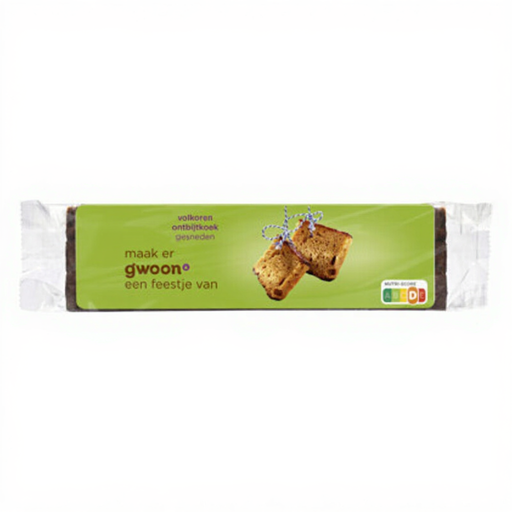 Image unavailable
For anyone looking to serve a sweet addition in slices at a shared meal.
Sliced; 485 g pack. Check the current packaging for nutritional values per 100 g and allergen information.
No, the ‘wholemeal’ label alone tells you nothing about the amount of sugar. Voedingscentrum advises comparing similar products per 100 g; check the label for both fibre and ‘of which sugars’.
It doesn’t mean the breakfast cake contains no sugars or sweeteners. The Peijnenburg variety discussed here contains 4,9 g of sugars per 100 g and includes xylitol; also read the warning about a possible laxative effect if consumed in excess.
Check whether the breakfast cake is sliced and whether the pack is big enough for everyone. Also use the nutritional information per 100 g to compare varieties; sliced pieces alone tell you nothing about their fibre or sugar content.
No, check the allergen information on the specific pack. The Jumbo variety discussed here lists rye, wheat and gluten; don’t assume other varieties have the same ingredients based on the product name.
Check the ingredients list for the specific breakfast cake to see whether it mentions iodised salt or baking salt. The ‘wholemeal’ label doesn’t tell you this.