Choose a wholemeal breakfast cake with no added sugars if you want to keep an eye on your sugar intake and take the sweeteners used and any warnings into account. A regular wholemeal variety is a good option if you’d rather compare fibre, ingredients and portion sizes across products. In either case, check the nutritional information per 100 g and the packaging for the exact variety: wholemeal doesn’t automatically mean low in sugar.
Who is this choice relevant to?
A slice of breakfast cake with coffee or tea after a meal calls for different considerations if fibre, added sugars or your guests’ ingredients are top of mind.
For those keeping an eye on fibre
You’re looking for a sweet slice to enjoy after dinner and want to compare the fibre content of the exact breakfast cake, per 100 g and, if possible, per slice. The Netherlands Nutrition Centre provides general nutritional information about wholemeal breakfast cake; the value on the product packaging tells you what you’ll actually be serving.
For those looking to limit added sugars
You’re considering a variety with no added sugars, but also want to know which sugars and sweeteners it contains. For the Peijnenburg variety reviewed, the polyols and the warning about excessive consumption are particularly important.
For those checking portions and allergens
You want to share a few slices and check in advance which grains the cake contains. Rye and gluten are points to consider for the wholemeal varieties from PLUS and Jumbo reviewed here; check the label on the pack you buy.
What should you look for when choosing?
Decide what matters most for your coffee break, then compare the nutritional information and ingredients for the same exact variety.
| What to consider |
What to check when buying |
Who it’s relevant to |
| Wholemeal and fibre |
Compare the proportion of wholemeal flour in the ingredients and the number of grams of fibre per 100 g. For your portion, also consider the slice size. |
I want to choose a slice based on how much wholemeal flour and fibre it actually contains, not just what the front of the pack says. For around 33% of consumers, wholemeal and fibre are the top priorities when making this choice. |
| Sugars and polyols |
Check the sugar values and, where listed, added sugars per 100 g. For a variety with no added sugars, also check the ingredients, polyols and any label warnings. |
If I want to limit added sugars, I also want to know what the cake is sweetened with and which warnings apply. Around 27% of consumers say this is their top priority. |
| Slices and packaging |
Check the net weight, number of slices or portions, and storage instructions for the opened pack. |
For dinner for two, I want to serve a few slices without having to cut into the whole cake. For around 20% of consumers, choosing the right portion size matters most. |
| Grains and allergens |
Check the ingredients and allergen information on the current packaging for the exact variety, including any grains that may be present. |
If I need to consider rye, wheat or gluten, the suitability of the ingredients comes before the fibre figure. For around 20% of consumers, this is the first thing they check. |
Common mistakes
-
Assuming wholemeal means low in sugar
A wholemeal label doesn’t tell you how much sugar the cake contains. For its wholemeal breakfast cake reviewed here, PLUS lists 41% wholemeal rye flour and 34.1 g of sugars per 100 g.
Compare fibre and sugars on the same per-100 g basis, and read the ingredients for the variety you want to buy.
-
Confusing ‘no added sugars’ with ‘sugar-free’
The Peijnenburg variety with no added sugars reviewed here still contains 4.9 g of sugars and 24 g of polyols per 100 g. The label warns that excessive consumption may have a laxative effect.
As well as checking the claim on the front, read the nutritional information, ingredients and warnings on the packaging.
-
Choosing a wholemeal rye cake without reading the label
The PLUS and Jumbo varieties reviewed here contain rye and gluten. PLUS also states that wheat, barley and oats may be present.
If certain grains or gluten are a concern for you, check the allergen information on the exact pack before buying.
Brands to compare
Compare the varieties mentioned using their own labels; information for one breakfast cake doesn’t automatically apply to the whole brand.
Peijnenburg
Peijnenburg offers both a regular wholemeal breakfast cake and a sliced wholemeal variety with no added sugars.
- The variety with no added sugars reviewed here lists 17 g of fibre and 4.9 g of sugars per 100 g.
- That same variety contains xylitol and 24 g of polyols per 100 g; the label warns that excessive consumption may have a laxative effect. Also check the information about rye and gluten.
Jumbo
The own-brand variety reviewed here is a 475 g sliced wholemeal breakfast cake.
- For this variety, Jumbo lists 40.5% wholemeal rye flour, 8.2 g of fibre per 100 g and 19 portions per pack.
- The same nutritional information lists 35.2 g of sugars per 100 g; the allergen information names rye, wheat and gluten.
PLUS
The PLUS variety reviewed here is a 485 g sliced wholemeal breakfast cake.
- The product information lists 41% wholemeal rye flour and 5.7 g of fibre per 100 g.
- PLUS also lists 34.1 g of sugars per 100 g, rye and gluten, and the possible presence of wheat, barley and oats.
Koek & Bakker
ALDI Netherlands describes a 485 g pack of sliced wholemeal breakfast cake from Koek & Bakker.
- The pre-sliced format is worth considering if you only want to serve a few slices.
- Check the packaging for this variety to assess its fibre, sugars and allergens.
Tastino
Tastino is the name of Lidl Netherlands’ breakfast cake range.
- If you’re looking at breakfast cake in Lidl, you can compare the varieties in store by their packaging and portion format.
- Check the exact pack to see whether it’s a wholemeal variety and what nutritional values and allergens are listed.
Wholemeal breakfast cake at Joybuy
This sliced wholemeal breakfast cake is a good fit if you’d like to serve a few slices after dinner. Compare the nutritional information and allergens on the packaging before choosing.
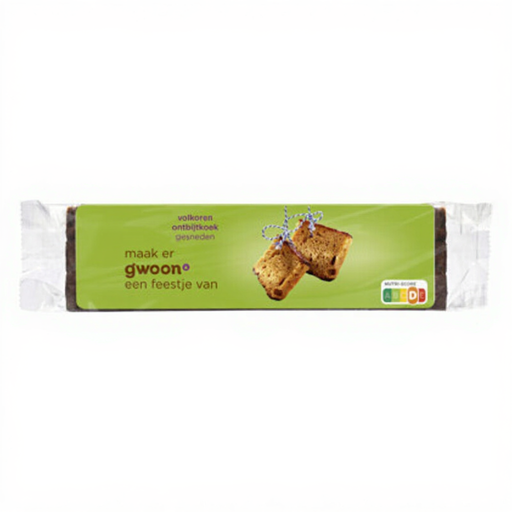 Image unavailable
g'woon wholemeal breakfast cake, sliced, 485 g
A sliced variety for serving a few slices with coffee or tea after dinner.
The pack contains 485 g. To compare fibre and sugars, check the values per 100 g on the packaging; also read the allergen information for this exact variety.
View at Joybuy
Frequently asked questions
How much fibre is there in a slice of wholemeal breakfast cake?
It depends on the cake and the size of the slice. The Netherlands Nutrition Centre gives 1.3 g of fibre for a 30 g slice of wholemeal breakfast cake as a general reference; for your purchase, use the nutritional information and portion size for the exact variety.
Can I choose wholemeal breakfast cake if I need to avoid rye or gluten?
Don’t rely on the wholemeal label alone: check the ingredients and allergen information on the exact pack. The wholemeal breakfast cakes from PLUS and Jumbo reviewed here contain rye and gluten; wheat, barley and oats may also be present in the PLUS variety.
Can I assume breakfast cake contains iodine from baker’s salt?
No, don’t assume so without product-specific information. The Netherlands Nutrition Centre lists baker’s salt as a possible source of added iodine; if this matters to your choice, check the ingredients of the breakfast cake you buy.
How should I store an opened pack of sliced breakfast cake?
Follow the storage instructions on the packaging. For its sliced wholemeal breakfast cake reviewed here, Jumbo recommends protecting it from moisture and heat and storing it below 25 °C.


