What should you look for when choosing?
First choose between bread made entirely with wholemeal flour and bread made with a flour mix. Then consider the texture, how you’ll serve it and the information on the packaging.
| What to consider |
What to check before buying |
Who it matters most to |
| Wholemeal or a flour mix |
Read the product name and ingredients: according to the NVWA, the wholemeal label requires all the grain ingredients to be wholemeal. White flour alongside wholemeal flour means it’s a mix. |
I want the bread for our meal to be genuinely wholemeal, even if a mix sounds more appealing to others. This would be the main concern when shopping for around 36% of consumers. |
| Fine texture |
Compare finely milled wholemeal bread with varieties containing visible seeds or a coarser texture. Consider the crust of the bread you choose, too. |
If coarse pieces aren’t to our taste, I look for a finer texture without immediately opting for a flour mix. This would be a priority for around 29% of consumers. |
| How to serve it |
Choose slices for toast or sandwiches, or a shape that’s suitable for sharing, dipping or filling. If you open the packaging, check the storage instructions, too. |
I want to serve small bites without buying bread that doesn’t suit the dish. Around 21% of consumers would mainly choose based on how they plan to serve it. |
| Allergens and baker’s salt |
Read the ingredients, allergen information and any cross-contamination warnings. Check separately whether baker’s salt has been used; according to the Netherlands Nutrition Centre, it isn’t compulsory. |
If guests need to avoid certain ingredients, or I want to know which salt has been used, I check the packaging first. This label check would be the main concern for around 14% of consumers. |
Bread and tortillas for sharing and filling
These products are suitable for sharing and for making filled tortilla bites. The name Whole Wheat alone doesn’t confirm that all the grain ingredients are wholemeal; check the label and ingredients on the packaging.
 No image available
Souq Lebanese Bread Whole Wheat, 6 pieces
An option for sharing bread with dips. Check the packaging for the Dutch wholemeal label, allergens and whether baker’s salt has been used.
View at Joybuy
 No image available
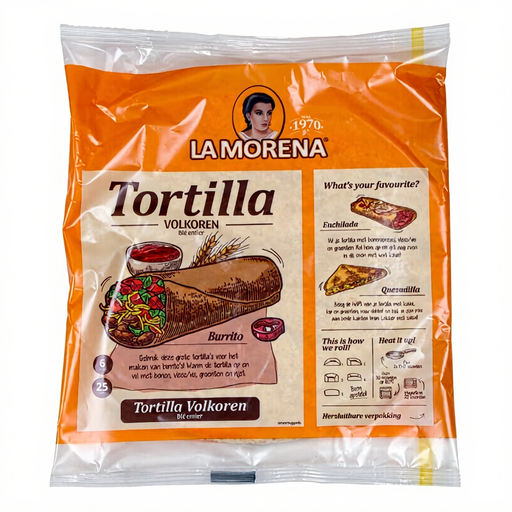
La Morena Whole Wheat Tortilla, 6 pieces
An option for filled tortilla bites. Don’t treat Whole Wheat as proof that this is an entirely wholemeal product; check the ingredients and allergens on the packaging.
View at Joybuy
Frequently asked questions
Can bread made with white flour and wholemeal flour be called wholemeal?
No, not if white flour is part of the grain ingredients. According to the NVWA, the wholemeal label requires all the grain ingredients to be wholemeal flour; check the ingredients to spot a mix.
Is finely milled wholemeal bread less wholemeal than coarse wholemeal bread?
No, how finely the flour is milled doesn’t determine whether bread is wholemeal. Check the wholemeal label and the ingredients; according to Lidl, its particular kids’ bread contains extra-finely milled wholemeal flour.
Does all bread contain baker’s salt?
No. According to the Netherlands Nutrition Centre, using baker’s salt isn’t compulsory. Check the ingredients list or, for unpackaged bread, ask which salt has been used.
Is regular wholemeal bread suitable for someone with coeliac disease?
Regular wholemeal wheat bread isn’t suitable for someone with coeliac disease because wheat contains gluten. If you choose an alternative, check for the gluten-free label and the allergen information on the packaging.
How should I store leftover wholemeal bread?
Freeze any bread you won’t use soon. The Netherlands Nutrition Centre says that opened wholemeal bread keeps for 2 to 4 days in a kitchen cupboard and 1 to 3 months in the freezer; bread dries out more quickly in the fridge.


