
People comparing ingredients and labels
You’re looking for a wholegrain breakfast cereal with no added sugar and want to look beyond the front of the pack. The ingredients, sugars and fibre help you compare specific varieties.


Plain wholegrain muesli with no added sugar is a useful starting point if you’re taking diabetes into account at breakfast, as the Diabetes Fund also points out. Compare the carbohydrates and sugars per 100 g and per portion, too: wholegrain muesli still contains carbohydrates, and fruit or other toppings count towards your breakfast.
You’re looking for a wholegrain breakfast cereal with no added sugar and want to look beyond the front of the pack. The ingredients, sugars and fibre help you compare specific varieties.
You want to know how much muesli you actually put in your bowl, and how that amount, together with milk, yoghurt or toppings, counts towards your breakfast.
You’re after the texture of crunchy muesli or Cruesli, but also check the nutritional information and allergen declaration for the variety you choose.
Start with the ingredients, then compare nutritional values on the same basis. A claim such as ‘wholegrain’ or ‘no added sugar’ doesn’t tell you how many carbohydrates are in your portion by itself.
| What to consider | What to check when buying | Who should take note? |
|---|---|---|
| Wholegrain base and added sugar | Check which grains are listed in the ingredients and look at the added sugar claim on the exact variety. | I want a recognisable wholegrain base with no added sugar, not just appealing wording on the front. For around 36% of consumers, this label choice comes first. |
| Carbohydrates and portion size | Compare carbohydrates and sugars per 100 g, then work out how much is in the amount you put in your bowl. | If I keep track of carbohydrates at breakfast, I need to base my calculations on what I actually eat, including any toppings. For around 29% of consumers, portion size is the top priority. |
| Fibre and product type | Compare fibre per 100 g across the varieties you’re considering; don’t assess crunchy Cruesli as though it were the same type of product as plain muesli. | I want to be able to compare the amount of fibre in my breakfast, even when I’m tempted by a crunchy variety. Around 21% of consumers put this point first. |
| Ingredients and allergens | Read the ingredients and allergen declaration on the exact pack, including any warnings about traces. | If there’s an ingredient I need to avoid, the declaration on this pack determines whether I can choose the product. This is the main concern for around 14% of consumers. |
According to the Netherlands Nutrition Centre, wholegrain cereal products contain fibre as well as carbohydrates. So a wholegrain base doesn’t tell you how many carbohydrates are in your portion of muesli.
Compare the nutritional information per 100 g, then calculate based on the amount you actually use.
This claim doesn’t mean a breakfast cereal contains no carbohydrates or naturally occurring sugars. Ingredients can also differ between varieties carrying the same claim.
As well as checking the ingredients list, look at the carbohydrate and ‘of which sugars’ values on the label.
For example, Jumbo Muesli Fruit & Nuts lists 19,7 g of sugars per 100 g. When a product contains fruit, it’s important to check the total amount of sugars, regardless of any added sugar claim.
Compare fruit varieties with a plain variety per 100 g, then check your portion size.
Allergens vary by recipe: a fruit or nut variety may contain different ingredients and warnings from a plain variety by the same brand.
If you need to avoid an ingredient, check the allergen declaration on the current pack of the specific product.
For these brands, always compare the product type and exact variety; a brand name doesn’t guarantee one set of nutritional values.
Brinta Wholegrain Cereal Breakfast is an alternative for anyone who wants a prepared grain-based breakfast instead of loose muesli.
Quaker describes Cruesli as a crunchy cereal mix and offers a range of flavours.
Albert Heijn offers its own-brand wholegrain muesli, including a plain variety.
Jumbo has muesli varieties with a range of ingredients, including fruit and nuts.
Golden Bridge is an ALDI own brand with a range of breakfast cereals, including wholegrain muesli and crunchy muesli.
Lidl is a supermarket option to consider when comparing breakfast cereals and wholegrain products.
These products are crunchy Quaker Cruesli varieties. First, decide which flavours and ingredients you want to compare, then check the latest nutritional information and allergen declaration for each variety. The product name alone won’t tell you how a portion fits into your breakfast.
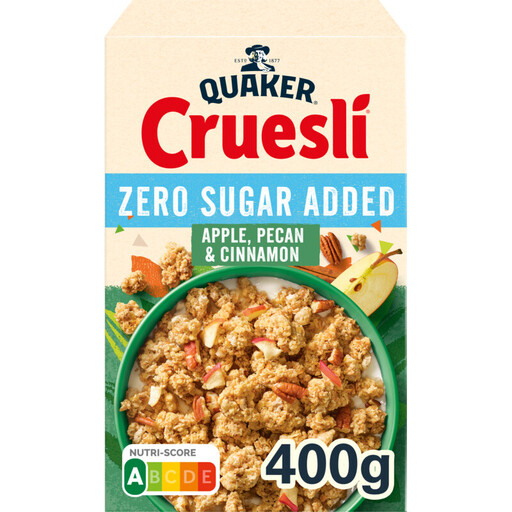 Image unavailable
For anyone comparing a crunchy variety with apple, pecan and cinnamon. The pack contains 400 g; check the allergens for this variety and use the label to calculate the carbohydrates in your own portion.
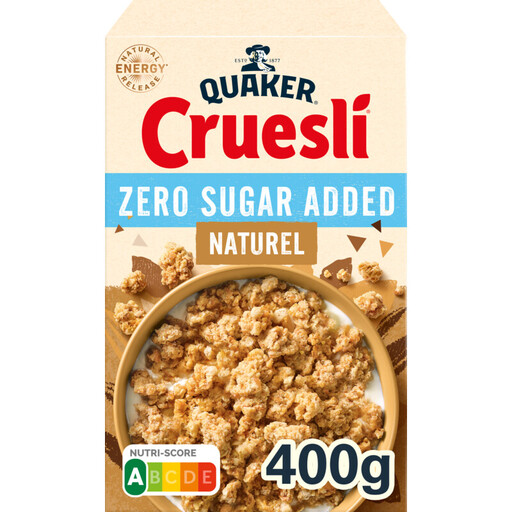 Image unavailable
For anyone looking for a plain option among the crunchy Cruesli varieties. The pack contains 400 g; compare the nutritional values per 100 g and read the allergen declaration before deciding on a portion.
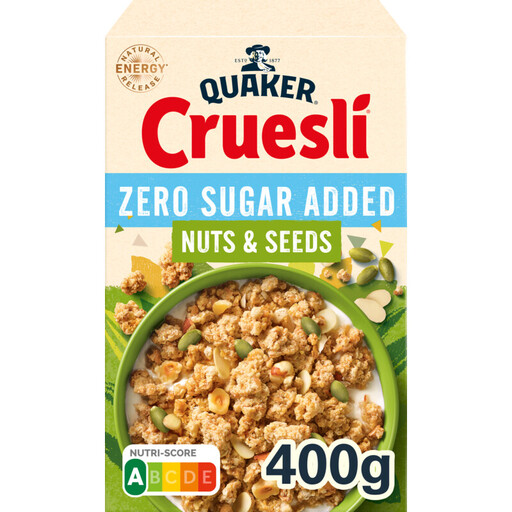 Image unavailable
For anyone considering a crunchy variety with nuts and seeds. The pack contains 400 g; when comparing, look beyond the nutritional values and check the allergen declaration for this variety too.
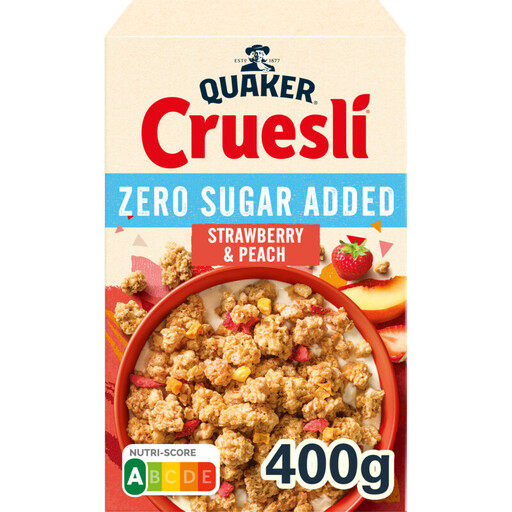 Image unavailable
For anyone looking for a crunchy variety with strawberry and peach. The pack contains 400 g; use the nutritional values per 100 g alongside the amount you actually eat to assess your portion.
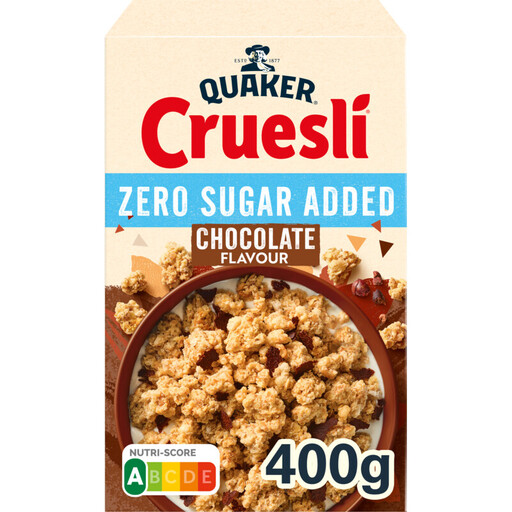 Image unavailable
For anyone comparing a crunchy chocolate variety. The pack contains 400 g; check the label to see the basis used for the fibre value, and read the information about carbohydrates, portion size and allergens too.
No, the wholegrain base alone doesn’t determine that. Wholegrain muesli also contains carbohydrates, so compare the nutritional information for the variety you choose and consider how much you eat, including any toppings.
No. Even with no added sugar, muesli can contain carbohydrates and naturally occurring sugars. Check the values per 100 g and work out your own portion rather than relying only on the claim on the pack.
First compare the ingredients, carbohydrates, sugars and fibre per 100 g. Then consider how much you have yourself; the portion size shown on the pack may not be the same as the amount in your bowl.
Not automatically. According to the Diabetes Fund, the right level of carbohydrate restriction varies from person to person, and a low-carbohydrate or reduced-carbohydrate diet may require changes to diabetes medication. So discuss any such change with your doctor and dietitian.