
Stock-up shopper who measures out their own portions
You eat porridge regularly and want to keep a plain base to which you can add your own ingredients. Jumbo and Albert Heijn describe wholegrain oats with a simple ingredients list.


If you use porridge oats regularly, a large pack of plain wholegrain oats is an obvious choice for your store cupboard, especially if you want to choose your own portions and toppings. Individual instant sachets are a better fit if measuring and preparation time matter more to you. Whichever option you choose, check the ingredients, allergens and storage instructions on the pack.
You eat porridge regularly and want to keep a plain base to which you can add your own ingredients. Jumbo and Albert Heijn describe wholegrain oats with a simple ingredients list.
You don't want to measure out oats every morning. Albert Heijn lists individual sachets for Quaker Oats Express Naturel; Jumbo says this product takes around two minutes to prepare.
You want to know which grains and other ingredients a product contains. If you have coeliac disease, oats need extra checking: the Netherlands Nutrition Centre recommends looking for the official Crossed Grain symbol on the pack.
First, decide whether you’d rather measure out your own portions from a larger pack or choose an individual serving. Then check the ingredients and any requirements around allergens or gluten-free oats.
| What to consider | What to check when buying | Who it matters to |
|---|---|---|
| Pack size | Compare the net weight and decide whether you want to measure out your own portions. | If I eat porridge often, I want a pack that lets me take out the amount I need each time. Pack size would be the first consideration for around 36% of consumers. |
| Preparation and portions | Check the portion size, amount of liquid needed and preparation method on the pack. | On busy mornings, I want to be able to grab a portion without measuring out oats first. Quick, predictable preparation would be the top priority for around 29% of consumers. |
| Ingredients and nutritional information | Check which type of oats is used and compare details such as fibre per 100 g and any added ingredients. | I want to choose what I add to my porridge, so I need to be able to compare the base ingredients and nutritional information. Around 21% of consumers would see this as their main consideration. |
| Allergens and suitability for a gluten-free diet | Read the latest allergen information. If you have coeliac disease, check that the pack carries the official Crossed Grain symbol. | If I need to check oats because of coeliac disease, the word ‘wholegrain’ on its own isn’t enough. For around 14% of consumers, suitability for their allergen or gluten-free requirements would be their main concern. |
Individual sachets give you a set amount each time, while you measure out your own portions from a larger pack. This affects how much freedom you have to adjust the serving size.
Check the amount in each pack and per serving before deciding which format suits your breakfast routine.
According to the Netherlands Nutrition Centre, ordinary oats are often contaminated with gluten. So a pack containing oats as its only ingredient is not automatically suitable for someone with coeliac disease.
If you have coeliac disease, check for the official Crossed Grain symbol and read the latest allergen information.
Albert Heijn lists wholemeal wheat flour and salt as ingredients in Brinta Volkoren graanontbijt. This is a different type of product from porridge oats.
If you specifically want oats, check the type of grain in the ingredients list rather than relying on the word ‘wholegrain’ on the front of the pack.
Even with a product you’re keeping in the cupboard, it’s important to follow the storage instructions on the pack. The Netherlands Nutrition Centre advises keeping products in their original packaging wherever possible and moving items that need using up first to the front.
Seal an opened pack properly and follow the storage advice on the label.
Offers both regular porridge oats and Oats Express Naturel in individual portions.
Offers fine wholegrain porridge oats in a 500 g pack, ideal as a base for measuring out your own portions.
Offers a 1 kg pack of fine wholegrain oats for anyone who regularly measures out their own portions.
Offers fine wholegrain porridge oats in a 500 g pack.
Lists a 500 g pack of jumbo oats as an in-store product.
A wholegrain cereal breakfast for anyone looking for a hot cereal, but not specifically oats.
These are Quaker Express options for anyone considering a quick-to-prepare oat breakfast. Compare their ingredients and pack sizes separately; they aren’t the larger packs of plain porridge oats discussed above.
 No image available
A handy option if you’re looking for a quick-to-prepare oat breakfast: Joybuy describes this product as containing wholegrain oats and taking around two minutes to prepare.
The listed ingredient information mentions cereals containing gluten and possible traces of soya, barley and wheat. Check the current label, especially if you’re looking for oats suitable for a gluten-free diet.
 No image available
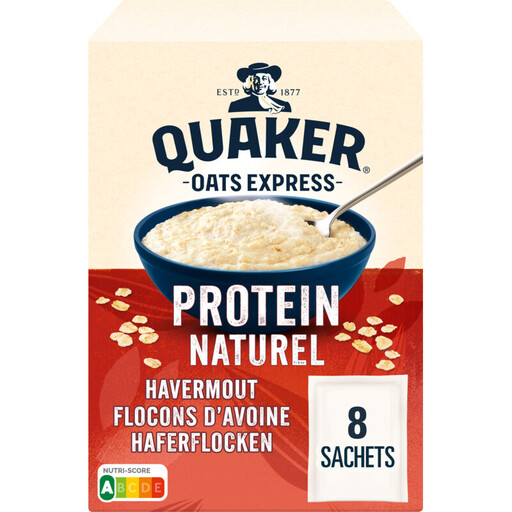
An Express option to consider if you’re looking for this specific Protein version as well as oats; the pack contains 302 g.
The listed ingredient information mentions soya and cereals containing gluten. Check the current label for the ingredients and preparation method, especially if allergens are important to your choice.
Yes, as long as you follow the storage advice on the pack. Seal an opened pack properly. The Netherlands Nutrition Centre advises keeping products in their original packaging wherever possible and moving items that need using up first to the front.
No. ‘Wholegrain’ describes the grain, not all the other ingredients. Check the ingredients list and nutritional information for the specific product; Albert Heijn lists 0 g of added sugars per 100 g for its fine wholegrain porridge oats.
Regular porridge oats aren’t automatically suitable for someone with coeliac disease, so you’ll need to check carefully. The Netherlands Nutrition Centre notes that oats are often contaminated with gluten and says to look for the official Crossed Grain symbol on the pack when choosing oat products.
Check the ingredients list on the current pack. The Netherlands Food and Consumer Product Safety Authority says that allergens which must be declared need to be clearly identified there, and that the type of grain must be clear for cereals containing gluten.