
If you like choosing your own toppings
You’re looking for a plain wholegrain base and want to add fruit, nuts, yoghurt or milk to suit your taste. A short ingredients list makes it easier to see what’s already in your porridge oats.


Choose porridge oats with only wholegrain oats in the ingredients list if you want to decide on the flavour and toppings for your weekend breakfast. Then compare fine and jumbo oats, or portioned products, based on preparation and ingredients. If you have coeliac disease, ordinary porridge oats are not automatically suitable, so the packaging must display an appropriate gluten-free certification mark.
You’re looking for a plain wholegrain base and want to add fruit, nuts, yoghurt or milk to suit your taste. A short ingredients list makes it easier to see what’s already in your porridge oats.
You want a hot or cold bowl without much preparation. Fine oats or a portioned product could suit you, but it’s worth checking the preparation instructions and any additional ingredients separately.
You’ll need to distinguish ordinary porridge oats from a suitable gluten-free option. The Voedingscentrum advises people with coeliac disease to look for the official Crossed Grain mark on the packaging.
First, decide whether you want a plain base, a particular preparation method or a ready-made portioned product. If you need to eat gluten-free because of coeliac disease, the suitability of the specific product takes priority over these preferences.
| What to consider | What to check before buying | Who it matters to |
|---|---|---|
| Plain wholegrain base | Check whether the ingredients list contains only wholegrain oat flakes or 100% wholegrain porridge oats. For products with added ingredients, compare the sugar and salt content per 100 g too. | If I’m adding my own fruit or other toppings, I want to know what’s already in the base. Around 36% of consumers place the greatest importance on choosing their own ingredients. |
| Preparation and oat type | Compare the preparation instructions and choose between fine or jumbo oats, or a portioned product. The name alone doesn’t tell you how to prepare it. | On a weekend morning, I want to choose between quickly making a warm bowl and taking a little more time over preparation. For around 29% of consumers, this practical difference comes first. |
| Gluten-free suitability | If you have coeliac disease, check the gluten-free label, the official Crossed Grain mark and the latest allergen information. | If I need to eat gluten-free because of coeliac disease, suitability determines which porridge oats I can buy. For around 21% of consumers, this is their first consideration. |
| Protein and portion convenience | For products with added ingredients, check the ingredients and allergen information. Compare the nutritional information per 100 g and per serving. | If I prefer a portioned product or extra protein, I also want to assess the rest of the ingredients. Around 14% of consumers prioritise this consideration. |
A product with flavourings or added protein ingredients has a different composition from porridge oats made with wholegrain oats alone. The name on the front doesn’t always make the difference clear.
Read the ingredients list, and for products with added ingredients, compare the sugar, salt and fibre per 100 g.
According to the Voedingscentrum, ordinary oat products may be unsuitable for people with coeliac disease because of contact with gluten, even though oats themselves are naturally gluten-free.
Choose an explicitly labelled gluten-free oat product with the official Crossed Grain mark, and check the latest packaging.
A ready-made portioned product may contain other ingredients and allergens as well as oats. For example, Quaker lists milk powder and soya protein in its Pot Protein Naturel.
Check the full ingredients list and compare the nutritional information per serving and per 100 g before choosing between these types of product.
Brinta Porridge Oats are made with extra-fine flakes, for anyone choosing based on oat type and preparation.
Quaker offers both ordinary wholegrain porridge oats and ready-made portioned products. Compare the specific variety rather than the brand alone.
Albert Heijn offers separate fine wholegrain oat flakes and a wholegrain variety labelled gluten-free.
Jumbo offers its own-brand wholegrain porridge oats as both fine and jumbo flakes, so you can choose the type that suits you.
Lidl lists jumbo oat flakes as a breakfast product that can be eaten with milk or yoghurt, among other options.
Aldi lists fine and jumbo wholegrain porridge oats under the Golden Bridge brand.
These products are suited to a porridge breakfast you can customise, as well as Express varieties for anyone looking for convenience or a different composition. If you need a gluten-free product, always check that the specific product is suitable.
 No image available
An option if you’re looking for porridge oats you can customise, with preparation that suits your morning routine. Check the packaging if you specifically want whole flakes or need to choose gluten-free products because of coeliac disease.
Pack size: 324 g.
 No image available
A choice for anyone looking for a base to add their own toppings to. The product name says Whole Wheat, while the listed ingredients refer to oat flakes. If the exact type of grain matters to you, check the latest packaging. Also check the allergen information.
Pack size: 500 g.
 No image available
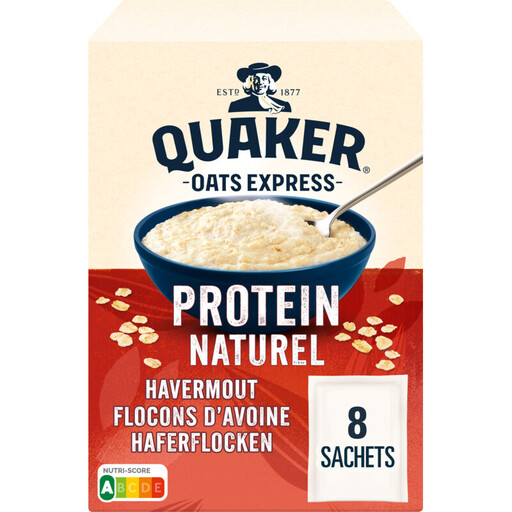
A blended alternative if you’re considering a protein version rather than plain porridge oats. Check the ingredients and allergens, including information about soya, and compare the protein content using the serving size on the latest packaging.
Pack size: 302 g.
Read the ingredients list: a plain base might list wholegrain oat flakes or 100% wholegrain porridge oats. If you also want to compare products with extra ingredients, check the sugar, salt and fibre per 100 g.
Ordinary porridge oats aren’t automatically suitable for people with coeliac disease. According to the Voedingscentrum, oat products may come into contact with gluten, so check that your chosen product carries the official Crossed Grain mark.
No, a protein version may contain other ingredients as well as oats. For example, Quaker lists milk powder and soya protein in Pot Protein Naturel. If you’re considering this type of product, check the allergens too, and compare the nutritional information per serving and per 100 g.