
If you’re looking for a simple wholegrain option
You want to eat muesli regularly and mainly check whether the product itself is labelled as wholegrain. Then you compare the ingredients, fibre and sugars per 100 g.


If you specifically want wholegrain muesli, start by choosing a product that is labelled as wholegrain. Then compare the ingredients and nutritional information per 100 g: plain muesli keeps things simple, while fruit and nuts add different flavours as well as allergens. A crunchy Cruesli with no added sugars may suit you if you prefer a crisp texture, but it is not automatically the same as wholegrain muesli.
You want to eat muesli regularly and mainly check whether the product itself is labelled as wholegrain. Then you compare the ingredients, fibre and sugars per 100 g.
You’re looking for a crunchy option with no added sugars or sweeteners. You’re happy to accept that Cruesli containing wholegrain ingredients isn’t automatically labelled as wholegrain muesli.
You order muesli along with your other shopping. Before you check out, you want to confirm your chosen variety, allergen information, delivery availability and available delivery slot.
If wholegrain is your main priority, start by checking whether the product is labelled as wholegrain. Then review the nutritional information for the specific variety and check whether it can be ordered and delivered to your address.
| What to consider | What to check before buying | Who it matters to |
|---|---|---|
| Wholegrain and fibre | Check whether the product itself is labelled as wholegrain. Then compare the fibre per 100 g in the varieties you’re considering. | If I specifically want wholegrain muesli, I don’t rely solely on the colour or individual ingredients shown on the pack. For around 37% of consumers, being able to verify that a product is wholegrain is the top priority. |
| Crunch and sugars | Read the ingredients list and compare total sugars and fat per 100 g; no added sugars doesn’t mean sugar-free. | I want something crunchy, but I also want to know exactly what the sugar information means. Around 27% of consumers prioritise this combination of crunch and avoiding added sugars. |
| Fruit, nuts and allergens | Check the ingredients and allergen information for the exact variety, as well as the sugars per 100 g. | I like the flavour of fruit and nuts, but if I have a relevant allergy, I need to read the ingredients and warnings carefully. This is a key consideration for around 18% of consumers. |
| Ordering online | Check the latest product information, delivery availability and delivery slot before completing your order. | If I want my muesli delivered with my other shopping, the retailer also needs to deliver to my address. For around 18% of consumers, being able to place an order conveniently is the main priority. |
A product may contain wholegrain flakes without being labelled as wholegrain muesli itself. According to the Netherlands Food and Consumer Product Safety Authority, a food may only be labelled as a wholegrain product when all of its grain ingredients are made from wholegrain flour.
If choosing wholegrain is a strict priority, look for the wholegrain label on the product itself. Use fibre or a no-added-sugars claim as additional points of comparison.
A product with no added sugars may still contain sugars. Dried fruit is also part of the ingredients in some fruit and nut mueslis.
For the varieties you’re considering, compare the ‘of which sugars’ figure per 100 g and read the ingredients list. Choose fruit and nuts for the ingredients you want, rather than assuming they mean a lower sugar content.
Muesli may contain cereals containing gluten or nuts. A product name or image doesn’t provide all the information about ingredients and possible cross-contamination.
Before ordering, read the allergen information for the exact variety. When it arrives, check the packaging label too.
A muesli being stocked by a supermarket doesn’t mean it’s also available for home delivery. For example, Lidl labels the muesli varieties mentioned as in-store only.
Check with the retailer you want to order from whether your chosen variety is available for your address and preferred delivery slot.
Albert Heijn’s range includes AH Wholegrain Muesli Plain and an organic wholegrain variety.
Jumbo Organic Wholegrain Muesli with Fruit and Nuts is an option if you’re looking for muesli labelled as wholegrain with dried fruit and nuts.
Brinta is an alternative if you’d prefer a hot cereal breakfast rather than cold muesli.
Quaker Cruesli Zero Sugar Added Plain is worth considering if you’re looking for a crunchy cereal with no added sugars or sweeteners.
ALDI lists Golden Bridge Wholegrain Muesli with cereal flakes and sultanas in its range.
Lidl’s range includes, among other things, fruit muesli and crunchy muesli with nuts.
This option suits you if you prefer crunchy breakfast cereal with no added sugars. If you specifically want muesli labelled as wholegrain, check the product description separately before ordering.
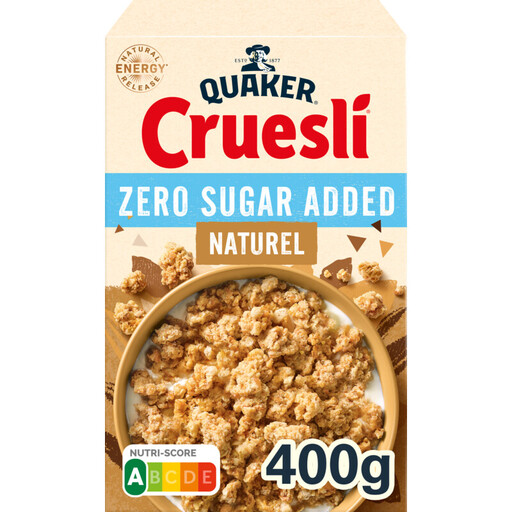 Image unavailable
An option if you’re looking for a crunchy cereal. The product information for this variety states that it contains no added sugars or sweeteners; the pack contains 400 g.
Don’t take wholegrain flakes in the ingredients list as confirmation that the product itself is labelled as wholegrain muesli. If you have an allergy, check the label too: the available product information lists cereals containing gluten and says that it may contain milk and nuts.
Check whether the muesli you’ve chosen is labelled as wholegrain itself, rather than simply containing wholegrain ingredients. According to the Netherlands Food and Consumer Product Safety Authority, a product may be labelled as wholegrain when all of its grain ingredients are made from wholegrain flour. Check the product page and the label when it arrives too.
No, a product with no added sugars may still contain sugars. Compare the total sugars per 100 g in the nutritional information and read the ingredients list for the specific variety.
Not necessarily: wholegrain ingredients alone don’t confirm that the product as a whole is labelled as wholegrain muesli. If you’re choosing strictly on that basis, check the label on the pack you’ve selected.
Read the ingredients and allergen information for the exact variety you want to order, including any warnings about the possible presence of allergens. Check the label again when it arrives, as product information may change.
Follow the storage instructions on the packaging you receive. Albert Heijn advises storing its wholegrain muesli in a well-sealed pack in a cool, dark and dry place; for other products, check the instructions on the pack.