
Commuters short on time for breakfast
If you want a quick breakfast at home or at work, a pre-measured portion and a clear preparation time are important. Just make sure you have the bowl and any equipment you need to hand.


Choose loose wholegrain porridge oats if you want to measure out your own portion, or sachets if pre-measured portions and quick preparation suit your mornings better. A variety with added soya protein is only a suitable choice if that’s an ingredient you’re specifically looking for. Check the ingredients, preparation instructions and allergen information on the current packaging for every variety.
If you want a quick breakfast at home or at work, a pre-measured portion and a clear preparation time are important. Just make sure you have the bowl and any equipment you need to hand.
If you eat porridge often and are happy to measure it out yourself, a pack of loose oats could fit neatly into your regular morning routine.
If you have an allergy or other dietary requirements, check the ingredients and allergen information for each variety. A product with added soya protein, for example, calls for a different consideration from a simple oat base.
Start by considering the time and equipment you have available for breakfast. Then compare the ingredients and decide whether you’d rather measure out your own portion or use individual sachets.
| What to consider | What to check before buying | Who should pay particular attention? |
|---|---|---|
| Preparation and convenience | Check the preparation time and whether you’ll need a microwave, saucepan or other equipment. | If I want breakfast straight away, the preparation needs to suit what I can use at the time. For around 36% of consumers, convenience matters most. |
| Wholegrain oats and ingredients | Read the ingredients and compare the nutritional information, such as fibre, sugars and salt, per 100 g. | I want to see how much wholegrain oat the product contains and what else has been added. This is the main consideration for around 29% of consumers. |
| Pack format | Check the pack size and number of portions, then decide whether you want to measure out your own or use individual portions. | For a regular breakfast routine, I want to know which pack format is practical for repeated use. Around 21% of consumers prioritise this practical choice. |
| Allergens and dietary requirements | Check the current ingredients and allergen information, including for varieties with added soya protein. | If I need to avoid certain ingredients, the exact variety must meet my requirements. For around 14% of consumers, this is the first thing they consider. |
According to the product information, the Quaker Express Protein variety contains soya protein and soya lecithin as well as wholegrain porridge oats. Its ingredients therefore differ from those of a simple oat base.
Read the ingredients for the exact variety, especially if you avoid soya or are specifically looking for a product with added soya protein.
For a mixed instant product, this word doesn’t tell you what other ingredients it contains or what its nutritional values are per 100 g.
As well as checking the ingredients, look at the nutritional information and consider what you’ll add to your breakfast.
Ingredients and allergen information can vary between varieties or packs. This is particularly important if you need to avoid an allergen.
Check the current packaging before use, and don’t rely solely on the front of the pack or an older online description.
The product ranges mentioned include regular wholegrain porridge oats and Express varieties with different pack formats or ingredients.
Brinta Porridge Oats are a fine-flake option for anyone who wants to make a warm bowl of porridge themselves.
Under its own brand, Jumbo lists fine, coarse and organic wholegrain porridge oats, among other options.
Albert Heijn lists its own-brand oat products in fine, coarse and protein varieties, among others.
Golden Bridge is an ALDI product range that includes fine and coarse wholegrain porridge oats.
These Express varieties are designed for a breakfast you prepare shortly before eating: one has pre-measured portions of wholegrain porridge oats, while the other contains added soya protein. Both preparation methods mentioned require a microwave or saucepan.
 Image unavailable
For anyone who wants a pre-measured portion and can use a microwave or saucepan.
The product information lists 12 sachets, 100% wholegrain oats and a preparation time of 2 minutes.
Check the current packaging if you have allergies: the product information states that traces of soya, barley and wheat may be present.
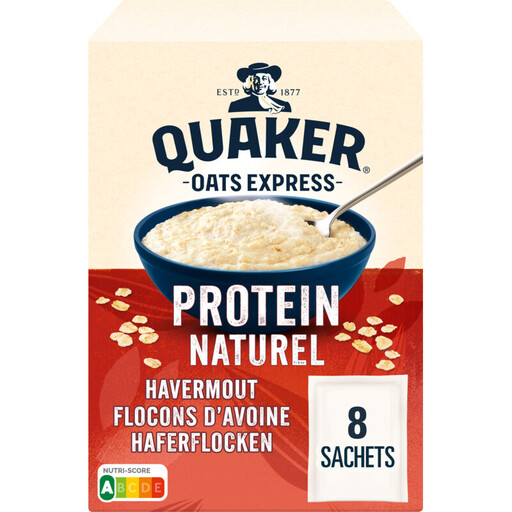 Image unavailable
For anyone looking for a quick-to-prepare oat product that deliberately includes added soya protein.
According to the product information, this variety contains 85% wholegrain porridge oats and 15% soya protein; the stated preparation time is 2 minutes.
The product also contains soya lecithin and may contain barley and wheat. If you have allergies, read the current packaging and check the nutritional information per 100 g or per portion.
Read both the product name and the ingredients list. For a mixed variety, the list shows how much wholegrain oat it contains and what else has been added.
It depends on the exact products, so compare the ingredients, nutritional information per 100 g, portion format and preparation instructions. The word ‘instant’ alone doesn’t tell you what has been added to a product.
Choose a preparation method that suits the equipment you can actually use. According to their product information, the Quaker Express varieties mentioned take 2 minutes to prepare; with loose porridge oats, you’ll also need to measure out your own portion.
Yes. Check the ingredients and allergen information on the exact pack. According to the product information, the Quaker Express Oatmeal mentioned may contain traces of soya, barley and wheat, while the Express Protein variety contains soya protein.