
Fibre-conscious shoppers stocking up
You regularly buy crispbread for breakfast, lunch or a snack, and want to compare the fibre content per 100 g as well as per typical serving.


When doing your weekly shop, use the ‘wholegrain’ designation as your starting point, then compare fibre and salt per 100 g, ingredients and allergens. A larger pack can be handy for several meals, but check that the ingredients suit your household and consider how you’ll store it after opening before you choose one.
You regularly buy crispbread for breakfast, lunch or a snack, and want to compare the fibre content per 100 g as well as per typical serving.
You eat crispbread often and want to compare the salt content of different packs, bearing your toppings in mind.
You want to know which grains and allergens are listed on the packaging before you buy. The word ‘wholegrain’ doesn’t replace that check.
Start with the wholegrain designation. Then compare the nutritional information on the same basis, and only after that decide which pack size to add to your weekly shop.
| What to consider | What to check when buying | Who it matters to |
|---|---|---|
| Wholegrain designation | Check whether the product is called ‘wholegrain’. If it says ‘with whole grains’, also read the ingredients and any percentages listed. | If wholegrain crispbread is going to be my regular choice for the week, I want to know what the designation on the pack means. For around 33% of consumers, choosing a wholegrain option comes first. |
| Fibre | Compare fibre per 100 g and check the weight of a typical serving. | For regular breakfasts or lunches, I want to compare the fibre content of different packs. Around 27% of consumers say this comparison is their top priority. |
| Salt | Compare salt per 100 g and take your toppings into account. | If I often eat crispbread with toppings, I don’t want to look at the salt in the crispbread alone. Comparing salt is the top priority for around 20% of consumers. |
| Allergens and storage | Read the current allergen information and check how to store the pack after opening. | I want to choose packaging that suits what my household can eat and finish. For around 20% of consumers, this check comes first. |
According to the Netherlands Food and Consumer Product Safety Authority, the grain ingredient in a product described as wholegrain must consist entirely of wholemeal flour. A statement that a product contains whole grains doesn’t, by itself, provide the same clarity.
Use the exact product description as your first filter. If the wording is different, read the ingredients list.
A pack with more fibre per 100 g may also have a different salt content or different allergens. Albert Heijn lists 20 g of fibre and 1.2 g of salt per 100 g for Wasa Volkoren; for AH Knäckebröd volkoren, the retailer lists 12 g of fibre and 0.7 g of salt per 100 g.
Compare fibre and salt on the same basis, then read the ingredients and allergen information.
The salt content shown on a pack of crispbread doesn’t tell you everything about the meal: toppings can contain salt too.
If you regularly have crispbread for lunch, check both the crispbread and what you put on it.
Ingredients can change. Storage instructions also matter if the pack will be open for several days.
Check the allergen information every time you buy, and seal the pack after opening as directed on the packaging.
If the crispbread goes soft before you finish the pack, some of your weekly supplies could go to waste.
These examples refer to the products listed. When you buy, always check the packaging of the specific variant you choose.
Wasa Volkoren is rye crispbread in a 260 g pack.
AH Knäckebröd volkoren is an own-brand product in a 375 g pack.
Jumbo Knäckebröd Volkoren is an own-brand product for anyone looking for a pack to enjoy over several meals.
Bolletje Volkoren knäckebröd vezelrijk is a wheat and rye variant in a 265 g pack.
These products include packs of crispbread and a cracker option to compare with your weekly shopping list. For each variant, check the current wholegrain designation, nutritional information and allergens. Crackers aren’t necessarily the same type of product as crispbread.
 Image unavailable
An option to compare with other packs for fibre and salt if you eat crispbread regularly.
Check the packaging for nutritional information per 100 g and the current allergen information.
 Image unavailable
A larger pack for a household that wants to enjoy crispbread on several days.
If it’s essential to you that all the grain ingredients are wholegrain, check the ingredients and exact wholegrain designation on the label.
 Image unavailable
A smaller pack to weigh up against the larger options for the week.
Compare fibre and salt per 100 g on the packaging, and check which grains and allergens are listed.
 Image unavailable
A wholegrain option to compare if crispbread regularly features on your table.
Use the nutritional information for this specific variant to compare fibre and salt; don’t assume the figures are the same as for other Wasa products.
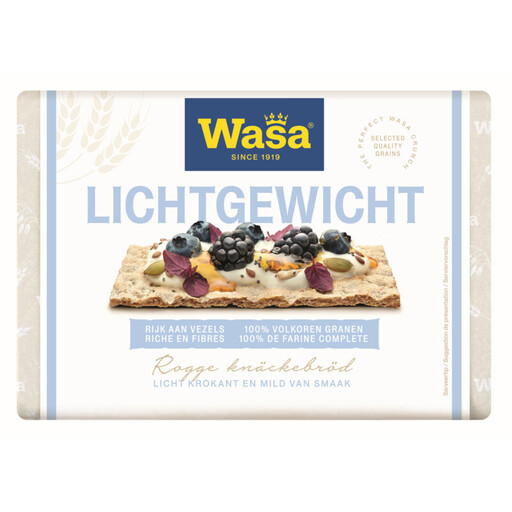 Image unavailable
If you’re also considering crackers as an alternative, check that this type of product matches the crispbread you’re looking for.
Also check the wholegrain designation, nutritional information and allergens on this pack.
Check whether the product itself is described as ‘wholegrain’. According to the Netherlands Food and Consumer Product Safety Authority, products labelled this way must have grain ingredients consisting entirely of wholemeal flour. If it says ‘with whole grains’, it’s a good idea to check the ingredients too.
Not if salt, ingredients or allergens are more important to you. Albert Heijn lists 20 g of fibre and 1.2 g of salt per 100 g for Wasa Volkoren. Compare both figures on the pack you’re actually choosing.
Read the full allergen information on the current label. The Netherlands Food and Consumer Product Safety Authority says this information must be shown on prepacked products. For the variants discussed here, gluten-containing cereals and, depending on the product, sesame are among the allergens to look out for.
Follow the storage instructions on the packaging and seal the pack securely after opening. Keeping it somewhere dry helps stop moisture from affecting its crispness, especially if the pack will last several days.