
Student on a tight food budget
You’re looking for a wholegrain base for a quick meal and want to choose a pack you’ll actually finish.


For a student meal, first choose crispbread labelled ‘wholegrain’, then compare the fibre and salt per 100 g. Check the ingredients and allergens on the pack you’re buying, too. If you often eat crispbread instead of bread, don’t automatically assume you’re getting iodine from baker’s salt: check the label.
You’re looking for a wholegrain base for a quick meal and want to choose a pack you’ll actually finish.
You want to be able to tell whether a product is wholegrain and compare the fibre, salt and ingredients using the same nutritional basis: per 100 g.
You regularly eat crispbread instead of bread, or need to check carefully for gluten and other ingredients. According to the Voedingscentrum, bakers don’t always use baker’s salt, so check the exact pack if iodine from bread is a concern for you.
Start with the ‘wholegrain’ label. Then compare pack sizes and nutritional information, and read the ingredients if you’re replacing bread or need to avoid certain substances.
| What to consider | What to check when buying | Who it matters to |
|---|---|---|
| Pack size | Check the weight and choose an amount you can finish once opened. Store crispbread in a dry place in a tightly sealed pack. | With a tight food budget, I don’t want to be left with an opened pack that loses its crunch; around 36% of consumers put this practical consideration first. |
| Wholegrain and fibre | Look for the ‘wholegrain’ label, then compare fibre per 100 g; check the salt content on the same basis, too. | I want to be sure my crispbread is wholegrain and compare the nutritional values of different packs; around 29% of consumers give this the highest priority. |
| Using it as a bread substitute | Check the ingredients list for iodised salt or baker’s salt. The Voedingscentrum points out that baker’s salt isn’t always used. | If I often replace bread with crispbread, I don’t want to assume, without checking the label, that both products contribute to my iodine intake in the same way; this is the main question for around 21% of consumers. |
| Ingredients and allergens | Read the full ingredients and allergen information. Standard wholegrain crispbread made with rye, wheat or barley is not the same as a product specifically labelled gluten-free. | If I need to avoid gluten or another ingredient, the exact pack needs to suit my diet; around 14% of consumers put this check ahead of other selection criteria. |
A fibre claim doesn’t, by itself, tell you whether crispbread is wholegrain. The Voedingscentrum explains that the ‘wholegrain’ label on crackers is linked to the use of wholemeal flour.
First check that the pack says ‘wholegrain’, then compare the fibre per 100 g.
According to the Voedingscentrum, bakers aren’t required to use baker’s salt. So you can’t tell whether a pack contains iodised salt just from the type of product.
Read the ingredients list if crispbread regularly replaces bread, and take the rest of your diet into account when making your choice.
The standard varieties described here, made with rye, wheat or barley, contain gluten-containing grains. ‘Wholegrain’ or ‘high in fibre’ doesn’t mean gluten-free.
If needed, choose a product specifically labelled gluten-free and check its other ingredients and allergens, too.
The details below apply to the varieties named, not necessarily to all crispbread from the same brand. Always check the pack you’re planning to buy.
The Wasa Wholegrain variety described by Albert Heijn is made with wholegrain rye and has a short ingredients list.
AH Wholegrain Crispbread is a standard own-brand variety. Albert Heijn also sells a separate crispbread product labelled gluten-free.
Jumbo Wholegrain Crispbread is an own-brand variety made with wheat and rye.
The Bolletje Wholegrain High-Fibre Crispbread variety described combines wholegrain wheat, rye and barley.
Ryvita describes its Original Crispbread as a product made with wholegrain rye.
These packs may suit you if you’re looking for wholegrain crispbread for a student meal. Before choosing, compare the nutritional information and ingredients on the specific pack, especially if you’re checking fibre, iodine or allergens.
 No image available
An option if you’re looking for wholegrain crispbread for a quick meal. For this pack, check the fibre and salt per 100 g, and read the ingredients and allergen information if you need to avoid certain grains or sesame.
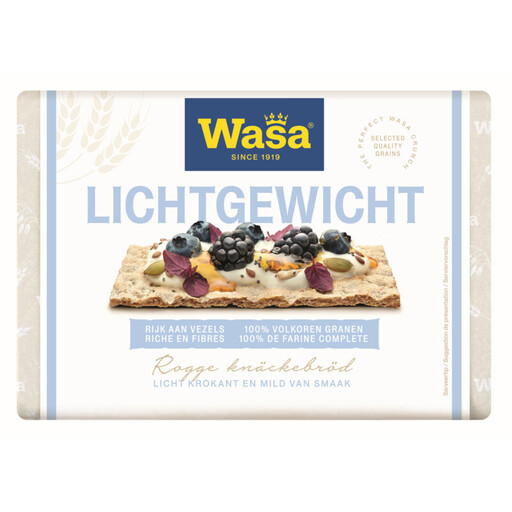 No image available
This pack could be a good option if you want crispbread to eat with toppings. Check the exact pack for the wholegrain label and fibre per 100 g, and read the ingredients if rye or dairy products are relevant to you.
 No image available
An option if you’re specifically looking for wholegrain crispbread to eat with toppings. Check the fibre per 100 g and allergen information on this pack; rye-based crispbread isn’t suitable if you need to avoid gluten.
Check whether the pack says ‘wholegrain’. According to the Voedingscentrum, ‘brown’, ‘multigrain’ or ‘high in fibre’ alone doesn’t prove that a cracker is made entirely with wholemeal flour.
No, don’t assume it does. The Voedingscentrum says that bakers aren’t required to use baker’s salt; if you often eat crispbread instead of bread, check the ingredients list for iodised salt or baker’s salt.
Not if it contains gluten-containing grains such as rye, wheat or barley. If you need to avoid gluten, choose a product specifically labelled gluten-free and check its other ingredients and allergens, too.
Store crispbread in a dry place and seal the pack tightly after opening. Albert Heijn and Jumbo’s product information recommends storing it in a dry, sealed pack to keep it crisp.