
Families comparing fibre content
You regularly buy crispbread for several people and want to weigh up the fibre content per 100 g against the salt content.


For a large household, compare more than just pack size: check fibre and salt per 100 g too. Then check the ingredients and allergens on the pack. A variety that suits one member of the household may not be suitable for everyone.
You regularly buy crispbread for several people and want to weigh up the fibre content per 100 g against the salt content.
You want to choose a pack that suits how often your household eats crispbread and the space you have to store it somewhere dry and well sealed.
Before buying for several family members, you check each product’s grains, sesame and any warnings about other allergens.
Start with what matters most to your household: the nutritional information, pack size or ingredients. Always compare fibre and salt on the same basis, per 100 g.
| What to consider | What to check when buying | Who is it most relevant to? |
|---|---|---|
| Fibre and salt | Read both figures per 100 g; don’t assess a fibre claim without considering the salt content. | When buying crispbread for several people, I want to weigh up how much fibre and salt the same variety contains. For around 36% of consumers, this would be the main consideration. |
| Pack size | Compare the weight in grams and consider whether you can keep an opened pack dry and well sealed. | In a household that eats crispbread often, I want to stock up without opening more than we’ll use. For around 29% of consumers, choosing the right pack size would come first. |
| Ingredients and allergens | Check the current ingredients list, allergen declaration and any warnings about possible traces. | If someone in the household needs to avoid certain grains or sesame, I want to know whether everyone can eat the same pack. For around 21% of consumers, suitability would be their main concern. |
| Wholegrain and iodine | Read the wholegrain description and ingredients. If you have a question about iodine, look for information about baker’s salt on the pack or ask the manufacturer. | If the exact grain composition or iodine information determines my choice, I don’t want to infer it from the product category. For around 14% of consumers, checking this information on the label would be most important. |
Consumentenbond considers both fibre and salt when assessing crispbread. The varieties described by Jumbo and Albert Heijn differ in both respects.
Put the nutritional information for two packs side by side and compare fibre and salt per 100 g.
According to the Netherlands Food and Consumer Product Safety Authority, the grain ingredient in a product labelled ‘wholegrain’ must consist entirely of wholemeal flour. However, the grains used and allergens can still vary from product to product.
When buying, check the product name, ingredients list and allergen declaration on the current pack.
A 375 g pack is only practical if your household uses it regularly and you can store opened crispbread properly.
Choose an amount that suits how much you use and follow the storage advice on the pack once opened.
Voedingscentrum states that using baker’s salt in baking is not compulsory. So you can’t assume that crispbread contains baker’s salt.
If iodine information matters to your choice, check the label or ask the manufacturer.
A brand to consider if you’re looking for crispbread made with wholegrain rye.
A brand to compare if you’re looking for a variety made with wheat, rye and barley.
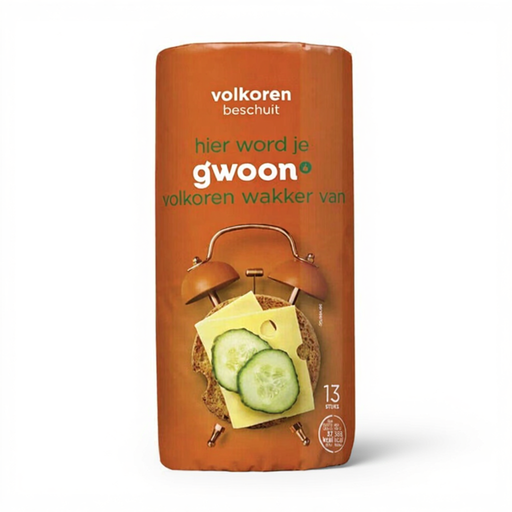
The own-brand range includes a wholegrain crispbread variety in a 375 g pack.
The own-brand range includes a wholegrain crispbread variety in a 375 g pack.
These products come in packs ranging from 125 to 375 g, so you can compare them side by side. To choose what’s right for your household, check the current nutritional information, ingredients and allergens on the pack.
 No image available
An option if you want to take fibre into account when choosing crispbread. Compare fibre and salt per 100 g on the pack, and check the information about grains and sesame if you have allergies.
 No image available
The 375 g pack may suit regular use. Check the current ingredients carefully: the mention of ordinary wheat flour in this variety means it’s worth taking a closer look at the wholegrain description. Also check the allergen declaration.
 No image available
Consider this variety if you’re looking for rye crispbread. Check the nutritional table for the exact fibre content per 100 g, and if you have allergies, check the information about rye and possible traces of milk or sesame.
 No image available
An option to consider if you prefer wholegrain rye. Compare the fibre and salt on the current pack; if you have allergies, also look out for rye and possible traces of sesame or milk.
 No image available
The 125 g pack may suit you if you’d rather keep less in stock. Check the wholegrain description and ingredients on the pack, as this variety also lists wheat flour without a wholegrain description; check the allergen declaration too.
Read the product name and ingredients list on the current pack. According to the Netherlands Food and Consumer Product Safety Authority, the grain ingredient in a product labelled ‘wholegrain’ must consist entirely of wholemeal flour. Also check which grains the product contains.
Follow the instructions on the pack and seal it well after opening. Albert Heijn recommends storing its wholegrain crispbread in a sealed tin; Jumbo advises keeping its variety somewhere dry and sealing it well.
No, don’t assume it does. Voedingscentrum states that using baker’s salt in baking is not compulsory. Check the label or ask the manufacturer about the ingredients in the specific product.
Check the grains used, sesame and any warnings about other allergens on each pack. The varieties described by Jumbo and Albert Heijn differ, so a previous purchase is no substitute for checking the current allergen declaration.