
Households keeping an eye on pack sizes
If you eat crispbread often, you’ll want to know how many pieces or how many grams are in a pack, without accidentally choosing a non-wholegrain option.


If you eat crispbread regularly, start by choosing a product labelled wholegrain, then compare pack sizes and fibre per 100 g. A larger pack does not automatically have the same nutritional value or ingredients as another wholegrain option, so always check the latest label for salt and allergens too.
If you eat crispbread often, you’ll want to know how many pieces or how many grams are in a pack, without accidentally choosing a non-wholegrain option.
If you regularly have crispbread for breakfast or lunch, you can compare the wholegrain label and fibre per 100 g. According to the Voedingscentrum, a 10 g piece of wholegrain crispbread contains an average of 1.4 g of fibre; the value for a specific product is shown on the pack.
If you need to avoid certain grains or other ingredients, the wholegrain label alone isn’t enough. Product information from Albert Heijn, Jumbo and Wasa shows that ingredients and allergen statements vary between products.
Start with the wholegrain label if that’s your main priority. Then compare the pack size and nutritional information of the options that meet your needs.
| What to consider | What to check when buying | Who it matters to |
|---|---|---|
| Pack size | Compare the net weight and, where stated, the number of pieces. | If I eat crispbread often, I want to know how much is in a pack. Around 40% of consumers put pack size first. |
| Wholegrain and fibre | Look for the wholegrain label and compare fibre per 100 g. | For my daily breakfast or lunch, I want a wholegrain option whose fibre content I can compare. This is the top priority for around 40% of consumers. |
| Ingredients and allergens | Read the latest ingredients and allergen information; check salt per 100 g too if needed. | If I need to avoid an ingredient, the label determines which options are suitable. This is the first consideration for around 20% of consumers. |
Wholegrain crispbread packs don’t all contain the same amount. So a quick glance at the front won’t tell you how much crispbread you’re taking home.
Compare the net weight and, for packs that state the number of pieces, check the piece count too.
A product containing several types of grain isn’t necessarily made with wholemeal flour. According to the Voedingscentrum, the wholegrain label on crackers means that wholemeal flour has been used.
If wholegrain is a must for you, look specifically for that wording on the pack.
The fibre content doesn’t tell you whether a product is suitable for someone with an allergy. The options reviewed list, among other things, cereals containing gluten and sesame, or warn that other allergens may be present.
Check the latest ingredients and allergen information every time you buy, even if you’ve bought the product before.
A salt declaration doesn’t tell you whether iodised baker’s salt has been used in a particular product.
If this matters to your choice, check the ingredients on the pack or ask the manufacturer.
Own-brand option with a 375 g pack of wholegrain crispbread.
Own-brand option with a 375 g pack of wholegrain crispbread.
ALDI own-brand option: a pack of 25 pieces of wholegrain crispbread, weighing 375 g.
The Wasa Wholegrain option reviewed is made with wholegrain rye.
The wholegrain crispbread option reviewed contains, among other things, wheat, rye, barley and sesame.
These four packs are worth considering if you’re looking for crispbread for breakfast, lunch or a snack. Compare the wholegrain label and nutritional information for each option; the details for Wasa Wholegrain in the brand section don’t necessarily apply to Wasa Lightweight or Wasa Rustic.
 No image available
A pack for anyone who likes to have crackers for breakfast or lunch. Check the latest pack to see whether the wholegrain label, fibre content and ingredients suit your needs.
 No image available
A wholegrain option to consider if the types of grain and fibre content matter to you. Compare the nutritional information per 100 g and read the latest ingredients and allergen information.
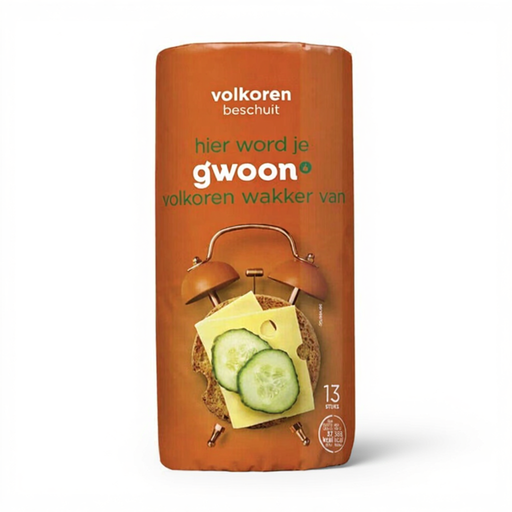 No image available
The 125 g pack is a good option if you’d prefer to buy a smaller amount. Also check the nutritional information and ingredients for this particular product.
 No image available
A rye option to try with toppings or as a snack. If the wholegrain label and fibre content matter to you, check the pack.
Look for the wholegrain label on the pack and read the ingredients list. The Voedingscentrum explains that multigrain doesn’t automatically mean wholegrain.
No, fibre content varies by product. Jumbo lists 10.9 g of fibre per 100 g for the wholegrain crispbread reviewed, Albert Heijn lists 12 g, and Wasa Wholegrain product information lists 20 g per 100 g. Always compare like for like, per 100 g, and check the latest pack.
You can’t tell from the product category alone. The Netherlands Food and Consumer Product Safety Authority sets out conditions for the use of iodine compounds through baker’s salt in bread, bread substitutes and other baked goods. This doesn’t confirm that a particular pack of crispbread contains this salt. Check the label or ask the manufacturer.
Seal the pack tightly after opening and follow the storage instructions on the label. Albert Heijn recommends keeping its crispbread in a sealed tin, while Jumbo advises sealing its pack tightly after opening.