
Hosts catering for fussy eaters
Want to offer guests a familiar white roll without leaving out the wholemeal option. Albert Heijn lists separate white and wholemeal rolls that could work well on a platter with both options.


Put white rolls and rolls explicitly labelled as wholemeal side by side, so guests can easily tell them apart if they have different bread preferences. White rolls are a familiar choice; for guests who are particularly interested in fibre, wholemeal is the relevant option. Don’t assume multigrain means wholemeal without checking the label, and if anyone has an allergy, check the information on the exact pack you’ve chosen.
Want to offer guests a familiar white roll without leaving out the wholemeal option. Albert Heijn lists separate white and wholemeal rolls that could work well on a platter with both options.
Want a roll that is actually labelled as wholemeal, rather than one that simply contains several types of grain. According to the Netherlands Nutrition Centre, wholegrain cereal products contain more fibre than white cereal products.
Want to serve bake-at-home rolls on time alongside the other snacks. Compare the cooking instructions and number of rolls on the pack; PLUS, for example, lists different baking times for its white and multigrain rolls.
First decide whether you want to offer both white and wholemeal rolls. Then choose a pack of each that suits the number of guests and when you plan to serve them.
| What to consider | What to check when buying | Who is this important for? |
|---|---|---|
| Choosing between white and wholemeal | Choose both types of bread if you expect different preferences, and keep them clearly separate when serving. | If guests are particular about the taste or texture of bread, I don’t want everyone to have to choose the same roll. Around 40% of consumers put having that choice first. |
| A genuine wholemeal option | Check that the product is labelled wholemeal; don’t rely on the name or colour alone for multigrain rolls. | I specifically want to serve wholemeal because fibre matters to me. For around 40% of consumers, this is their main bread preference. |
| Baking time and quantity | Compare the number of rolls and cooking instructions on the packs you’re considering. | If the rolls need to be ready at the same time as the snacks, I want to know how many to put in the oven and how long they’ll take to bake. This is the main consideration for around 20% of consumers. |
The name ‘multigrain’ doesn’t, by itself, mean that all the grain ingredients are wholemeal. You could end up choosing a roll that doesn’t meet someone’s specific preference for wholemeal bread.
Look for the wholemeal label and read the information on the specific rolls. Choose multigrain for the taste or texture you want, not as an unverified substitute for wholemeal.
General information about bakers’ salt doesn’t tell you which type of salt was used in the rolls on your platter.
If iodine is important to your choice, check the latest ingredients information for the product you’ve chosen.
White, wholemeal and multigrain are no substitute for product-specific allergen information. If someone has a food allergy, a wrong assumption could have serious consequences.
Check the current packaging before serving. For unpackaged rolls, ask the shop for allergen information.
Guests who consciously choose wholemeal won’t have a suitable bread option. According to the Netherlands Nutrition Centre, wholegrain cereal products contain more fibre than white cereal products.
If your guests have different preferences, serve a separate, clearly labelled wholemeal option alongside the white rolls.
Albert Heijn lists separate AH rolls in white and wholemeal varieties.
Jumbo lists wholemeal rolls in packs of four and also includes white rolls in its bake-at-home range.
PLUS lists white and multigrain bake-at-home rolls in 300 g packs.
Dirk lists white and multigrain bake-at-home rolls in packs of four.
ALDI lists an individual white roll and also describes white and wholemeal rolls in its wider bakery range.
Lidl lists a white roll and describes a fresh-from-the-oven range in its shops.
These Joybuy rolls are a white-bread option for guests who prefer it. If you’d also like to offer wholemeal, choose separate rolls that are explicitly labelled as wholemeal.
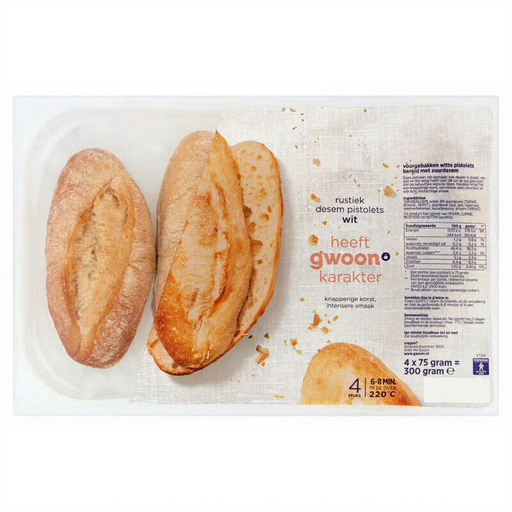 Image unavailable
For guests who’d like a white roll; the pack contains 4.
Check the cooking instructions on the pack and, if anyone has an allergy, read the latest allergen information.
No. ‘Multigrain’ doesn’t automatically mean that all the grain ingredients are wholemeal. Check the product description and label if you specifically want wholemeal rolls; the NVWA defines the wholemeal label in relation to a grain ingredient made from 100% wholemeal flour.
Use the latest allergen information for the exact rolls you’re serving. Read the label on packaged products and ask the shop for product-specific information about unpackaged rolls. Don’t rely on the description ‘white’, ‘wholemeal’ or ‘multigrain’ alone.
You can’t assume that every roll does. Dutch rules on iodine in bakers’ salt don’t tell you which ingredients have been used in an individual product. Check the latest product information if this matters to your choice.
Start with the cooking instructions on the pack you’ve chosen and plan when to serve the food accordingly. For example, PLUS says to bake its white rolls at 220 °C for 6–8 minutes and its multigrain rolls at 220 °C for 8–10 minutes. For other products, follow their own instructions.
Albert Heijn and Jumbo both list the two types of bread as separate products. Check the current product description and availability before buying; a multigrain roll or a general listing for wholemeal rolls isn’t necessarily the specific wholemeal roll you’re looking for.