
Vandaag of morgen in huis

Kwaliteit gegarandeerd

Welkomstaanbiedingen ontgrendelen: GRATIS bezorging | Tot 80% korting | Gratis 30 dagen JoyPlus-proefperiode
Download de app
Would you like to reduce surface stains without immediately considering a professional treatment? Whitening toothpaste can be a practical choice for your daily routine. Its effectiveness depends mainly on the type of discolouration and the toothpaste’s formulation. Coffee, tea, red wine and tobacco can cause deposits on the tooth surface. Toothpaste for whiter teeth generally targets these surface stains, not the natural colour of the dentine.
Packaging can sometimes make comparisons difficult. Terms such as “white”, “crystals” and “3D White” say little on their own about how the product is actually intended to be used. Instead, look for verifiable information such as fluoride content, recommended age, volume and frequency of use.
A stain-removing toothpaste can help loosen deposits caused by coffee or tea. However, discolouration caused by ageing, a damaged tooth or a filling will not automatically change as a result. Brands may make whitening claims based on their own research or a clinical study. Treat such claims as product information, not a guarantee for every set of teeth.
Toothpaste for discolouration should also be suitable for daily brushing. Check whether it contains fluoride and how much. Several products in this overview list 1450 ppm fluoride, including various Oral-B and Colgate options. According to the product information, fluoride helps protect against cavities and support tooth enamel.
A strong mint or Arctic Fresh flavour creates a clean feeling, but does not in itself say anything about the cleaning performance. If fresh breath is your main priority, you can compare flavours and ingredients, but you should also pay attention to brushing time and technique. Brushing too hard is not a good way to achieve results faster.
For adults, a fluoride toothpaste for daily use is a sensible starting point. Check the label for the exact fluoride content and follow the manufacturer’s age recommendations. Some whitening products are not intended for young children. For children aged 6 and over, the instructions often mention using a small amount and supervising brushing, but recommendations vary from product to product.
If you are unsure about fluoride from multiple sources, sensitivity or irritation, it is advisable to consult a dentist. Do not swallow toothpaste and keep the tube out of the reach of young children.
Ingredients such as hydrated silica and pyrophosphates are found in several whitening formulas. Product descriptions link them to removing or helping to prevent surface stains. The presence of these ingredients does not mean that a product is suitable for every sensitive mouth.
Claims such as “enamel-safe” or “without harsh abrasives” come from the brand’s product information. According to Oral-B’s own research, certain 3D White formulas are designed to remove surface stains without damaging enamel. Always use gentle pressure and a soft toothbrush.
A tube often contains 75 or 100 ml. Multipacks, such as 3 x 75 ml, 5 x 75 ml or 12 x 75 ml, can be convenient for a household with several users. Do not compare only the total price; also compare the price per 100 ml. In addition, check the shelf life and the product information on the packaging, especially when buying several tubes at once.
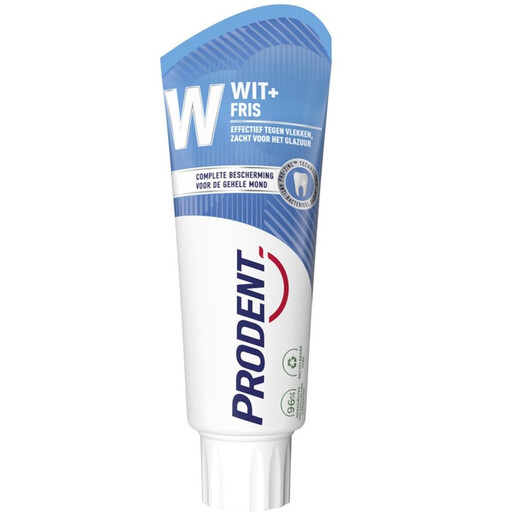
Why it suits this profile: A compact tube for anyone looking for a simple toothpaste for whiter teeth with a fresh flavour, without buying a multipack straight away.
The product information lists fluoride and instructions for daily brushing. This means you look beyond just the word “white” on the packaging.
75 ml, with hydrated silica, kaolin, zinc citrate and sodium fluoride according to the ingredients list.
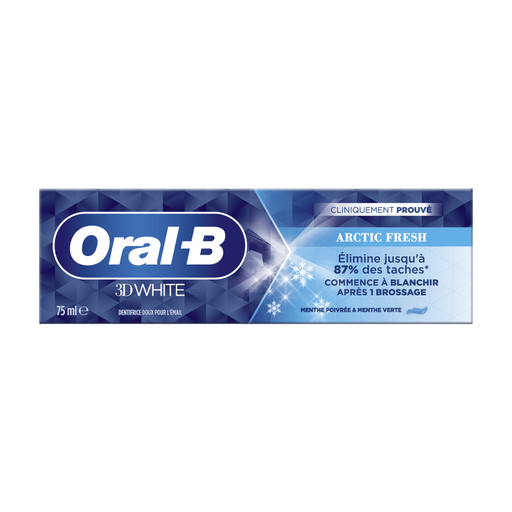
Why it suits this profile: For adults who want to combine whitening, fluoride protection and a distinctly fresh flavour in one tube.
The product description refers to a formula for daily use and lists 1450 ppm fluoride. The claim of removing up to 87% of surface stains is a brand claim.
75 ml, Arctic Fresh flavour, hydrated silica and disodium pyrophosphate according to the product information.
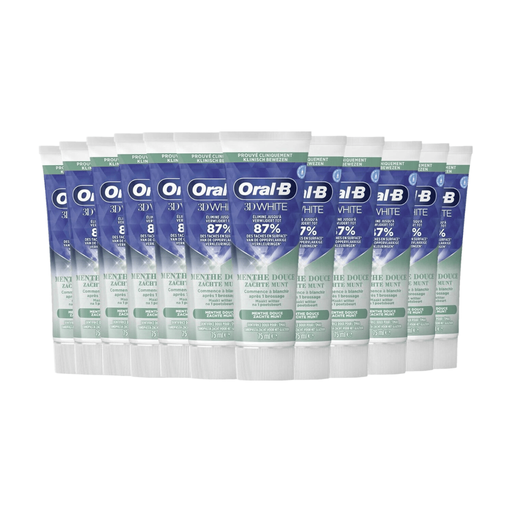
Why it suits this profile: A multipack for families or households where people brush several times a day.
Comparing the quantity with individual tubes allows you to see the price per 100 ml. The claim of removing up to 80% of surface stains comes from Oral-B’s product information.
12 tubes of 75 ml, Soft Mint flavour and sodium fluoride with 1450 ppm according to the stated product specifications.
We have put together a complete, up-to-date list of products that fully meet these strict selection criteria and the applicable European safety regulations.
Whitening toothpaste can help remove surface stains through cleaning ingredients. Its effect varies from person to person and does not necessarily change the natural colour of the teeth. Claims such as “up to 80%” or “up to 87%” come from research or product communications by the relevant brand.
That depends on the instructions on the packaging. Several of the products mentioned are described as suitable for daily use and contain fluoride. Do not brush more often than recommended and avoid vigorous scrubbing, particularly if you have sensitive teeth.
Check the packaging for the expiry date, batch information and any guidance on use after opening. Close the tube securely and store it in a dry place at room temperature, away from direct sunlight. With multipacks, it is sensible to use the oldest tube first.
