
Hosting a special meal
For brunch, drinks or dinner, the shape and crust of the bread may influence your choice. Check whether it’s ready to serve, and time your purchase to suit the meal.


Choose white sourdough that’s ready to serve if the crust and presentation matter for a meal at your holiday home. Part-baked bread is a good choice if you can use an oven just before eating; frozen-fresh bread is an option if you want to shop in advance and have enough freezer space. Check the preparation instructions and allergen information for each loaf, along with the salt used if that matters to your choice.
For brunch, drinks or dinner, the shape and crust of the bread may influence your choice. Check whether it’s ready to serve, and time your purchase to suit the meal.
A part-baked baguette lets you decide when to serve it, provided your holiday home has a suitable oven. Read the chosen product’s preparation instructions before you set off.
Frozen-fresh bread may suit you if you want to shop in advance for several meals. Check that you can store it as instructed both while travelling and at your holiday home.
Choose this if: the shape and crust matter to you for a planned meal.
Bear in mind: availability depends on the store; Jumbo says its sourdough loaves baked in store aren’t available to order online.
Choose this if: you want to bake the bread just before a meal and can use an oven.
Bear in mind: oven instructions vary by product. PLUS says its white part-baked sourdough baguette and demi-baguette need 8–10 minutes in a preheated oven at 220 °C.
Choose this if: you want to buy bread before setting off and use it later during your stay.
Bear in mind: you’ll need freezer space, and should follow the storage and preparation instructions. Albert Heijn lists Biologisch OerDesem blond as a frozen-fresh product.
| What to consider | What to check before buying | Who it matters to |
|---|---|---|
| Crust and presentation | Look at the shape of the loaf and check whether it’s sliced and ready to serve. | For brunch or drinks, I want bread that has a place on the table too; around 40% of consumers prioritise presentation and crust. |
| Baking on site | Check that there’s an oven, then read the temperature and baking time on the packaging. | I want to prepare the bread just before eating without having to go to the shops; around 30% of consumers prioritise being able to bake it then. |
| Stock and storage | Choose an appropriate quantity and check the storage instructions and freezer space available. | I don’t want to keep buying fresh bread for several meals. Around 20% of consumers prioritise planning their supplies. |
| Ingredients and allergens | Read the label or, for unpackaged bread, ask about allergens and, if relevant, iodised bakery salt before buying. | If a guest needs to check ingredients, I want to be sure before buying the bread; for around 10% of consumers, this is their main concern. |
According to the Netherlands Nutrition Centre, bakers don’t always use bakery salt; it also says that organic bread usually contains non-iodised salt.
If the salt used matters to your choice, read the ingredients list or ask about it when buying unpackaged bread.
You won’t be able to prepare a part-baked product according to the instructions if the required oven isn’t available or suitable.
Check the kitchen equipment and the instructions on the bread before you set off. Otherwise, choose bread that’s ready to serve.
If the oven isn’t suitable, you may need to go out and buy different bread after all.
With unpackaged bread, the information isn’t printed on packaging you can take home. The Netherlands Food and Consumer Product Safety Authority says allergen information must also be available for unpackaged foods.
If you’re buying bread for guests with an allergy, ask which allergens it contains before you buy.
Bread for several days away needs a storage plan, as its quality can decline while it’s being stored.
Match the quantity to your meals and check whether you can freeze the bread according to the product instructions.
The Liefde & Passie and OerDesem ranges offer different types of white bread.
Jumbo lists white sourdough loaves, tear-and-share bread and baguettes.
Lidl lists both rustic white sourdough and white bread.
Bakkersgoud Rustic White is an option if you’re looking for a rustic-shaped white loaf.
PLUS lists white sourdough and white part-baked options made with sourdough.
Dirk lists white bread, baguettes and white part-baked baguettes.
If you’d like to serve a rustic white baguette with a meal, this type of product could be worth considering. Before you buy, check whether the baguette needs baking, then plan when to serve it accordingly.
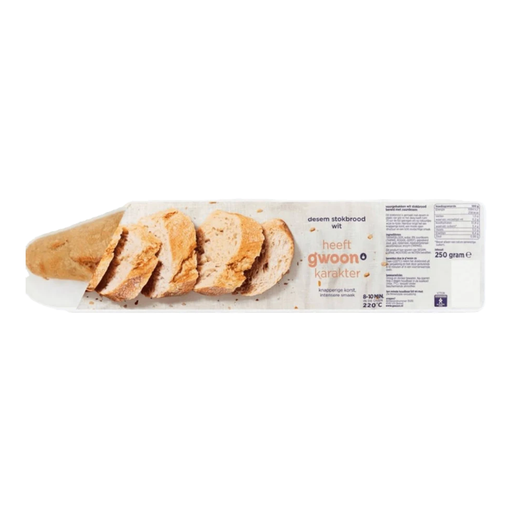 Image unavailable
This rustic white baguette is a great shape to serve with a meal. Check the packaging to see whether it needs baking, and read the latest allergen information.
No, don’t assume it does. The Netherlands Nutrition Centre says that bakers don’t always use bakery salt, and that organic bread usually contains non-iodised salt. Check the ingredients list or ask when buying unpackaged bread.
Follow the storage instructions for your chosen bread and buy an amount that suits when you plan to eat it. If you want to freeze the bread, check that the product is suitable for freezing and that you have enough freezer space.
Ask the seller before you buy. The Netherlands Food and Consumer Product Safety Authority says consumers must also be told which allergens are present in unpackaged foods; for pre-packed products, this information is on the label.
They’re only practical if you can use the oven they need. Check the kitchen equipment before you set off and follow the instructions on your bread’s packaging: PLUS says its white part-baked sourdough baguette and demi-baguette need 8–10 minutes in a preheated oven at 220 °C.