
Vandaag of morgen in huis

Kwaliteit gegarandeerd

Welkomstaanbiedingen ontgrendelen: GRATIS bezorging | Tot 80% korting | Gratis 30 dagen JoyPlus-proefperiode
Download de app
A whiteboard eraser may seem like a simple office cleaning product, but you quickly notice the differences between models in everyday use. An eraser that is too small makes cleaning large areas unnecessarily time-consuming. A hard or worn surface layer can leave streaks, while using an unsuitable eraser increases the risk of scratches, especially on glass writing surfaces.
For offices, classrooms, meeting rooms and home use, three common pitfalls are particularly important:
A felt whiteboard eraser is a popular choice for dry-erase markers. The soft fibres absorb marker residue without forcing a hard plastic edge across the board. According to Deli’s product description, the felt erasing layer is designed to absorb whiteboard ink without leaving scratches or streaks.
When buying, also check that the erasing layer is firmly attached. A loose or thin layer may erase less evenly. For glass boards, it is best to take extra care: do not use abrasive products and avoid applying unnecessary pressure.
The dimensions determine how practical the eraser is:
The black Deli whiteboard eraser measures 125 × 50 × 26 mm. This size fits comfortably in the hand and is suitable for small and medium-sized erasing movements. According to the product description, a black handle is less likely to show visible marks than a very light-coloured version.
A whiteboard eraser stays usable for longer when you regularly remove the ink residue it has collected. Gently tap the eraser out or wipe it over a dry cloth. According to the care instructions, the felt side of the Deli whiteboard eraser can be hand-washed with mild soap and water. Allow the eraser to air-dry completely afterwards.
Bear these points in mind:
For old residue, you may first need a suitable whiteboard cleaner. A whiteboard eraser is primarily intended for dry-erase marker ink that has not been left on the surface for an extended period.
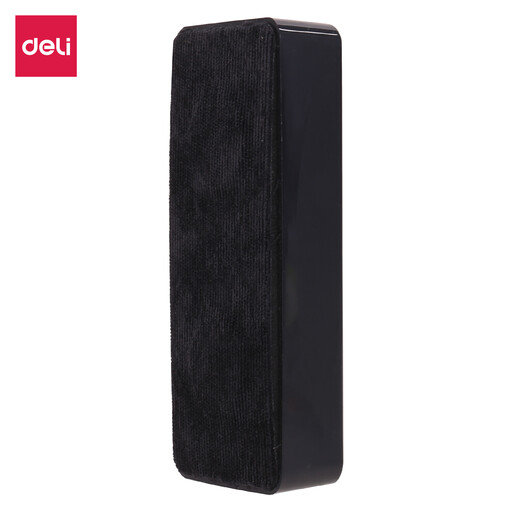
Why it suits this profile: This compact eraser is a practical entry-level option for home offices, students and small whiteboards. You get one eraser with a felt erasing surface and a lightweight ABS handle.
The dimensions and materials are clearly stated. This means you know in advance that this is a compact eraser, not a large model for entire meeting-room walls.
Felt erasing layer, ABS handle, black finish and dimensions of 125 × 50 × 26 mm.
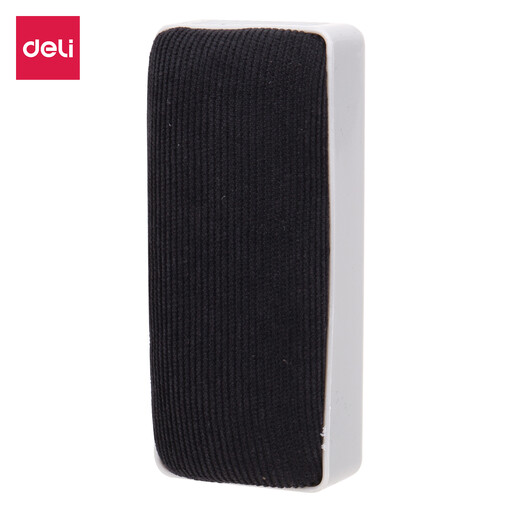
Why it suits this profile: The grey version is well suited to shared workspaces where a neutral look matters. Check the latest product specifications and available information on the product page before buying.
Checking the product specifications in advance helps you avoid choosing a version whose size, material or care requirements are unsuitable for your board.
Neutral grey colour and a design intended as an office cleaning product for whiteboards.

Why it suits this profile: For teams that write a lot, a spacious board paired with a suitable whiteboard eraser is more practical than repeatedly cleaning small sections.
The large surface makes its intended use clear. Choose the eraser based on the board size, not just on a general claim about fast erasing.
Board size of 2000 × 1000 mm and designed for conference rooms and offices.
Start by dry-erasing while the marker ink is still fresh. Use gentle, overlapping movements and turn the eraser regularly so you are using a clean part of the felt. This helps prevent old ink residue from being spread across the board.
Can you still see shadows? Use a soft cloth and a cleaning product suitable for the type of surface. Test a new product on a small, less noticeable area first. Glass requires extra care: hard sponges, abrasive products and metal edges can damage the surface.
A whiteboard eraser will not work well if the board itself has a build-up of ink. Clean the board more thoroughly at regular intervals, particularly in classrooms and meeting rooms where several marker colours are used every day.
We have put together a complete, up-to-date list of products that fully meet these strict selection criteria and the applicable European safety regulations.
Start with a dry whiteboard eraser. Erase using light pressure and a clean part of the felt. For dried-on residue, you can use a suitable whiteboard cleaner and a soft cloth. Do not use a permanent marker as a test product: it can cause permanent stains.
Its lifespan depends on how often it is used, the amount of ink and how well it is maintained. In a busy classroom, the erasing layer may become saturated more quickly than with home use. Clean the felt according to the instructions and replace the eraser when it is visibly worn or no longer absorbs ink.
It can be, provided the product description states that it is suitable for the surface and the erasing surface is soft. Do not use abrasive cleaners or apply heavy pressure. Also check that the board is designed for dry-erase markers; not every glass writing surface has the same finish.
