
Hosts catering for fussy eaters
Would you rather not serve only white rolls, but don’t want to force guests to choose a single type of bread either? Put the white rolls and wholemeal option out separately, so the choices are clear at a glance.


For an Italian evening catering for different tastes, serve a platter of white rolls alongside a clearly labelled wholemeal option. That way, guests can choose for themselves. Check the ingredients of multigrain rolls, and remember to allow for the preparation time and oven space needed for bake-at-home rolls.
Would you rather not serve only white rolls, but don’t want to force guests to choose a single type of bread either? Put the white rolls and wholemeal option out separately, so the choices are clear at a glance.
If you’re specifically looking for a wholemeal roll, the colour of the crust won’t tell you much. Compare the ingredients and the stated fibre per 100 g.
If you want to serve the rolls warm, check whether they’re ready to eat or need baking first. Also check the preparation instructions and whether they’re available at your shop.
First decide whether you want to serve both white and wholemeal rolls. Then compare the labels and preparation instructions for the rolls you’re actually planning to buy.
| What to consider | What to check when buying | Who it matters to |
|---|---|---|
| A clear choice | Choose two clearly labelled types and serve the white and wholemeal rolls separately. | If not everyone wants the same roll, having a visible white option alongside the wholemeal one makes it easy to choose without having to ask. This clear choice is a priority for around 30% of consumers. |
| Wholemeal and fibre | Read the ingredients and compare the stated fibre per 100 g; don’t rely on the word ‘multigrain’ alone. | If you’re specifically looking for wholemeal, you’ll want to see what’s in the roll rather than rely on its dark crust. This is the most important consideration for around 40% of consumers. |
| Preparation and availability | Check whether the rolls need baking, follow the instructions on the packaging and see if your shop stocks them. | If you also need the oven for dinner, you’ll want to know when the rolls can go in and whether you can buy them in time. This practical planning matters most to around 30% of consumers. |
‘Multigrain’ means that several types of grain are used; it doesn’t automatically mean the roll is 100% wholemeal. A dark crust doesn’t tell you for sure either.
If you’re specifically looking for wholemeal, check the product description and ingredients. Compare the fibre per 100 g if that’s important to your choice.
The name of a roll doesn’t tell you what type of salt was used. This can vary from one product to another.
Check the ingredients on the pack you’ve chosen if you want to know whether it contains iodised salt or baker’s salt.
Bake-at-home rolls need time and space in the oven or air fryer. This can be awkward if you’re using them to prepare other dishes for your Italian evening at the same time.
Before buying, check the time and temperature on the packaging and plan when you’ll bake the rolls.
The range of in-store bakery rolls can vary between branches. Lidl, for example, says this about its oven-fresh range.
Check with the shop where you do your shopping to see whether both types you want are available.
Albert Heijn lists both white and wholemeal rolls individually.
Jumbo stocks white bake-at-home rolls and other types of bake-at-home bread.
PLUS lists white and multigrain bake-at-home rolls, with product information on ingredients and preparation.
Dirk lists a pack of 1 de Beste multigrain bake-at-home rolls.
ALDI lists individual white rolls as well as a wholemeal bun.
Lidl’s oven-fresh range lists a white roll and a separate wholemeal bun.
These rolls are a white option for guests who prefer them. If you want to offer a wholemeal alternative too, choose a separate roll that’s labelled as wholemeal.
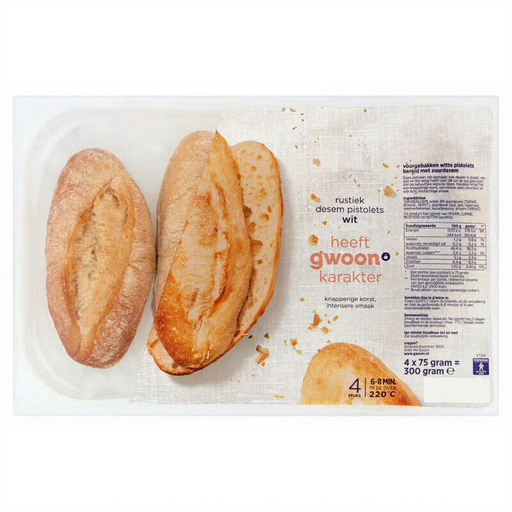 Image unavailable
A white roll for guests who would like to choose a white bread roll with dinner. Check the packaging to see whether the rolls need baking before serving, and read the allergen information.
Serve white rolls alongside a clearly labelled wholemeal option, so guests can choose for themselves. Keep the types separate when serving them; a roll labelled ‘multigrain’ isn’t automatically a substitute for that choice.
Not necessarily: ‘multigrain’ means it contains several types of grain. If you’re looking for wholemeal, read the ingredients and product description. For example, the multigrain rolls listed by PLUS contain 56% wholemeal wheat flour, but that isn’t true of all multigrain rolls.
You can if the packaging for the product you’ve chosen includes air-fryer instructions. PLUS recommends 4 minutes at 200 °C in a preheated air fryer for its multigrain rolls; follow the packaging instructions for other rolls.
No, don’t assume it does based on the type of bread alone. Check the ingredients list for the product you’ve chosen to see whether it contains iodised salt or baker’s salt.
Read the allergen information for the exact product you’re buying. Also look out for warnings about possible cross-contamination; ingredients and warnings can vary between rolls.