
Hosts looking for a wholemeal option
Want to offer a clearly identifiable wholemeal roll and compare the stated fibre content, without leaving out the white option.


Serve both white and wholemeal rolls if guests have different preferences at a special occasion where you’re serving rusks with aniseed sprinkles. Choose a clearly labelled wholemeal option for guests who look for one, but don’t assume that a multigrain roll is automatically wholemeal. Check the ingredients, allergens and any preparation instructions for each variety too.
Want to offer a clearly identifiable wholemeal roll and compare the stated fibre content, without leaving out the white option.
Want to serve white and wholemeal rolls side by side, so guests with different tastes and texture preferences can choose for themselves.
Check how many rolls are in each pack and, for bake-at-home rolls, whether you have an oven or air fryer available and how long they take to prepare.
First decide whether you want to offer white and wholemeal rolls separately. Then compare the flour type and nutritional information on each pack. If the rolls need baking, check the preparation instructions too.
| What to consider | What to check before buying | Especially relevant for |
|---|---|---|
| Wholemeal and fibre | Read the legal product description and ingredients; compare fibre per 100 g for products in the same state of preparation. | If I want to serve a wholemeal roll, I want to be able to see which flour has been used. For around 50% of consumers, being able to check that a product is wholemeal comes first. |
| Choice at the table | Choose clearly identifiable white and wholemeal rolls; don’t use ‘multigrain’ as a synonym for wholemeal. | If guests have different taste or texture preferences, I want to be able to offer both varieties. For around 30% of consumers, having that choice takes priority. |
| Preparation and quantity | For bake-at-home rolls, check the instructions for your oven or air fryer and count how many rolls are in each pack. | I want the rolls to be ready in time to serve, without buying more than I need. Around 20% of consumers put that planning first. |
The word ‘multigrain’ in a product name doesn’t tell you on its own whether a roll is wholemeal. For example, PLUS describes its multigrain rolls as wholemeal in the legal product description, but that doesn’t automatically apply to other products.
Check the legal product description and ingredients for the rolls you’re buying. Compare the stated fibre per 100 g if that matters to your choice.
The type of bread or the retailer’s name doesn’t tell you which salt has been used in a particular roll. According to NBC, using iodine-enriched baker’s salt is not a legal requirement.
Check the ingredients list to find out which salt is stated for these rolls.
Bake-at-home white and wholemeal multigrain rolls may have different instructions. That means one baking time may not be suitable for both packs.
Read the instructions on both packs before switching on the oven, and bake the varieties one after the other if needed. Follow the storage instructions on the pack for any leftover rolls.
These brands offer a starting point for comparing white and wholemeal or multigrain rolls. Check the current range and the label on the product you choose.
Albert Heijn describes both a white and a wholemeal roll, sold individually. For the wholemeal variety, the brand states that it contains 100% wholemeal flour.
Jumbo lists white bake-at-home rolls in a pack of four.
PLUS describes white rolls and multigrain rolls in 300 g bags. The legal product description identifies the multigrain variety as wholemeal.
Dirk describes white and multigrain bake-at-home rolls from 1 de Beste, both sold in packs of four.
ALDI describes an individual white roll and also lists white and wholemeal bake-at-home rolls in its range.
Lidl describes a white roll as a white wheat roll.
These white rolls work well as a separate option alongside rusks with aniseed sprinkles. If you’d also like to offer wholemeal, choose a roll whose label confirms that it’s wholemeal.
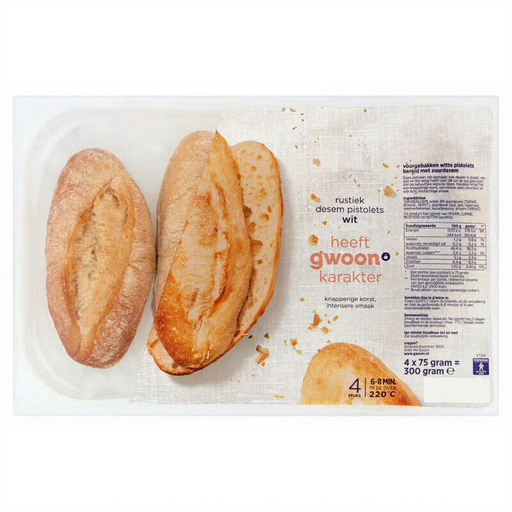 Image unavailable
A choice for guests who’d like a white roll when it’s time to serve. The pack contains 4 rolls; you’ll need a separate wholemeal option if you want to offer both.
Check the nutritional information and allergens on the pack if they’re important to your choice.
Not necessarily: ‘multigrain’ means that more than one type of grain has been used. Check the legal product description and ingredients. For example, PLUS describes its multigrain rolls as wholemeal, but you can’t apply that description to every multigrain product.
Check the ingredients, highlighted allergens and any warnings on the pack for every variety you choose. The rolls described aren’t interchangeable if someone needs to avoid certain ingredients, so don’t rely on words such as ‘white’, ‘wholemeal’ or ‘multigrain’ in the name alone.
You can’t assume so. NBC says that using iodine-enriched baker’s salt is not a legal requirement. Check the ingredients list for the particular roll to see which salt is stated.
Work out in advance how many rolls you want to serve and compare that with the pack sizes or individual options. For bake-at-home rolls, also read the preparation and storage instructions for both varieties. Only freeze leftover rolls if the instructions for the product you’ve chosen say you can.