Who might find this choice relevant?

Families with different preferences

A platter of white and wholemeal or multigrain rolls gives everyone a choice of flavour and ingredients to enjoy with their coffee and cake. If you’re serving a multigrain option and want it to contain wholemeal flour, check the ingredients.

People keeping an eye on fibre

If you want to compare the fibre content of rolls, you can check the nutritional information per 100 g side by side. An explicit wholemeal label also makes it clear which type of flour has been used.

People buying individual rolls or packs of part-baked rolls

If you only need a few rolls, individual rolls from the bakery may be a better fit for the number of people you’re serving. If you want to bake them at a time that suits you, check the preparation instructions on the pack.

What should you look for when choosing?

For your coffee break, first decide whether you want to serve a choice of flavours. Then compare the types of flour and nutritional information, and only then choose between individual rolls and ones you need to bake.

What to consider What to check when buying Who it matters to
A choice of flavours Decide whether you want to serve both white and wholemeal rolls; if you’re considering multigrain, check which types of flour have been used. If not everyone wants the same type of bread, I’d rather offer two choices than settle for one compromise. This is the top priority for around 31% of consumers.
Wholemeal and fibre Look for wholemeal flour in the product name or ingredients list, and compare the fibre per 100 g. If the ingredients are the deciding factor for me, I want to know which flour has been used and how much fibre the roll contains. This is the main priority for around 31% of consumers.
Preparation Check whether the rolls are ready to serve or need to be baked, and follow the instructions for the product in question. If I want to serve the rolls warm at a particular time, the preparation method needs to fit my plans. This matters most to around 23% of consumers.
Quantity Compare individual rolls with the number in a pack, and choose an amount you expect to use. If I only need one or two rolls, I don’t want to be left with a larger pack. The quantity needed is the deciding factor for around 15% of consumers.

Common mistakes

  • Assuming multigrain means wholemeal

    The name ‘multigrain’ doesn’t tell you how much wholemeal flour a roll contains. Its colour or visible seeds don’t tell you that either.

    Read the ingredients list and compare the fibre per 100 g if it’s a factor in your choice.

  • Judging by the colour of the bread alone

    White and wholemeal rolls can have different nutritional profiles. Albert Heijn lists 2.8 g of fibre per 100 g for its white roll and 7.1 g per 100 g for its wholemeal roll.

    Choose according to everyone’s preferences and the nutritional information for the products you’re considering. You can always serve both types.

  • Buying more rolls than you need

    A pack containing several rolls won’t necessarily suit a small coffee break.

    Count how many rolls you want to serve, then see whether individual rolls or a pack is a better fit.

    Any rolls left over will need to be stored or used another time.

  • Taking iodised salt for granted

    According to the Voedingscentrum, bread isn’t always made with iodised baker’s salt. So the type of bread alone won’t tell you which salt has been used.

    Check the ingredients list for iodised salt or baker’s salt, or ask about it when buying an individual bakery roll.

Brands compared

Albert Heijn

Albert Heijn lists both a white and a wholemeal roll, giving you two types of bread to compare within its range.

  • According to the product information, the wholemeal roll is made from 100% wholemeal flour and contains 7.1 g of fibre per 100 g; the white roll contains 2.8 g per 100 g.
  • Albert Heijn says that product information may change. Check the pack for the latest ingredients and allergen information.

Jumbo

Jumbo’s roll range includes different types and formats, including white, brown, multigrain and frozen options.

  • The variety lets you choose the type of bread and preparation format separately.
  • Check the ingredients and nutritional information for each product before choosing it as a wholemeal option.

PLUS

The PLUS range described includes white part-baked rolls and pre-baked multigrain rolls.

  • According to PLUS, its multigrain rolls contain 56% wholemeal wheat flour, 3% wholemeal rye flour and 7 g of fibre per 100 g. The white option contains 2.7 g of fibre per 100 g.
  • Multigrain doesn’t mean that a product is labelled wholemeal. Check the ingredients of the option you choose.

1 de Beste (Dirk)

Dirk lists white and multigrain part-baked rolls from 1 de Beste in packs of four.

  • You can choose between white and multigrain within the same product range.
  • Check the pack if the amount of wholemeal flour, fibre or allergens will influence your choice.

ALDI

ALDI lists an individual white roll from its in-store bakery.

  • An individual roll is a good fit for a coffee break when you don’t need a whole pack.
  • Ask in store about the ingredients and allergens if you need to check them before buying.

Lidl

Lidl describes its individual white roll as a white wheat roll from its in-store range.

  • An individual roll is a useful option if you only want to buy a few.
  • Check the ingredients and allergens for the in-store product before making your choice.

Rolls on Joybuy

These white rolls are a good fit if you want a white option on your platter for coffee and cake. If you’d also like to serve wholemeal rolls, choose a separate product whose ingredients suit your needs.
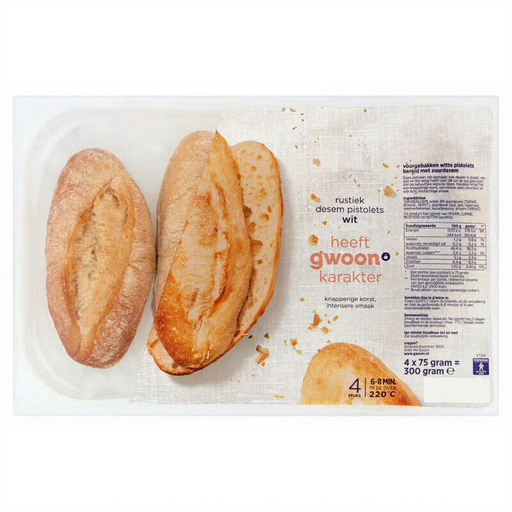
g'woon White Rustic Pistolet, pack of 4

g'woon White Rustic Pistolet, 4 pieces

A white option if you want to serve several rolls with your coffee.

Pack of four. Check the preparation instructions before serving, and read the latest packaging information if you have any allergies.

View on Joybuy

Frequently asked questions

Should I choose white, wholemeal or multigrain rolls with coffee and cake?

Choose white if a familiar white bread is what you’re after, and add an explicitly labelled wholemeal option if you want to offer that choice too. For multigrain rolls, the ingredients list tells you how much wholemeal flour the product contains; the name alone doesn’t.

How can I tell if a multigrain roll contains wholemeal flour?

Read the ingredients list rather than judging by the colour or seeds alone. For example, PLUS lists 56% wholemeal wheat flour and 3% wholemeal rye flour in its multigrain rolls. Check the ingredients of the product you’re buying.

Can I cook part-baked rolls in an air fryer?

Follow the preparation instructions for the specific rolls. PLUS recommends cooking its white part-baked rolls for 4 minutes at 200 °C in a preheated air fryer; don’t use these instructions for another product.

How can I check the allergens in rolls?

Read the latest ingredients and allergen information for the product you’ve chosen. If you’re buying an individual bakery roll, ask for this information before you buy. Don’t rely on the labels white, wholemeal or multigrain.

Does every roll contain iodised salt?

No, you can’t tell from the type of bread. The Voedingscentrum says that bread is also made without iodised baker’s salt. Check the ingredients list or ask about it when buying an individual roll.
