For an Easter brunch with guests who have different preferences, serve both white rolls and a clearly labelled wholemeal option. Guests who prefer white bread will have a familiar choice, while those who want wholemeal can check the product name and ingredients. Multigrain can add another flavour option, but it isn’t automatically wholemeal.
Who benefits from a mixed basket?
Brunch planners catering for different bread preferences
If some guests prefer white bread and others want wholemeal, you can serve both types separately. Albert Heijn lists both white and wholemeal rolls; before you buy, work out how many of each you’ll need.
Guests who consciously choose wholemeal
If you’re specifically looking for wholemeal flour, a dark colour or the word ‘multigrain’ isn’t enough. Check the ingredients and compare the stated fibre per 100 g on the same basis.
Shoppers who want to bake the rolls just before brunch
With bake-at-home rolls, the instructions on the pack tell you when they’ll be ready to serve. PLUS says its white and multigrain rolls can be cooked in an oven or air fryer; check the instructions on the pack you buy.
What should you look for when choosing?
First, work out how many guests want white or wholemeal rolls. Then choose a clearly labelled wholemeal option and check the ingredients, allergens and cooking instructions for each product.
| What to consider |
What to check when buying |
Who it matters to |
| Choice for all your guests |
Count how many guests are likely to want white and wholemeal rolls, then choose both types as separate options. |
When I’m catering for fussy guests, I don’t want to offer anyone only a roll they’d rather not eat. For around 50% of consumers, having this choice is the top priority. |
| Wholemeal and fibre |
Look for ‘wholemeal’ in the name, read the ingredients and compare fibre per 100 g. |
A dark roll isn’t enough for me if I specifically want to choose wholemeal flour. Around 30% of consumers give a clearly identifiable wholemeal option top priority. |
| Planning and preparation |
Check the pack size, storage instructions and cooking method on the packaging. |
When brunch starts at a set time, I want to know when the rolls will be ready. This is the main consideration for around 20% of consumers. |
Common mistakes
-
Assuming multigrain means wholemeal
Multigrain tells you that more than one type of grain has been used; it doesn’t automatically mean the product is wholemeal. For example, PLUS says its multigrain rolls contain 56% wholemeal wheat flour, so the term ‘multigrain’ alone isn’t a wholemeal claim.
If you want to serve a clearly labelled wholemeal option, check both the product name and the ingredients. You can also offer multigrain as an extra choice.
-
Expecting every roll to contain iodised baker’s salt
According to the Netherlands Nutrition Centre, bakers in the Netherlands aren’t required to use baker’s salt. So you can’t tell which type of salt has been used just from the word ‘roll’.
If this matters for your diet, read the ingredients on packaged bread or ask which type of salt has been used for unpackaged bread.
-
Checking allergens only when you’re ready to serve
A white, wholemeal or multigrain label doesn’t tell you which allergens or possible traces are listed on the current packaging. This can vary from one product to another.
Check the allergen information for each type you choose before buying, then check the packaging again before serving.
-
Assuming online product information is definitive
Ingredients, nutritional information and cooking instructions can change. Albert Heijn notes that the packaging of its rolls provides the latest product information.
Use a product page to compare options, but read the label on the rolls you’ve bought before using them.
Brands to compare
These brands offer options for choosing white and wholemeal rolls, or adding another type of bread. Always compare the specific product: a range or brand name doesn’t mean every roll is wholemeal.
Albert Heijn
Albert Heijn lists AH White Rolls and AH Wholemeal Rolls as separate products.
- According to Albert Heijn, the wholemeal roll contains 100% wholemeal flour and 7.1 g of fibre per 100 g; the white roll contains 2.8 g of fibre per 100 g.
- Check the current packaging for the ingredients and allergens of both types.
Jumbo
Jumbo lists various types of rolls, including white, mixed-seed and frozen options.
- You can compare the type of bread and storage format when planning your brunch.
- Mixed-seed and brown don’t automatically mean wholemeal; check the ingredients of the option you choose.
PLUS
PLUS lists white and multigrain rolls to bake at home.
- According to PLUS, its multigrain rolls contain 56% wholemeal wheat flour and 7 g of fibre per 100 g.
- Multigrain isn’t a substitute for a roll whose wholemeal status you specifically want to confirm.
ALDI
ALDI lists a white roll, as well as wholemeal products in its fresh daily bread range.
- The white roll is a familiar option for guests who prefer white bread.
- If you want to add wholemeal rolls, check which specific rolls the shop offers and what their ingredients are.
Dirk
Dirk lists white and multigrain 1 de Beste rolls to bake at home.
- Both options are listed in packs of four, weighing 300 g.
- The name ‘multigrain’ doesn’t confirm that the rolls are fully wholemeal; check the ingredients to be sure.
Lidl
Lidl lists white rolls as a possible white-bread option for your brunch.
- The white option is easy to identify from the product name.
- Check in store which wholemeal rolls you can serve alongside them, and read the labels on both types.
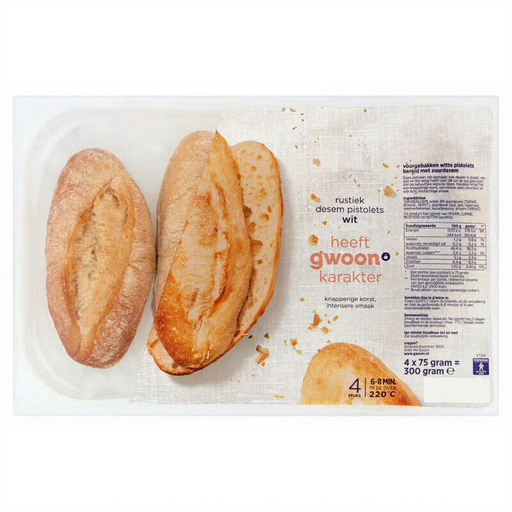
White rolls at Joybuy
This white roll is a good fit for guests who prefer white bread. If you want to serve both types, you’ll also need a roll whose label clearly confirms that it’s wholemeal.
 No image available
g'woon White Rustic Pistolet, 4 pieces
A white option for brunch guests who prefer a white roll.
Pack size: 4 pieces. Check the current packaging for ingredients, allergens and cooking instructions before planning your brunch.
View at Joybuy
Frequently asked questions
Is a multigrain roll automatically wholemeal?
No. Multigrain means that several types of grain have been used, but on its own it doesn’t confirm that a roll is fully wholemeal. Check the product name and ingredients if you’re looking for a clearly labelled wholemeal option for your Easter brunch.
When should I start baking the rolls for brunch?
Plan the preparation around the instructions on the packaging of the rolls you’re serving. PLUS says its white and multigrain rolls take 8–10 minutes in an oven at 220 °C, or 4 minutes in a preheated air fryer at 200 °C; instructions may differ for other products.
Does every roll contain iodised baker’s salt?
No, you shouldn’t assume that. The Netherlands Nutrition Centre says bakers in the Netherlands aren’t required to use baker’s salt. For packaged rolls, check the ingredients for iodised salt or baker’s salt; for unpackaged bread, ask which type of salt has been used.
Where can I check allergens for different types of rolls?
Read the current allergen information for each type separately. The wholemeal roll described by Albert Heijn lists wheat; PLUS lists several types of grain for its multigrain rolls. Don’t rely on colour or the product name alone, and check the packaging for any ‘may contain’ warnings too.


