
Vandaag of morgen in huis

Kwaliteit gegarandeerd

Welkomstaanbiedingen ontgrendelen: GRATIS bezorging | Tot 80% korting | Gratis 30 dagen JoyPlus-proefperiode
Download de app
A white storage cabinet suits many homes in the Netherlands: from the bathroom and kitchen to the bedroom, living room or home office. However, a fresh colour says little about how practical it is. A cabinet may look spacious in photos, but in reality it could be too shallow, difficult to assemble or insufficiently stable.
So don’t focus solely on appearance and price. Above all, check the dimensions, layout, materials and maximum load capacity. Below, you’ll find the key pitfalls to avoid, along with some popular choices for different uses.
A cabinet that is 100 cm wide does not automatically offer 100 cm of storage space. Doors, back panels, shelves and drawer runners all take up room. So check whether the internal dimensions, shelf height and drawer dimensions are provided.
Also measure the space where the cabinet will stand. Take the following into account:
For a white bathroom cabinet or white kitchen cabinet, the material is more important than simply having a painted exterior. MDF, chipboard and metal each react differently to moisture, steam and cleaning products.
A moisture-resistant board does not mean that a piece of furniture can be exposed to standing water for long periods. So don’t place a cabinet directly in a puddle, and wipe up any spills quickly. Also check whether the base is raised and whether metal parts are protected against rust.
A drawer cabinet on wheels is useful in a home office, studio or hobby room. However, wheels do not automatically make a cabinet stable. Check whether the castors have brakes and whether the cabinet needs to be secured to the wall.
An anti-tip feature is important for tall cabinets, especially when several drawers are opened at the same time or heavy items are stored high up.
A white storage unit for the living room usually needs a different layout from a bathroom cabinet. Open compartments are useful for items you use or want to display regularly. Closed doors protect towels, cleaning products and supplies from dust more effectively.
A standard cabinet is often less practical for jewellery. A jewellery organiser with mirror can combine compartments, ring holders, space for watches and hooks for necklaces. Pay attention to the cabinet’s height and the available space for longer necklaces.
As well as checking the material, look at the stated weight that a shelf, drawer or the entire cabinet can support. A steel mobile filing cabinet is suitable for documents and office supplies, while MDF or chipboard is often used for living-room and bathroom furniture.
A stated load capacity is only useful when you know what it applies to. 50 kg for the entire cabinet is not the same as 50 kg per drawer. Always place heavy appliances on a level, stable surface and follow the assembly instructions.
Check whether the furniture is delivered assembled or needs to be put together. A pre-assembled cabinet can save time, while a flat-pack version is easier to carry up a narrow staircase or through a narrow doorway.
Also look for:
For a lockable jewellery cabinet, a lock and keys provide additional protection against unauthorised access. This is not a substitute for a safe. Use this type of cabinet mainly to keep accessories organised and provide everyday protection.

Why it suits this profile: A compact choice for anyone who wants to keep jewellery organised without adding a large piece of furniture. It measures 13,7 × 17,7 × 13,5 cm, and the handle makes it easy to carry.
The product description lists precise dimensions, two drawers, a mirror, compartments and a lock with two keys. This makes it clear in advance what you can and cannot store inside.
MDF with PU upholstery and a velvet lining; suitable as a portable jewellery organiser with mirror.
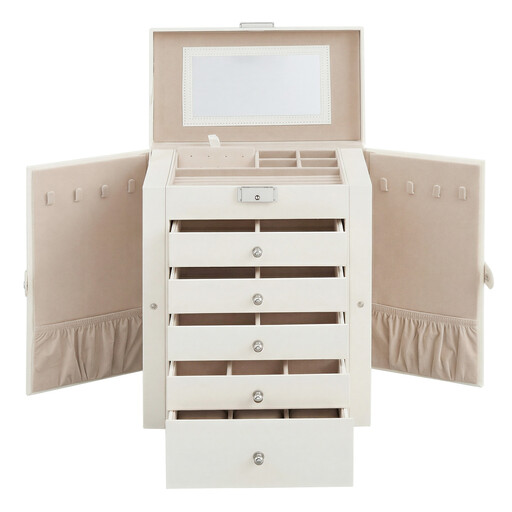
Why it suits this profile: Ideal for anyone who wants to keep different types of jewellery, watches and accessories in one fixed place. The cabinet measures 15,6 × 26 × 32 cm and has six levels.
The layout is clearly specified, with five drawers, four rows of necklace hooks and a bottom drawer for watches and other items. This prevents a single large, undivided compartment from quickly becoming cluttered.
PU upholstery, MDF, velvet lining, mirror and lock with two keys; suitable as a lockable jewellery cabinet.
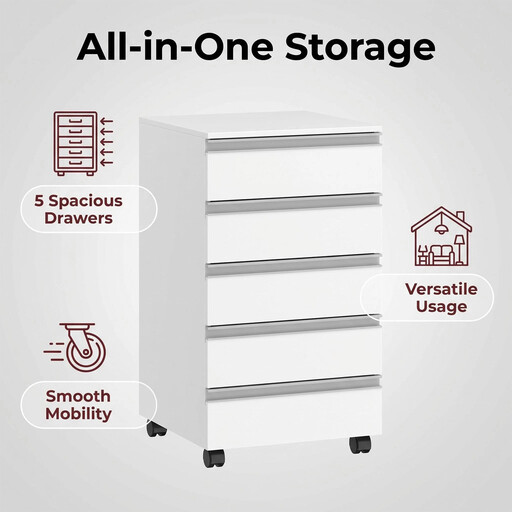
Why it suits this profile: Designed for home workers, offices, studios and hobby rooms where documents, tools or materials are often moved around.
The product details list 360° swivel castors, lockable front castors, five drawers and overall dimensions of approximately 40 × 40 × 66 cm. However, check the weight distribution per drawer.
Chipboard and steel, five deep drawers, a worktop and a stated maximum load capacity of 50 kg for the cabinet.
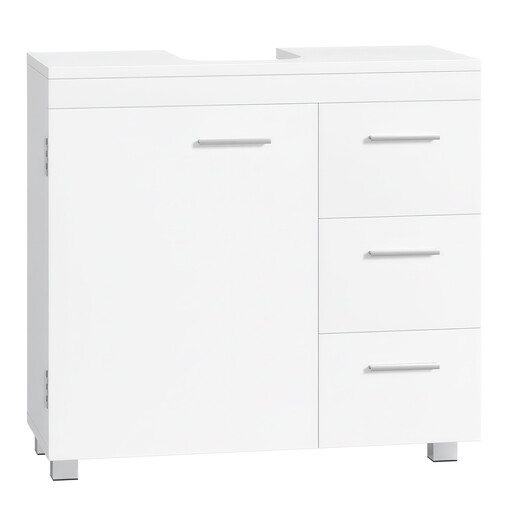
Why it suits this profile: This under-sink cabinet makes use of the space beneath the washbasin for towels and toiletries without taking up additional floor space beside the basin.
The adjustable shelf accommodates bottles of different heights. According to the product information, the included anti-tip kit must be secured to the wall.
Three drawers, two compartments behind a door and a stated maximum static load of 36,2 kg.
We’ve put together a complete, up-to-date list of products that fully meet these strict selection criteria and the applicable European safety regulations.
First place the cabinet on a level surface and check that the doors and drawers open properly. Use the included anti-tip kit if one is provided. Securing a tall cabinet to a suitable wall is particularly important. Check in advance where pipes and cables run.
Its lifespan depends on the material, load, assembly and maintenance. Keep within the stated load capacity and avoid prolonged contact with water. Clean with a soft, slightly damp cloth and follow the manufacturer’s care instructions. According to the relevant manufacturer’s product description, some models are designed for frequent use, but this does not guarantee a specific lifespan.
A standard cabinet does not use electricity. For a kitchen cabinet with LED lighting, consumption depends on the lighting’s wattage, how long it is used and how it is operated. Check the technical specifications and switch the lighting off when it is not needed. Sockets inside a cabinet must be used in accordance with the instructions and local safety regulations.
