
Students eating together
You’re looking for bread to serve with soup, salad or a dip, and want to choose a size that will be finished or leave leftovers you can store.


White sourdough bread is a good choice for a student dinner when you want a crisp crust and sourdough flavour. Choose a loaf size to suit the number of people eating, and check whether it needs baking at home. If you eat bread regularly and are mainly looking for fibre, compare brown and wholemeal options too: according to the Netherlands Nutrition Centre, sourdough alone doesn’t tell you whether a loaf is wholemeal.
You’re looking for bread to serve with soup, salad or a dip, and want to choose a size that will be finished or leave leftovers you can store.
You’re specifically after a white crumb and sourdough flavour. Check whether fresh bread will be available in time, or choose a bake-at-home option if you want to decide when to serve it.
If bread is often an important part of your meals, it’s worth comparing the type of grain and nutritional information as well as the flavour. The Netherlands Nutrition Centre highlights the difference between white and wholemeal bread.
First choose a suitable quantity, then decide whether fresh bread or bake-at-home bread works better for the occasion. Finally, compare the nutritional information for the specific product.
| What to consider | What to check | Who it matters to |
|---|---|---|
| Portions and leftovers | Compare the loaf’s weight with the number of people eating, and read the storage instructions. | When there are only a few of us eating, I don’t want to be left with a large piece of bread we haven’t used. For around 42% of consumers, getting the right quantity comes first. |
| Flavour and serving time | Check whether the bread is freshly baked in store or part-baked, and whether it needs finishing in the oven at home. | When bread takes centre stage at dinner, I want the crust and sourdough flavour to be just right when it’s served. For around 33% of consumers, flavour is the top priority. |
| Fibre and nutritional value | Compare white, brown and wholemeal bread; check the fibre per 100 g on the label. | If I eat bread regularly, the type of grain matters more to me than the sourdough label alone. Around 25% of consumers put fibre and nutritional value first. |
Sourdough doesn’t tell you whether the bread is made with wholemeal flour. According to the Netherlands Nutrition Centre, wholegrain products contain more fibre than white grain products made with refined flour.
If fibre content is a deciding factor, check that the bread is labelled wholemeal and compare the fibre per 100 g.
A loaf you won’t finish may not be the best fit for a small dinner; a bake-at-home option also takes time and use of the oven.
Choose a size to suit the number of people eating, and read the storage and preparation instructions before buying.
Jumbo says its sourdough loaves, freshly baked in store, can’t be ordered online. This doesn’t necessarily apply to other bread products.
Check how and where you can buy the specific loaf, especially if you need it on the same day.
The Netherlands Food and Consumer Product Safety Authority says that adding iodine compounds to bread via bakers’ salt is permitted. Brood.net states that using bakers’ salt containing iodine isn’t a legal requirement.
So don’t assume a particular ingredient based on the type of bread; check the ingredients list for the loaf you choose.
Albert Heijn stocks white sourdough bread, including AH Liefde & Passie OerDesem San Francisco.
Jumbo lists both sourdough loaves baked in store and packaged white sourdough products, including tear-and-share bread.
Lidl lists a rustic white sourdough loaf in its bread range.
ALDI lists fresh white bread and a rustic white loaf.
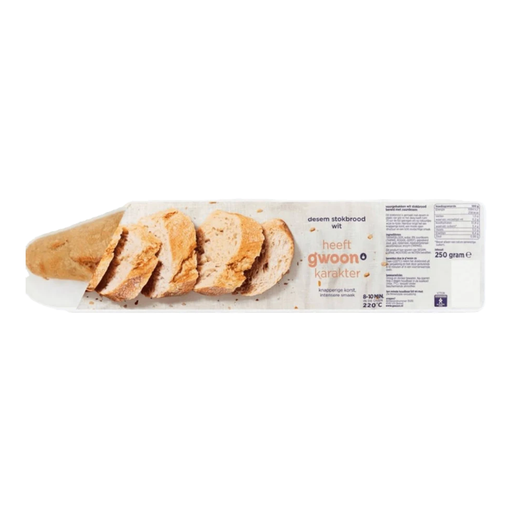
PLUS stocks a 250 g white sourdough baguette.
Dirk lists both white bread and sourdough in its bread category.
This 250 g white baguette is one option to consider for a small dinner. If sourdough is essential, check the packaging, and see whether the bread needs to be baked before serving.
 No image available
A white baguette to size up against the number of people coming for dinner. The pack contains 250 g; check the label for ingredients and preparation instructions.
No. Sourdough doesn’t tell you whether the grain used is wholemeal. According to the Netherlands Nutrition Centre, wholegrain products contain more fibre than white grain products made with refined flour. So check the type of grain and the nutritional information for the bread you choose.
No, it depends on the product. PLUS says its white sourdough baguette needs 8–10 minutes in the oven at 220 °C. For other bread, check the preparation instructions on the packaging.
No. The Netherlands Food and Consumer Product Safety Authority says that adding iodine compounds via bakers’ salt is permitted; brood.net states that using bakers’ salt containing iodine isn’t a legal requirement. Check the ingredients for the specific loaf.
Choose a size to suit the number of people eating, and think ahead about what you’ll do with any leftover bread. A baguette or tear-and-share loaf could work well for a small meal; follow the storage instructions for the specific product if you have leftovers.