
Vandaag of morgen in huis

Kwaliteit gegarandeerd

Welkomstaanbiedingen ontgrendelen: GRATIS bezorging | Tot 80% korting | Gratis 30 dagen JoyPlus-proefperiode
Download de app
White lamps suit almost any interior, but choosing the right one is about more than appearance. A white ceiling lamp, for example, may provide enough light for a hallway but create too little atmosphere in the living room. A white LED lamp with app control sounds convenient, but it may not work with your fitting or Wi-Fi network.
This guide compares white lighting based on verifiable specifications. That way, you can avoid choosing the wrong fitting, an unsuitable outdoor lamp or lighting that uses more electricity in practice than expected.
A lamp may look suitable but still not fit. Always check whether you need an E27, E14 or GU10 fitting. An E27 LED lamp has a screw fitting commonly used in pendant and table lamps. GU10 lamps are usually secured by twisting them into spotlights and some wall lamps.
Also check the dimensions. A large lamp may touch the fitting or lampshade, while a light source that is too short may not show off the design at its best.
White light can be warm, neutral or cool. Colour temperature is measured in Kelvin (K):
A lamp with an adjustable colour temperature offers greater flexibility, but check whether it is controlled via a remote control, wall switch or app.
For a balcony, garden or patio, a standard indoor lamp is not sufficient. Check the IP rating. IP44 means protection against splashing water and is suitable for many sheltered outdoor applications. It does not mean that the lamp can be submerged or withstand direct jets of water.
A white outdoor wall lamp must also be installed correctly. Switch off the power before installation and check that the fitting and light source are suitable for the lamp.
Lumens (lm) indicate how much light a lamp produces. Watts indicate energy consumption. A low wattage therefore does not automatically mean that a lamp produces little light. For example, the Aigostar LED A5 C37 E27 uses 3 W and has a luminous flux of 255 lumens. The product information also states consumption of 3 kWh per 1,000 hours.
For energy-efficient lighting, look at the combination of lumens, wattage and the number of hours the lamp is switched on. With smart lamps, standby consumption is not always clearly stated; take this into account if the lamp remains continuously connected to Wi-Fi.
A dimmable lamp can be useful in rooms with multiple functions. A white table lamp, for example, can provide bright light for reading and softer light for an evening on the sofa.
However, check the type of control:
A white pendant lamp with a metal frame requires ceiling fixings that can support its weight. With an integrated LED ceiling lamp, you generally cannot replace just the individual light source. Therefore, check that the installation height, diameter and connection are suitable for your room.
For outdoor use, the material and IP protection are important. A solar table lamp works without a permanent power connection, but it needs sufficient daylight to charge. A USB-rechargeable lamp offers an alternative on cloudy days.
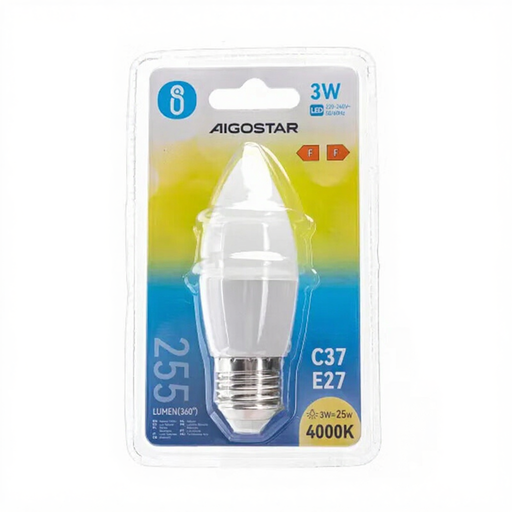
Why it suits this profile: This E27 LED lamp is ideal if you want to replace an existing fitting without buying a new fixture. Its 4000 K colour temperature provides natural white light for indoor spaces.
The fitting, wattage, luminous flux and stated consumption are clearly specified. This means you do not have to rely solely on the appearance or marketing name.
3 W, 255 lumens, 220–240 V, E27 fitting and a stated service life of 15,000 hours according to the product information.

Why it suits this profile: This white ceiling lamp is designed for households that want to set different lighting modes without using an app. The included remote control adjusts brightness and colour temperature.
The lamp specifies clear values for 16 W, 2,000 lumens, a 29.1 cm diameter and IP20. This makes it clear that the lamp is intended for indoor use.
Integrated LED, five lighting settings, adjustable brightness and colour temperature from 2200 K to 6500 K.
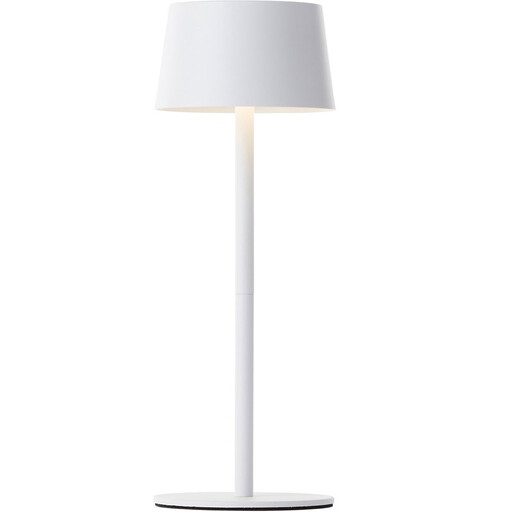
Why it suits this profile: This white table lamp is designed for balconies, patios or other places without a permanent power connection. The lamp can be charged using solar power or USB.
The IP44 rating makes the intended use clear: suitable for splashing water, but not for submersion or direct jets of water.
2 W, 170 lumens, warm white light at 3000 K, integrated battery, USB and solar charging, and three dimming levels.
We have compiled a complete, up-to-date list of products that fully meet these strict selection criteria and the applicable European safety regulations.
For a modern living room, a white pendant lamp with an E27 fitting can offer a practical combination of fixture and separate light source. The Aigostar Pendant Lamp Retro White has a steel frame, an E27 lamp holder and a 1.1-metre cable. The light source is not included, allowing you to choose the colour temperature and wattage yourself.
If smart control is important to you, consider the Alecto SMARTLIGHT30. According to the product information, this E14 lamp offers control via the Smart Life app, scheduling, dimming and colour temperatures from 2000 K to 4000 K. The lamp is rated at 5 W and 470 lumens. Check beforehand that your fixture has an E14 fitting and that Wi-Fi coverage is available.
For an outdoor wall, the Philips Fylx is a white wall lamp with a GU10 fitting and an IP44 rating. The GU10 LED lamp must be purchased separately. This gives you greater freedom of choice, but it also means that you need to check the light source and fixture together for wattage, size and suitability for outdoor use.
For a living room, 2700 K to 3000 K is often a practical choice if you want warm white light and a relaxed atmosphere. For reading or working, 4000 K may be more comfortable. A lamp with an adjustable colour temperature offers several settings, but check that the controls suit your situation.
The stated service life varies by model. The product information for the Aigostar lamp mentioned above states 15,000 hours; the Philips Hue GU10 lamps are rated at 25,000 hours. These are the manufacturer's product specifications and do not guarantee that every lamp will work for exactly that number of hours. Switching frequency, heat dissipation and operating conditions can affect service life.
LED lighting generally uses fewer watts than traditional incandescent bulbs for a similar light output, but always compare lumens and watts together. A 3 W lamp with 255 lumens is not directly comparable with a 16 W ceiling lamp producing 2,000 lumens. For your own situation, also calculate how many hours per day the lamp is switched on. This will give you a more realistic picture of running costs.
